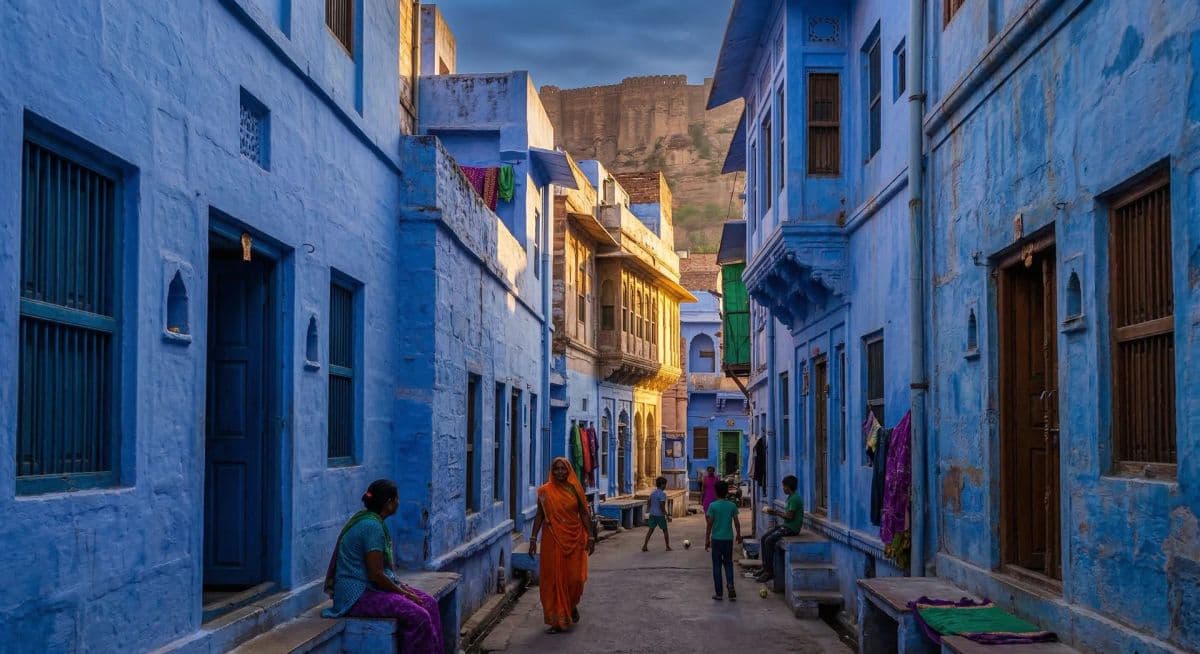
Why Jodhpur Is Blue

Thomas Hardy
Writer
You see it first from the ramparts of Mehrangarh Fort, and the effect is so total, so saturating, that for a moment the brain refuses to process it as real. Below you, spreading across the valley like a spilled ocean, an entire city glows blue. Not a uniform blue — the eye, adjusting, begins to distinguish between a hundred shades: the pale, chalky indigo of a freshly washed wall, the deep cobalt of a doorway in shadow, the faded cerulean of a facade that has not been repainted in decades and has softened to the color of a winter sky. Jodhpur, Rajasthan's second city, the gateway to the Thar Desert, the Blue City. Forty thousand structures rendered in variations of a single hue.
The question every visitor asks is the obvious one: why? And the answers, depending on whom you ask, arrive in layers — each one plausible, none entirely sufficient, all of them together composing something more interesting than a simple explanation. This is the nature of signature-color cities. Their chromatic identities are not accidents, but neither are they the result of a single decision made at a single moment. They are accumulated choices, shaped by caste and climate, superstition and pragmatism, imitation and pride. To understand why Jodhpur is blue is to understand something about the way color functions in human settlement — not as decoration, but as meaning.
The most commonly cited explanation is caste. The Brahmins, Jodhpur's priestly class, are said to have painted their homes blue to distinguish them from the dwellings of other castes. In a city where social hierarchy was mapped onto geography and architecture, color became a marker — a way of reading status from a distance. A blue house was a Brahmin house. To paint your walls blue was to announce your position in the social order without speaking a word.
There is historical evidence for this. The oldest blue houses cluster around the Brahmpuri neighborhood, just below the fort walls, where Brahmin families have lived for generations. The color choice aligns with broader Hindu symbolism: blue is the color of Lord Shiva, the destroyer and transformer, and Brahmins, as the caste closest to the divine, would have had reason to cloak their dwellings in his color. In a society organized around ritual purity, even the walls carried theological weight.
The Practical Theories
But caste alone does not explain the spread. If blue were strictly a Brahmin marker, it should have remained confined to Brahmin neighborhoods. Instead, it bled — slowly, over decades, then centuries — across the entire old city, adopted by families of every caste and occupation. Something else was at work.
Enter the termite theory. Copper sulfate, mixed into whitewash or lime plaster, produces a pale blue tint. It also repels termites, which in the arid climate of western Rajasthan are a genuine and persistent threat to wooden roof beams and door frames. The blue, according to this explanation, was not primarily aesthetic but structural — a preservative measure that happened to produce a beautiful side effect. Homeowners who painted their walls blue were protecting their investments. Neighbors noticed that blue houses lasted longer and followed suit.
There is a third theory, and it concerns heat. Jodhpur sits at the edge of the desert. Summer temperatures routinely exceed forty-five degrees Celsius. In a city without air conditioning — which is to say, Jodhpur for most of its six-hundred-year history — any measure that reduced the heat absorption of walls and roofs was not a luxury but a necessity. Blue pigment reflects more solar radiation than bare stone or dark-colored plaster. A blue wall is measurably cooler to the touch than a brown one. In a city where the difference between forty-three and forty-six degrees is the difference between bearable and dangerous, this matters.
Modern thermodynamic studies have confirmed the effect. Researchers from the Indian Institute of Technology found that the blue-washed surfaces of Jodhpur's old city are, on average, three to five degrees cooler than unpainted surfaces of the same material. This is modest — but in a dense urban fabric where thousands of walls radiate heat into narrow streets, the cumulative effect is significant. The Blue City is not just beautiful. It is, in its accidental way, an exercise in passive cooling.
The Color That Migrated
What is most interesting about Jodhpur's blue is not any single explanation but the way the color migrated — how a practice that may have begun as caste signaling or pest control became, over time, something else entirely: identity. At some point, the residents of Jodhpur stopped painting their walls blue for any specific reason and began doing it because that is what one does. The blue became self-perpetuating. It became tradition. It became the city.
This is a pattern visible in signature-color cities around the world. The process begins with a practical or social cause, passes through a period of imitation, and arrives at a stage where the color is no longer chosen but inherited — part of the unspoken agreement that constitutes a place's visual identity. To paint your house a different color in Jodhpur's old city would not be illegal, but it would be odd. It would mark you as an outsider, or as someone who does not understand the rules. Color, in this context, is a form of belonging.
The phenomenon is not unique to India. Walk the streets of Chefchaouen in Morocco's Rif Mountains, and you will find another blue city — this one a softer, more Mediterranean blue, closer to sky than indigo. The explanation there is equally layered. Some say the blue was brought by Jewish refugees fleeing the Spanish Inquisition in the fifteenth century, who associated the color with heaven and divinity. Others point to the practical fact that blue pigment repels mosquitoes — a significant concern in a mountain town where standing water collects in every alley. Still others note that Chefchaouen's blue intensified dramatically in the 1970s and 80s, when the town began attracting tourists, and that the color is now maintained partly as economic strategy. The prettiest blues draw the most Instagram posts, and the most Instagram posts draw the most visitors.
Cities That Wear Their History
The relationship between color and identity is not limited to blue. Consider Jaipur, Jodhpur's neighbor to the east, known as the Pink City. The story there is more precise: in 1876, Maharaja Ram Singh ordered the entire old city painted pink to welcome the Prince of Wales. Pink, in Rajasthani culture, signified hospitality and welcome. The color stuck. Today, a municipal ordinance requires buildings within the old city walls to maintain their pink facades, enforcing with law what began as royal decree.
Or consider the white villages of Andalusia — the pueblos blancos that cascade down hillsides in a tumble of whitewash and terracotta. The white is lime-based, and lime is antiseptic. During centuries of plague and epidemic, whitewashing walls was a public health measure. The practice outlived its medical rationale and became aesthetic tradition. Now the white is maintained because it is beautiful, because it is expected, because it is Andalusian. The original reason has faded; the color remains.
In each case, the color functions as a kind of collective memory. It records, in pigment, decisions that were made generations ago for reasons that may no longer apply but whose visual consequences have become inseparable from the place's identity. To strip the blue from Jodhpur, the pink from Jaipur, or the white from Olvera would not merely change the appearance of these cities. It would erase something — a layer of meaning that has accumulated like the pigment itself, coat upon coat, each one slightly different from the last.
The Palette of Belief
Color in cities is never purely visual. It carries belief. In Izamal, a small city in Mexico's Yucatan Peninsula, every building in the historic center is painted a deep, saturated yellow — the color of maize, the sacred crop, and the color associated with Kinich Ahau, the Maya sun god. When the Spanish Franciscans built their massive convent there in the sixteenth century, they painted it yellow too, co-opting the indigenous color to smooth the transition from one faith to another. The yellow you see today in Izamal is simultaneously pre-Columbian and colonial, sacred and strategic. It holds contradictions without resolving them.
Similarly, the vermillion that adorns Hindu temples across India is not simply decorative. It is the color of sindoor, the powder applied to the hair part of married women, and of the tikka mark placed on foreheads during worship. It represents Shakti — divine feminine energy — and its presence on a building's facade transforms architecture into theology. A red temple is not a building painted red. It is a building that participates in a cosmology.
This is what makes signature-color cities so compelling to the attentive traveler. The color is never just color. It is an argument, a memory, a declaration. To walk through Jodhpur's blue streets is to walk through a palimpsest of explanations — caste, chemistry, climate, custom — none of which can be separated from the others without diminishing the whole. The blue is all of these things simultaneously, and it is also something that transcends them: a quality of light, a feeling in the chest, a visual experience so immersive that it alters your perception of every other color you encounter for the rest of the day.
The Blue Hour
There is a time of day when Jodhpur's blue reaches its apotheosis. It is not noon, when the desert sun bleaches everything to a pale, squinting sameness. It is the hour before sunset, when the light comes in low and golden from the west and strikes the blue walls at an angle that makes them glow. The warmth of the light and the coolness of the pigment produce a chromatic tension that is almost musical — a visual chord that resonates in the eye the way a minor seventh resonates in the ear. The shadows turn violet. The sky deepens to match the darkest walls. For twenty minutes, the city and the sky become continuous, and you understand, viscerally, why blue is the color of infinity in so many cultures.
It is during this hour that the narrow streets of the old city come alive. Women in saris of orange and magenta move through the blue alleys, and the color contrasts are so vivid they seem painted rather than lived. Children play cricket in courtyards where the blue walls amplify their shouts. The smell of dal and roti and cumin drifts from doorways. A man on a motorbike threads through a gap between walls so narrow that his handlebars nearly brush the blue on both sides. The city is not a museum of its own color. It is a living place that happens to be, for reasons both ancient and accidental, extraordinarily beautiful.
The Permanence of Pigment
Color outlasts most other forms of cultural expression. Languages evolve beyond recognition. Music transforms with each generation. Architecture crumbles and is rebuilt. But the practice of painting a wall a particular color — the mixing of pigment, the application of brush or rag, the standing back to judge the result — is so simple, so transferable, so deeply woven into the rhythms of domestic maintenance that it persists. A family in Jodhpur's Brahmpuri quarter may not know why their great-great-grandmother first mixed copper sulfate into her whitewash. They may not care. They paint the walls blue because the walls have always been blue, because blue is home, because a blue wall against the brown of the desert is one of the most beautiful things the human eye can encounter.
This is, perhaps, the deepest answer to the question of why Jodhpur is blue. Not Brahmins, not termites, not thermal physics — though all of these played their part. Jodhpur is blue because blue, once chosen, was too beautiful to abandon. Because color, once it becomes identity, acquires a momentum that no single explanation can account for. Because a city, like a person, becomes what it repeatedly does, and Jodhpur has been doing blue for five hundred years.