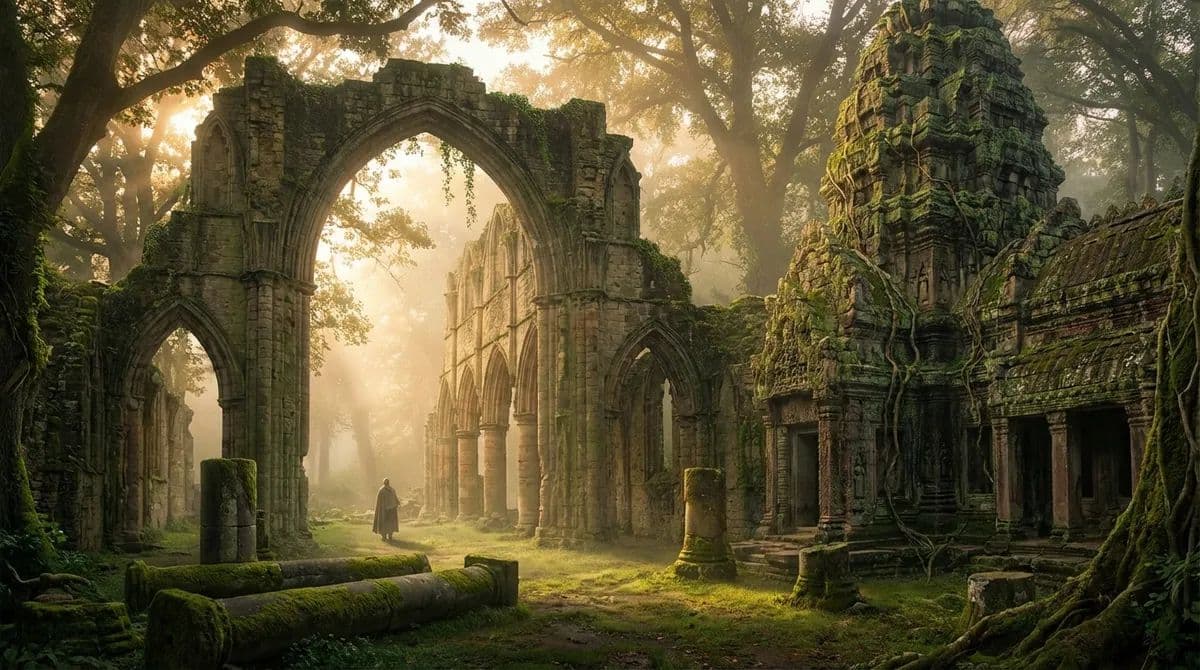
What Ruins Remember

Elena Mori
Writer
The roof fell in sometime during the sixteenth century, probably after the Scottish Reformation, when the monks were expelled and the lead was stripped from the vaults to make ammunition. The walls held on longer. Three centuries of Border weather -- the horizontal rain, the frosts that pry stone from mortar with geological patience -- reduced them by degrees, carving window tracery into abstract sculpture and eroding carved saints into faceless sentinels. What remains of Melrose Abbey today is roughly half a building: enough to suggest everything it was, not enough to pretend it still is.
I visited Melrose on a morning in late October when the ruins to visit in the Scottish Borders were empty of other tourists and the light had that thin, silver quality peculiar to Scottish autumn, where everything looks both sharper and more distant than it should. Jackdaws had colonized the upper reaches of the remaining walls, their calls echoing off stone that once amplified plainchant. Grass grew where the nave floor had been, soft and absurdly green against the grey masonry. A rowan tree had established itself in what had been the choir, its berries the color of fresh blood against the monochrome ruins.
Standing there, in the open air where a ceiling should have been, I felt something that intact buildings rarely provoke: a sense of time as a physical substance, heavy and slow-moving and absolutely indifferent to human intention. The monks who built Melrose Abbey in 1136 intended it to stand forever. They quarried the finest sandstone, hired the most skilled masons, dedicated the work to God. And none of it mattered, not against the entropy that undoes all things, not against the particular historical violence that made their forever last only four hundred years.
This, I think, is why we travel to see what's broken. Not for melancholy, though melancholy certainly attends. Not for the aesthetic pleasures of picturesque decay, though those are real. We visit forgotten places worth visiting because ruins are the only architecture that tells the truth about time.
The Education of Absence
An intact building tells you what its builders wanted you to know. A ruin tells you what they couldn't control.
Consider the difference between visiting the Parthenon and visiting the Temple of Olympian Zeus, just a few hundred meters away in Athens. The Parthenon, even in its reduced state, is so familiar from photographs and replicas that the eye slides off it -- you see what you already know. The Temple of Zeus, by contrast, survives as fifteen standing columns out of an original one hundred and four. The columns that remain are enormous, nearly seventeen meters tall, but it is the columns that are missing -- the negative space where eighty-nine pillars once stood -- that gives the ruin its power. You feel the building's absence as acutely as its presence. The temple becomes a lesson in scale that no intact structure could teach as effectively, because what is missing forces your imagination to work.
This is the education of absence, and it operates in every ruin. At Tintern Abbey in the Wye Valley, the soaring gothic arches frame nothing but sky. Wordsworth wrote a poem about the view; Turner painted it; and every visitor since has discovered the same thing -- that a window without glass, opening onto clouds and treetops instead of a dim interior, transforms architecture into something closer to landscape. The building and its setting merge. Nature is no longer excluded but invited in, and the result is a space that feels both more human and more wild than either architecture or nature alone.
The historical atmosphere travel that ruins provide is qualitatively different from what museums or restored buildings offer. Museums curate and explain. Restorations freeze time, maintaining the fiction that the past is recoverable. Ruins do neither. They present the past as it actually is: incomplete, weathered, ambiguous, shot through with gaps that no amount of scholarship can fill. They require you to do the interpretive work yourself, which is another way of saying they require you to be present.
The Hammams of Tbilisi
Not all ruins are ancient, and not all are monumental. Some of the most affecting are modest in scale and recent in their abandonment, their decay measured in decades rather than centuries.
In the Abanotubani district of Tbilisi, where sulfurous hot springs have fed public baths for at least fifteen hundred years, there are hammams in every state of existence: fully restored and operating, partially renovated and awaiting investment, and abandoned entirely, their domed roofs cracked open to the sky, their tiled pools filled with rubble and rainwater and the occasional determined weed.
It is the abandoned ones that haunt me. I found my way into one -- I will not say which, to avoid encouraging trespass in unstable structures -- through a doorway where the wooden door had long since rotted away. Inside, the layout was still perfectly legible: the cool room, the warm room, the hot room, arranged in the classic progression from social to solitary that hammam architecture has followed for a millennium. Blue and green tiles, many still intact, covered the lower walls in geometric patterns of considerable sophistication. The vaulted ceiling, pierced with star-shaped openings for light and ventilation, was blackened with decades of soot from fires that someone, at some point, had lit in the abandoned chambers.
What struck me most was the intimacy of the ruin. Unlike a cathedral or a temple, a hammam is a space scaled to the body. The pools are body-sized. The benches are body-height. The steam vents are placed to warm the skin. Standing in that abandoned hammam, I could feel the absent bodies more vividly than I have ever felt absent worshippers in a ruined church. The architecture remembered the human form even after the humans had left.
Tbilisi's relationship with its ruined hammams is instructive for anyone interested in how cities negotiate with their own decay. Some have been restored with such enthusiasm that they feel brand new, which means they feel like nothing at all -- scrubbed of the patina that gave them character, their tiles too bright, their plaster too smooth. The best restorations, like the Orbeliani Baths with their ornate blue-tiled facade, find a middle path: enough repair to ensure safety and function, enough visible age to maintain the connection with the deep past.
Angkor: Where Ruins and Forest Negotiate
If Scottish abbeys demonstrate the poetics of exposure -- stone stripped bare by weather and time -- and Tbilisi's hammams show the pathos of recent abandonment, then the temples of Angkor in Cambodia present something else entirely: a ruin in active negotiation with the living world.
The famous image is of Ta Prohm, where silk-cotton trees and strangler figs have wrapped their roots around the sandstone walls like the fingers of enormous hands, simultaneously destroying and preserving the structure. The trees are pulling the temples apart, stone by stone. They are also holding them together, their root systems functioning as an organic scaffolding that prevents total collapse. It is impossible to say where the temple ends and the forest begins, because the boundary has been erased by centuries of mutual encroachment.
What photographs of Angkor cannot convey is the sound. The temple complex is alive with insects, birds, and the constant dripping of moisture from the canopy above. The air is thick and warm and smells of damp stone and decomposing leaves. Monkeys move through the upper reaches of the ruins with proprietary confidence, and you realize with a start that from their perspective, these are not ruins at all -- they are habitat, as functional and inhabited as any intact building.
This is what makes Angkor a fundamentally different experience from European ruins. In Europe, the ruin is an endpoint: the building was alive, and now it is dead, and we visit it to meditate on mortality. At Angkor, the ruin is a transformation: the building was one kind of living system, and now it is another. The temples have not died. They have changed species.
The Khmer builders of Angkor understood this possibility, even if they did not intend it. Their cosmology was cyclical, not linear. The temples were built as mountains -- symbolic representations of Mount Meru, the axis of the universe -- and mountains, in Hindu-Buddhist cosmology, are not permanent. They rise, they erode, they rise again. The ruins at Angkor are performing exactly the cycle their builders believed in, returning to the earth from which they were carved, slowly, magnificently, on a timescale that makes human lifetimes feel like weather.
The Ethics of Ruin Gazing
There is something uncomfortable about traveling to see decay, and it is worth sitting with that discomfort rather than explaining it away. When we visit the Door of No Return on Goree Island, or the remnants of Oradour-sur-Glane in France -- the village left exactly as it was after a Nazi massacre in 1944 -- we are not engaged in picturesque contemplation. We are visiting crime scenes. The ruins are evidence, not aesthetics.
Even ruins that carry no association with atrocity raise ethical questions. Whose labor built them? Whose poverty allowed them to decay? When we find beauty in a crumbling Irish cottage, are we aestheticizing the economic devastation that emptied it? When we admire the "authentic patina" of a derelict hammam, are we romanticizing a failure of investment that reflects real human consequences?
These questions do not have easy answers, but they have honest ones. The honest answer is that beauty and injustice are not mutually exclusive, and that a ruin can be simultaneously beautiful and tragic without either quality canceling the other. The roofless abbey is genuinely moving, and it is also the product of genuine violence. The abandoned hammam is genuinely atmospheric, and it is also the result of genuine neglect. Holding both truths at once is part of what makes ruin-visiting a richer, more demanding form of travel than simply ticking off intact monuments.
The Ruin That Lives Inside the Building
Not all ruins are exposed to the sky. Some of the most powerful are ruins that have been enclosed within newer structures, creating a layered architecture that makes the passage of time visible in a single glance.
Rome, inevitably, provides the most dramatic examples. The Church of San Clemente, near the Colosseum, is a twelfth-century basilica built on top of a fourth-century church built on top of a first-century Roman house built on top of a Republican-era foundation. You can descend through all four layers, each one darker and damper and more ancient than the last, until you are standing in a room where you can hear the underground river that still flows beneath the city's foundations. The building is a vertical archaeological section, a ruin that has been not destroyed but absorbed, each layer of history serving as the foundation for the next.
In Istanbul, the Basilica Cistern performs a similar layering, though horizontally rather than vertically. The sixth-century underground reservoir, supported by 336 columns recycled from demolished temples and public buildings, is a ruin repurposed so successfully that it has outlived the civilization that built it by fifteen hundred years. The Medusa heads used as column bases -- one turned sideways, one inverted -- were almost certainly salvaged from an earlier Roman structure, giving the cistern a genealogy that extends back before the Christian era.
These enclosed ruins remind us that all architecture is, in some sense, built on ruins. Every foundation rests on what came before. Every new building contains the ghost of the building it replaced. The ruin is not the exception to architecture's rule. It is the rule itself, temporarily disguised by fresh paint and functional plumbing.