What Istanbul Sounds Like Before Dawn

Carmen Ruiz
Writer
At 4:47 a.m. on a Tuesday in late October, the first call to prayer breaks over Sultanahmet. It does not begin — it arrives, as though it has always been there and your ears have only just tuned to its frequency. The muezzin at the Blue Mosque leads, his voice threading through the pre-dawn darkness with a clarity that seems impossible for a human throat, and within seconds the call is answered — not in unison but in staggered, overlapping cascades — by mosques across Fatih, across the Golden Horn, across the water in Kadikoy and Uskudar. What reaches you is not a single voice but a city-wide chord, a sound that uses the Bosphorus itself as a resonating chamber, the water carrying the overlapping calls between continents. This is what the sounds of a city are when that city is Istanbul, and when the hour is the one that belongs to no one but the faithful and the sleepless.
I had come to Istanbul not to see it but to hear it. The city's visual splendor is well documented — the domes, the minarets, the improbable beauty of the strait at sunset. But the Istanbul travel experience that no photograph captures is its acoustic life, and that life is most vivid in the hours before dawn, when the modern city has not yet asserted itself and the ancient one briefly resurfaces. Between the last call to prayer and the first rush of morning traffic, Istanbul offers approximately ninety minutes of sonic archaeology — a window into what the city sounded like before engines, before amplification, before the twenty-first century settled its white noise over everything.
The Architecture That Carries the Voice
Istanbul was built to be heard. This is not metaphor. The great Ottoman mosques were designed by architects who understood acoustics with a sophistication that modern concert hall designers still study. Mimar Sinan, the sixteenth-century genius who shaped the city's skyline, embedded hundreds of resonance jars — hollow ceramic vessels — into the walls and domes of his mosques, tuning the interior acoustic space the way a luthier tunes an instrument. The Suleymaniye Mosque, his masterpiece, has a reverberation time of nearly six seconds, meaning that the imam's voice lingers in the air long after the words have been spoken, each syllable blurring into the next in a way that transforms speech into something closer to music.
But the acoustic design extends beyond individual buildings. The placement of mosques across Istanbul's seven hills follows a spatial logic that ensures the call to prayer can reach every neighborhood. Before electronic amplification — which was not introduced until 1952 — the muezzins relied entirely on the city's topography and architecture to project their voices. The minarets were positioned at precise heights, the courtyards oriented to channel sound outward, the surrounding streets narrow enough to act as natural waveguides. The result was a city that functioned as a distributed instrument, a single composition performed simultaneously from dozens of locations.
Even today, when speakers and amplifiers have replaced the need for architectural acoustics, the old design persists. Stand on the Galata Bridge before dawn and you can hear the spatial separation of the calls — the Yeni Mosque to your left, the Suleymaniye above and behind, Rustem Pasha somewhere in the tangle of streets to the right, and across the water, faintly, the mosques of Uskudar. The calls do not merge into cacophony. They layer, each voice occupying its own acoustic space in a way that the city's geometry still supports, five centuries after Sinan drew his plans.
The Bosphorus as Soundstage
Water is an extraordinary conductor of sound. It reflects rather than absorbs, carrying acoustic energy across distances that would dissipate over land. The Bosphorus, that narrow strait dividing Europe from Asia, functions as Istanbul's acoustic backbone — a liquid mirror that bounces sound between continents.
Before dawn, when the wind drops and the surface of the strait goes glassy, the Bosphorus becomes almost supernaturally clear as a sound channel. The horn of a tanker passing through the strait — a deep, resonant blast required by maritime law — can be heard from Arnavutkoy to Kandilli, a distance of several kilometers. The ferry horns, higher-pitched and more frequent, trace the routes of the early-morning commuter boats like auditory contrails. And beneath these larger sounds, the water itself contributes: the slap of small waves against the stone quays of Eminonu, the creak of fishing boats rocking at anchor, the occasional splash of a cormorant diving.
The acoustic relationship between Istanbul and its water is unique. Venice, the other great water city, is quieter — its canals are narrow and enclosed, muffling sound. Stockholm's archipelago disperses sound across too many islands to cohere. But the Bosphorus is just wide enough to create spatial depth and just narrow enough to connect the sounds of both shores into a single field. Standing on the Asian side in Cengelkoy, you can hear Europe. Standing in Bebek, you can hear Asia. The city is always in stereo.
The Dawn Vendors
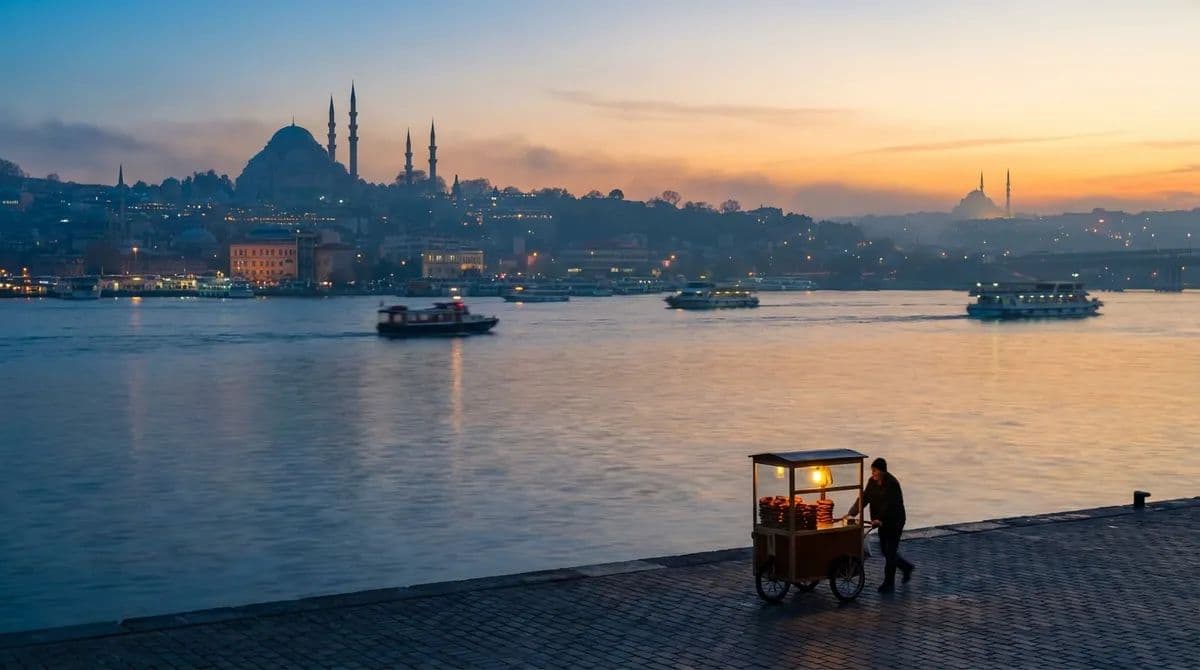
By 5:30 a.m., the first human commerce begins, and it announces itself acoustically. The simit sellers are first — their wooden carts have a distinctive rattle, a loose-jointed percussion produced by the bread-laden tray vibrating against the frame as the cart bounces over cobblestones. The simits themselves, those sesame-crusted rings that are Istanbul's most ubiquitous street food, are stacked on a vertical pole in a tower that the vendor balances with one hand while steering with the other. The sound of the cart is so embedded in Istanbul's acoustic identity that residents can identify it from inside their apartments, in their sleep.
Next come the tea vendors — the cay sellers — carrying their curved-glass glasses in metal holders that clink together with a bright, almost musical tinkling. The sound of cay glasses is the metronome of Istanbul life, the constant rhythmic background that accompanies every transaction, every conversation, every pause in the working day. Before dawn, when the first glasses are being prepared in the tiny cay houses of Eminonu, the sound is intimate, preparatory — the splash of water into the double-stacked kettle, the click of the gas burner, the particular ceramic scrape of sugar cubes being spooned from a tin.
Then the fishermen. The Galata Bridge's lower level, which during the day is a continuous restaurant, is at dawn occupied by its original tenants — the amateur fishermen who line the railings with their rods, casting into the Golden Horn for horse mackerel and bluefish. They arrive in near silence, their equipment making only the softest sounds: the click of a reel, the whisper of a line being cast, the gentle thud of a tackle box being set down. But they talk — quietly, conspiratorially, in the particular register of men who have known each other for decades. Their conversation is one of Istanbul's most reliable dawn sounds, as constant and as seasonal as the fish they catch.
The Ferry Horn at First Light
At approximately 6:15 a.m., depending on the season, the first Vapur — Istanbul's iconic commuter ferry — sounds its horn as it departs from Kadikoy on the Asian shore. The horn is a baritone blast, held for three seconds, and it carries across the water with a clarity that makes it seem much closer than it is. This is the sound that, more than any other, marks the transition from Istanbul's private, pre-dawn self to its public, daytime persona. The city, hearing the horn, begins to accelerate.
Within minutes, the acoustic texture changes dramatically. The trams on Istiklal Caddesi begin to ring their bells — a bright, insistent clanging that echoes down the narrow street. The school buses appear, their air brakes hissing at every stop. The muezzins fall silent, their work done until noon, and the space they occupied in the soundscape is immediately filled by traffic, by construction, by the rising tide of human activity that will not recede until well past midnight.
But for those ninety minutes before the ferry horn, Istanbul offers something that few cities can match: a dawn travel experience that is simultaneously ancient and alive. The sounds you hear at 5 a.m. in Sultanahmet — the call to prayer, the water against stone, the vendor's cart, the fisherman's reel — are functionally identical to the sounds that greeted dawn in this city three hundred, four hundred, five hundred years ago. The technology has changed. The sounds have not. And in a city that has been continuously inhabited for 8,500 years, that continuity is not quaint — it is the texture of civilization itself.
The Acoustic Neighborhoods
Istanbul's neighborhoods have distinct sonic identities that become most apparent in the early morning hours, before the citywide noise floor rises high enough to mask them.
Balat, the old Jewish quarter along the Golden Horn, is one of the quietest neighborhoods at dawn. Its narrow streets, lined with crumbling Ottoman houses in faded pinks and yellows, trap sound in intimate pockets. You hear individual sounds with startling clarity: a cat's paw on a windowsill, a key turning in a lock, the distant drone of a ship's engine transmitted through the water and the stone foundations of the buildings. Balat's acoustic character is domestic, private, almost confessional.
Beyoglu, up the hill, is different — even at 4 a.m., the neighborhood carries a residual buzz from the nightlife district, a hum of generators and distant music and the occasional shout of a late reveler finding their way home. By dawn, this fades into something gentler: the sound of shopkeepers hosing down sidewalks, the clatter of delivery trucks navigating streets not designed for them, the surprisingly sweet singing of the blackbirds that nest in the courtyard trees of Istiklal's churches.
And Uskudar, on the Asian shore, offers perhaps the purest pre-dawn listening in the city. Less touristed, more residential, its waterfront at dawn is populated mainly by elderly men walking slowly along the promenade and stray cats negotiating territory. The dominant sound is the Bosphorus itself — the steady, rhythmic lapping against the seawall that creates a white-noise foundation over which the call to prayer, when it comes, rises like a melody over a drone.