Volcanic Soil and Memory: How Eruptions Shape Cultures

Carmen Ruiz
Writer
Santorini's most famous wine, Assyrtiko, tastes like something that has survived a catastrophe. There is a mineral edge to it, a flinty sharpness that wine writers describe as volcanic -- a word that in most tasting contexts is pure metaphor but here is geological fact. The vines grow in pumice, the pale, porous stone that rained from the sky during the Minoan eruption of roughly 1600 BCE, an explosion so massive that it may have destroyed the Minoan civilization on nearby Crete, generated tsunamis that reached the coast of Egypt, and ejected enough ash to dim sunlight across the Eastern Mediterranean for years. The pumice in which the Assyrtiko vines root is, in the most literal sense, the debris of a civilization-ending event.
This is the paradox that nature experiences travel to volcanic landscapes forces you to confront: that destruction and creation are not opposites but partners, locked in a relationship so intimate that separating them is neither possible nor useful. The same eruption that buried Akrotiri -- Santorini's Pompeii, a Bronze Age city preserved under meters of ash with its frescoes intact and its streets still navigable -- also created the caldera that makes Santorini the most photographed island in the Aegean. The catastrophe and the beauty are the same event, viewed at different timescales.
I came to Santorini not for the sunsets (though they are, admittedly, remarkable) but to understand what it means to build a life on ground that has tried to kill you. The answer, which I found in the vineyards and the villages and the particular quality of light that bounces off pumice and white-washed walls with equal intensity, is that you build carefully, you build beautifully, and you never entirely forget that the ground beneath your feet is a temporary arrangement.
The Vineyards That Survived an Apocalypse
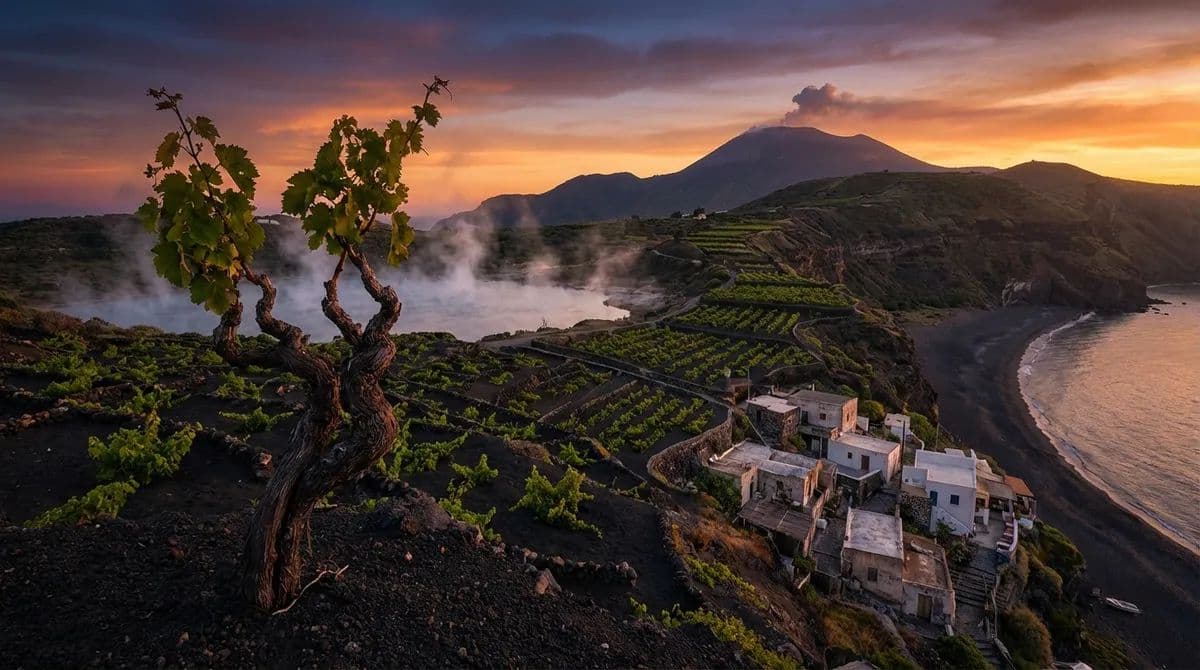
The unique landscapes to visit in Santorini's wine country are not picturesque in any conventional sense. There are no rows of staked vines stretching toward a stone farmhouse. The vines grow close to the ground, coiled into tight baskets called kouloura that protect the grapes from the relentless Aegean wind and trap the morning dew that is, in this nearly rainless climate, the plants' primary source of moisture. The effect, viewed from a distance, is of a field of green nests scattered across a grey, lunar landscape. It is stark, strange, and deeply beautiful in the way that survival is always beautiful.
The pumice soil that the vines grow in is extraordinary. It is almost entirely mineral -- nitrogen-poor, phosphorus-poor, acidic, and so porous that water passes through it before roots can absorb it. In any other context, this would be terrible agricultural land. But for viticulture, and specifically for the Assyrtiko grape, these hostile conditions are an advantage. The vine, forced to struggle, produces fruit of unusual concentration and intensity. The phylloxera louse, which devastated European vineyards in the nineteenth century, cannot survive in pumice, which means that Santorini's vines are ungrafted -- growing on their own rootstock, some of them continuously since before the French Revolution. These are among the oldest continuously cultivated vines in the world, and they owe their survival to a volcanic catastrophe that happened thirty-six centuries ago.
Tasting Assyrtiko in the cave cellars of the Koutsoyannopoulos Wine Museum, carved into the pumice cliff face above Kamari Beach, I was struck by how directly the wine communicates its geological origin. The salinity, the mineral bite, the almost electric acidity -- these are not winemaking choices but expressions of terroir in its most extreme form: the flavor of a landscape shaped by cataclysmic violence and sustained by its aftermath.
Iceland: Living on the Seam
If Santorini represents volcanic memory -- a landscape shaped by an eruption that happened millennia ago -- Iceland represents volcanic presence. The island sits directly on the Mid-Atlantic Ridge, the seam where the North American and Eurasian tectonic plates pull apart at a rate of roughly two centimeters per year. This geological position means that Iceland is not merely volcanic in origin but volcanic in real time: there are thirty active volcanic systems on the island, and eruptions occur, on average, every four to five years.
The result is a landscape of astonishing dynamism. Lava fields from eruptions within living memory lie alongside mossy plains that have had centuries to recover. Hot springs steam from cracks in rock that is cool to the touch a meter away. Glaciers sit atop active volcanoes, a juxtaposition so improbable that the first European visitors assumed the island was enchanted.
The slow travel experiences that Iceland offers are inseparable from this geological volatility. Soaking in the natural hot springs at Landmannalaugar, surrounded by rhyolite mountains streaked in ochre, pink, green, and grey -- colors produced by different mineral compositions in different lava flows -- you are taking a bath in the earth's circulatory system. The water that heats the spring was rain once, possibly centuries ago, that percolated deep into the crust, was heated by magma, and is now returning to the surface bearing a cargo of dissolved minerals. You are warm because the planet is restless. The comfort and the danger are the same thing.
The eruption of Eyjafjallajokull in 2010, which disrupted European air travel for weeks, was a reminder that Iceland's volcanic activity is not a historical curiosity but a present reality. The Westman Islands, just off the south coast, were partially buried by an eruption in 1973 -- within the memory of many current residents -- and the lava field that swallowed two hundred homes is still warm to the touch in places, a landscape that looks like the aftermath of a war conducted by geology.
Obsidian and Empire: Mesoamerica's Volcanic Inheritance
The relationship between volcanic activity and human culture reaches its most complex expression in Mesoamerica, where the volcanic highlands of central Mexico provided the raw material -- literal and figurative -- for some of the most sophisticated civilizations the Americas have ever produced.
Obsidian, the volcanic glass formed when silica-rich lava cools rapidly, was to Mesoamerican civilization what bronze was to the Mediterranean and iron was to Europe: the foundational technology around which economies, trade networks, and military power were organized. The obsidian deposits at Pachuca, in the highlands northeast of modern Mexico City, were among the most valuable resources in the pre-Columbian world. Pachuca obsidian, recognizable by its distinctive green-gold color, has been found in archaeological sites from the American Southwest to Costa Rica, evidence of trade networks spanning thousands of kilometers.
But obsidian was more than a utilitarian material. It was sacred. The Aztec god Tezcatlipoca -- "Smoking Mirror" -- takes his name from the obsidian mirrors used by priests for divination. The blades used in ritual sacrifice were obsidian, chosen not just for their sharpness (an obsidian blade can be flaked to an edge only a few nanometers thick, sharper than any surgical steel) but for their volcanic origin. To use an obsidian blade was to wield a fragment of the earth's interior, a piece of the underworld brought to the surface by forces beyond human control.
The volcanoes themselves were deities. Popocatepetl and Iztaccihuatl, the twin volcanoes that dominate the skyline of the Valley of Mexico, feature in Aztec mythology as doomed lovers transformed into mountains. Popocatepetl remains active -- it erupted most recently in 2023 -- and the communities on its slopes maintain a relationship with the volcano that blends modern civil defense with traditions rooted in pre-Columbian cosmology. The volcano is both a danger and a provider, its ash enriching the soil, its snow feeding the rivers, its eruptions periodically reminding the inhabitants of the valley that their tenure is conditional.
Black Sand and Sugar: The Volcanic Economy of Reunion
Reunion, the French overseas department in the Indian Ocean, is one of the most volcanically active islands on earth. Piton de la Fournaise, on the island's southeastern coast, erupts so frequently -- roughly once a year -- that the local population has developed a relationship with volcanic activity that outsiders find bafflingly casual. When the volcano erupts, people drive to viewing points along the Route des Laves and watch the lava flow into the sea from a respectful but not terrified distance. Schools stay open. Businesses operate normally. The volcano is not an emergency. It is a neighbor.
The unique landscapes to visit on Reunion are direct products of this volcanic hyperactivity. The island's three great cirques -- Mafate, Cilaos, and Salazie -- are enormous amphitheaters carved into the flanks of the extinct Piton des Neiges by millions of years of eruption and erosion. Their walls rise vertically for hundreds of meters, enclosing valleys of almost obscene fertility where tropical vegetation grows with visible urgency from soil enriched by millennia of volcanic ash.
The black sand beaches of the southeast coast, where lava flows have reached the ocean, are another direct volcanic product. Swimming off a beach made of ground basalt -- warm underfoot, almost velvety in texture, and so dark that the turquoise water seems to glow against it by contrast -- is one of the more surreal nature experiences travel has to offer. The sand is young enough that you can sometimes identify the individual eruption that produced it: a beach near Piton de la Fournaise is made almost entirely of material from flows within the last century.
Reunion's agricultural economy is also volcanic in origin. The sugar cane that has been the island's economic foundation since the eighteenth century thrives in the mineral-rich volcanic soil, and the rum distilled from that cane -- rhum arrange, infused with local vanilla, another crop that benefits from volcanic soil -- carries a flavor profile that, like Santorini's Assyrtiko, can only be described as geological. You are tasting the volcano. The sweetness and the fire are the same.
The Thermal Sublime: Hot Springs as Sacred Space
Wherever volcanoes occur, hot springs follow, and wherever hot springs occur, humans have built sacred spaces around them. The connection between geothermal activity and spiritual practice is one of the most consistent patterns in human culture, spanning every continent and every era.
In Japan, the onsen tradition -- communal hot-spring bathing -- is inseparable from Shinto beliefs about the spiritual purity of natural water. The oldest onsen in Japan, Dogo Onsen in Matsuyama, has been in continuous use for at least three thousand years, its waters heated by the volcanic activity of the Median Tectonic Line. In New Zealand, the Maori of the Rotorua region consider their geothermal features sacred, and the management of hot springs, mud pools, and geysers is governed by tikanga -- customary protocols that reflect the springs' spiritual significance.
In Iceland, the relationship is more pragmatic but no less profound. Geothermal energy heats 90 percent of Icelandic homes, and the experience of sitting in a naturally heated pool while snow falls around you and the Northern Lights ripple overhead is as close to a national sacrament as the fiercely secular Icelanders will admit to. The Blue Lagoon, despite its tourist-trail ubiquity, retains genuine power: the milky blue water, heated by a geothermal power plant and rich in silica and algae, creates a bathing experience that feels less like a spa and more like an immersion in the earth itself.
What all these thermal cultures share is an intuition that the water emerging from volcanic sources carries something more than heat. It carries information -- about the deep earth, about processes operating on timescales incomprehensible to the human mind, about the planet as a living, metabolizing system rather than a stable platform for human activity. To bathe in a hot spring is to be reminded that the ground beneath your feet is a thin crust floating on a sea of molten rock, and that the warmth you are enjoying is the same energy that builds mountains and destroys cities.