Traveling in the Off-Season: The Beauty of a Place Not Performing

Ingrid Olsen
Writer
Venice in February is a city that has taken off its costume. The carnival masks are in their boxes. The gondoliers are somewhere warm, nursing coffees, not standing at the prows of their boats calling to passersby in four languages. The vaporetto that in July carries a human compression rivaling a Tokyo rush-hour train is, on this Tuesday morning in the dead of winter, occupied by seven people, all of them Venetian, all of them looking out the window at a city they recognize as theirs. The fog — and there is always fog in February, a thick, brackish mist that rises from the lagoon and reduces visibility to fifty meters — has erased the skyline. San Marco's campanile is gone. The Rialto Bridge is a rumor. The city has been edited down to its immediate neighborhood, its local scale, the twenty meters of canal and campo visible through the gray, and in that reduction, something remarkable happens: Venice stops being a shoulder season travel destination and becomes, simply, a place where people live.
This is the gift of off-season travel, and it is a gift that the travel industry, for obvious economic reasons, does not advertise. The off-season is bad for business. Hotels drop their rates. Restaurants close. Tour operators reduce their schedules. The entire apparatus of tourism — the machinery that converts a living city into an experience for visitors — powers down, and what remains is the city itself, undressed, unprepared for company, going about the ordinary business of being inhabited. For the quiet travel destinations seeker, this is not a compromise. It is the point.
The Performance Problem
Every major tourist destination performs. This is not a criticism. It is a structural observation about what happens when a city's economy becomes dependent on visitors. The city develops a public face — a curated selection of experiences, views, flavors, and interactions designed to satisfy the expectations of people who have traveled a long way and spent a lot of money and want to feel that the experience has justified both. The waiter in the tourist restaurant is performing hospitality. The street musician on the Pont des Arts is performing romance. The sunset over Santorini, monetized by a hundred rooftop bars with minimum-spend requirements, is performing beauty. None of this is false, exactly. But it is not organic. It is a production, and like all productions, it requires an audience.
Remove the audience and the production stops. The waiter at the off-season restaurant does not perform hospitality because you are the only customer and he has known your face for three visits now and he simply brings you the same coffee you ordered yesterday without asking. The street musician is not there because there is no one to play for. The sunset is still happening over Santorini, but there is no one charging you twenty euros for a glass of prosecco to watch it, because the bar is closed, the chairs are stacked, and the sunset is free and unmonetized and witnessed only by you and a cat and the wind.
This is what the off-season offers: the unperformed city. The city that is not trying to be anything for you. The city in its bathrobe, making breakfast, scratching its ear, being private in its own space. And this private city, it turns out, is often more interesting, more beautiful, and more emotionally engaging than the public one.
Venice: Water and Fog
The fog transforms Venice. During tourist season, the city's visual spectacle — the palaces reflected in the canals, the grand vistas down the Grand Canal, the sheer improbable beauty of a city built on water — is so overwhelming that it becomes difficult to process. There is too much to see. The eye bounces from facade to facade, from bridge to bridge, from gondola to gondola, accumulating images at a rate that prevents any single image from settling. The fog eliminates this problem by eliminating the vista. In February, Venice becomes a city of foregrounds. You see the building you are standing next to, the bridge you are crossing, the canal directly below your feet, and nothing else. The city is parceled out in small, intimate servings, each one complete in itself.
The acqua alta — the periodic flooding that submerges Venice's lower streets and piazzas under several centimeters of seawater — adds its own theater to the February visit. Wooden walkways are erected across the flooded piazzas, and the Venetians navigate them with the ease of people who have been doing this their entire lives, stepping from walkway to doorstep to walkway with the practiced grace of a dance. San Marco, flooded, reflects its own basilica in a sheet of water that turns the piazza into a mirror — an image that is available only to the off-season visitor, because by May the floods have receded and the piazza is dry and packed with people who will never see it doubled.
Barcelona: The Empty Rambla
Barcelona in November is a revelation. The temperature is mild — fourteen or fifteen degrees — and the sky produces a clear, Mediterranean light that is softer than summer's glare but still warm enough to sit outside. The beaches of Barceloneta, which in August are so densely packed that finding a square meter of unoccupied sand requires strategic planning, are empty. The waves roll in and withdraw without encountering a single body. The chiringuitos — the beach bars — are shuttered. The boardwalk is populated by joggers, dog walkers, and old men playing dominoes on the sea wall, and the silence is not the silence of absence but the silence of a place that has remembered what it was before it became famous.
La Rambla, the city's most celebrated street and, during peak season, one of the most disappointing tourist experiences in Europe — a gauntlet of overpriced restaurants, living statues, and pickpockets — regains its dignity in November. The plane trees that line the central promenade have dropped their leaves, and the dappled light that in summer creates a pleasant shade now falls unobstructed onto the mosaic pavement that Joan Miro designed, making the colors visible for the first time. The flower sellers are still there, but they have room to breathe, and the flower stalls, no longer hemmed in by human traffic, become the centerpieces they were designed to be — small gardens in the middle of a boulevard, fragrant and unhurried.
The Boqueria market, which during tourist season is a challenging combination of genuine food market and tourist trap, tilts back toward its original purpose in November. The stall holders, freed from the pressure of serving customers who want a photograph more than a purchase, relax into the rhythms of actual commerce. The seasonal produce shifts — mushrooms from the Catalan forests, newly pressed olive oil, winter citrus from Valencia — and the conversations at the counters are about cooking, not about which credit cards are accepted. The slowcation idea finds its natural expression here: not a deliberate slowing down but an involuntary one, produced by the simple absence of the speed that tourism generates.
Kyoto: Snow on Silence
Kyoto in January is the inversion of Kyoto in April. The cherry blossom season — hanami — draws millions of visitors who pack the temple grounds and the Philosopher's Path and the banks of the Kamo River in a frenzy of pink-tinted photography. But in January, the same temples sit under a stillness so complete that the sound of snow falling from a bamboo branch is an event. The rock garden of Ryoan-ji, which during cherry blossom season is viewed by a continuous conveyor belt of tourists filing past the viewing platform, is in January inhabited by three people, or two, or sometimes only you, sitting on the wooden veranda in the cold air with a cup of green tea, watching the raked gravel and the fifteen stones do what they have been doing for five hundred years, which is nothing at all.
Snow in Kyoto is relatively rare — it falls perhaps ten or fifteen days per winter — and when it comes, it transforms the city with a gentleness that the cherry blossoms' extravagance does not achieve. The golden pavilion of Kinkaku-ji, reflected in its mirror pond, is beautiful in every season, but under a layer of fresh snow — the gold leaf visible through the white, the pond's surface partially frozen, the surrounding pines bowing under their burden — it achieves something beyond beauty. It achieves hush. The visual volume of the scene drops to a whisper. The snow acts as a mute on the landscape, dampening not just the sound but the color and the movement, and what remains is a composition so spare and so quiet that it seems to be demonstrating a principle rather than merely being a view.
The winter temples of Kyoto require no itinerary because there are no crowds to navigate around and no peak-hour strategies to optimize. You simply go, at whatever hour suits you, and you are likely to be alone or nearly so. The afternoon light in the moss garden of Saiho-ji — the moss temple, usually accessible only by advance reservation and group visit — falls through the bare branches of the maples with a cool, silver quality that makes the moss glow emerald against the gray tree trunks. In April, you would see this garden through a screen of other visitors' phone cameras. In January, you see it through your own eyes, which are the instruments it was designed for.
The Economics of Emptiness
Off-season travel is often presented as a budget strategy — fly cheaper, sleep cheaper, eat cheaper — and this is true but insufficient. The real economy of off-season travel is not financial. It is attentional. In peak season, attention is a scarce resource, competed for by crowds, noise, queues, and the logistical overhead of navigating popular places at popular times. In the off-season, attention is abundant. You have time to look. You have space to stand. You have silence to think. The attentional economy of a place — the ratio between what is available to see and the cognitive resources available to see it — shifts dramatically when the crowds depart, and the shift is always in the traveler's favor.
There are, of course, trade-offs. Some attractions close in the off-season. Some restaurants shut for vacation. The weather may be unfavorable, by conventional standards — though the conventional standards are calibrated for comfort rather than beauty, and fog, rain, snow, and wind are all beautiful if you are dressed appropriately and have abandoned the expectation of a postcard-perfect sky. The off-season traveler trades convenience for intimacy, predictability for surprise, and the certainty of the curated experience for the uncertainty of the real one.
The Emotional Register
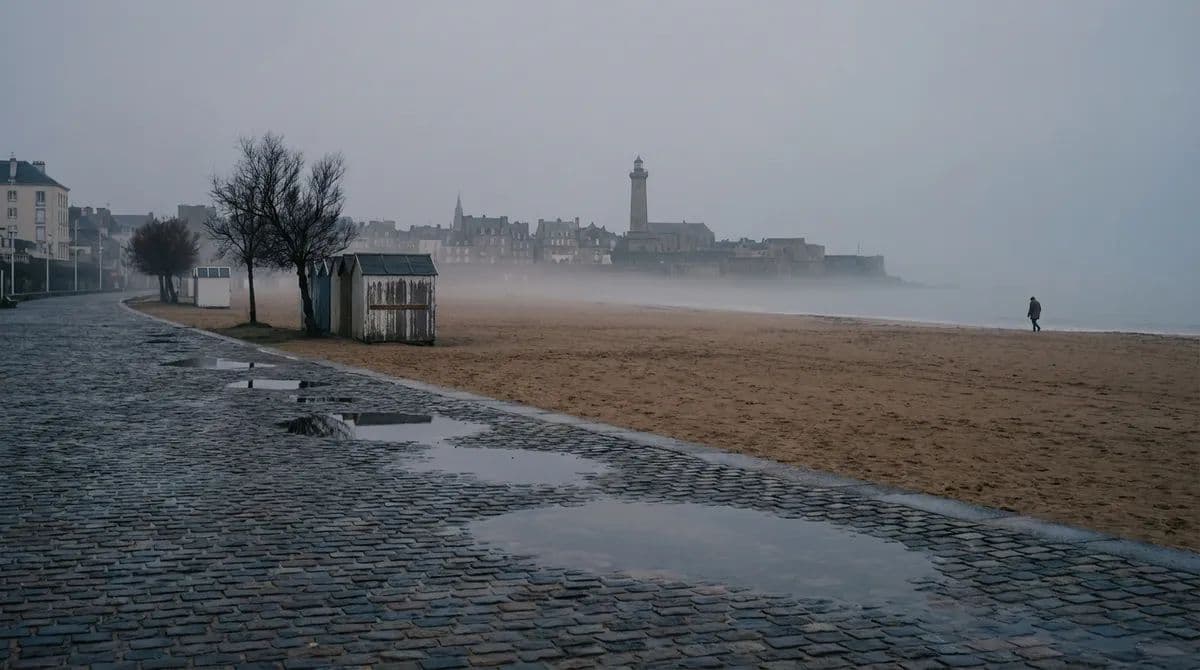
There is an emotional quality to off-season travel that has no peak-season equivalent. Call it melancholy, or call it tenderness, or call it the particular feeling that arises when you are present at a place in its quiet time and you sense that the place is grateful not to be performing. A closed beach in winter, the umbrellas folded and the sand raked smooth by wind, has a beauty that the same beach in summer — noisy, crowded, productive — cannot access. It is the beauty of rest. The beauty of a stage between shows. The beauty of a held breath.
This emotional register is not for everyone. Some travelers want the spectacle, the buzz, the assurance that they are in the right place at the right time, surrounded by others who have made the same choice. There is nothing wrong with this. But for those who are drawn to quieter frequencies — who travel not to be entertained but to be present, who want the real city rather than the curated one — the off-season is not a second-best option. It is the first choice, the only season worth traveling in, the time when the destination stops performing and starts simply being, and you, released from the obligation to have the experience the brochure promised, can start simply being too.