Train Windows: The Lost Art of Watching the World Go By

Anna Lindqvist
Writer
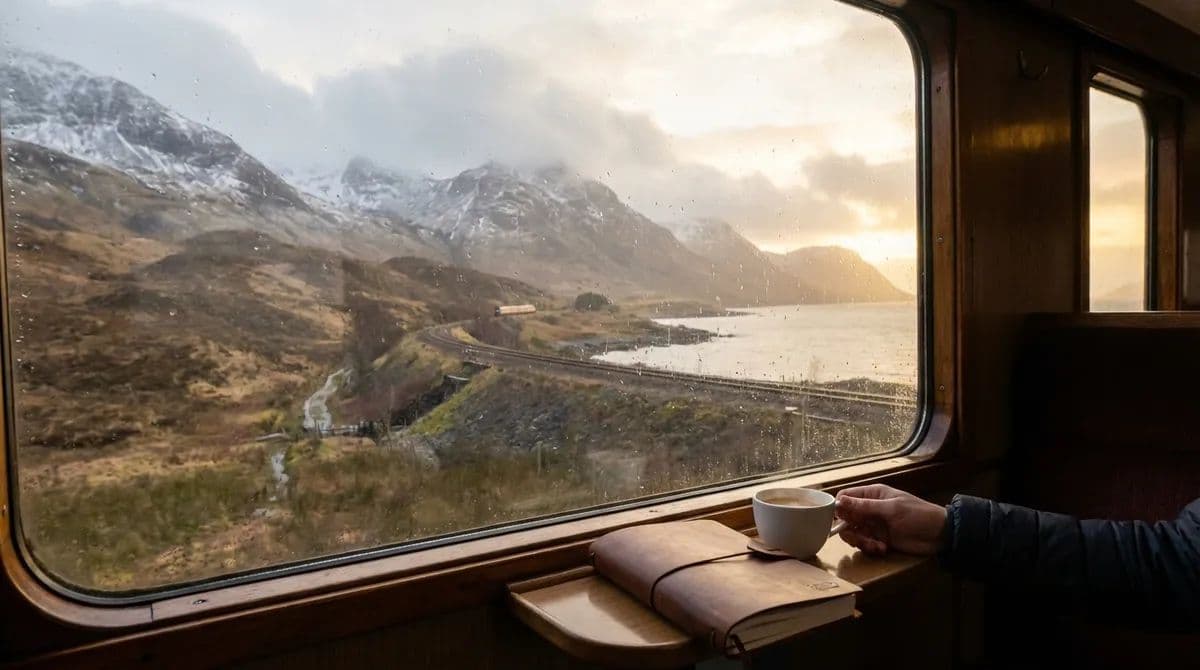
There is a speed at which the world becomes a story. Too fast -- airplane fast -- and the landscape below is an abstraction, a patchwork of colors with no narrative thread. Too slow -- walking pace -- and you are inside the story, a character rather than an observer, too close to the details to see the shape of the whole. But at train speed -- forty, sixty, a hundred kilometers per hour -- the world unspools outside the window at precisely the pace of comprehension. You can see individual trees but also the forest. You can read the names on station platforms and also the changing geology of the hills behind them. The train window is a frame, and what it frames, mile after mile, is a moving landscape that tells you everything about a place that a stationary viewpoint cannot.
This is why train travel Europe scenic routes remain, despite the efficiency of air travel and the convenience of rental cars, the most meaningful way to cross a continent. Not because trains are romantic -- though they are -- and not because they are environmentally virtuous -- though they are that too -- but because they operate at the precise speed at which the human brain processes landscape. The train was invented as a transportation technology. It turns out to be, equally, a perceptual technology -- a machine for looking.
I have spent a cumulative several months of my life looking out of train windows, and the habit has taught me more about geography, architecture, agriculture, history, and the varieties of human settlement than any guidebook or university course. The train window is a moving classroom, and its curriculum is the world itself, presented at a pace that allows you to absorb it without stopping to take notes.
The Bergen Line: A Masterclass in Gradual Revelation
The Bergen Railway, which crosses southern Norway from Oslo to Bergen in approximately seven hours, is regularly cited as one of the world's most beautiful train journeys, and it earns this reputation through a narrative structure so perfectly paced that it feels authored rather than engineered.
The journey begins in Oslo, at sea level, and climbs -- gradually at first, then with increasing drama -- into the Hardangervidda, Europe's largest mountain plateau, reaching a maximum elevation of 1,222 meters at Finse station before descending through the fjord country to Bergen on the western coast. The landscape changes continuously but never abruptly: lowland forest gives way to upland birch, birch gives way to scrub, scrub gives way to bare rock and snow, and then the entire sequence reverses in mirror image as the train descends toward the sea.
What makes the Bergen Line a slow travel destination rather than merely a scenic one is the relationship between the pace of the journey and the pace of the landscape's transformation. The train travels slowly enough that you can watch the treeline retreat as you climb, notice the exact point where birch surrenders to tundra, observe the lakes transitioning from green to blue to the milky turquoise of glacial meltwater. The journey is, in effect, a seven-hour time-lapse of a vertical ecosystem, compressed into the horizontal movement of a train.
I took the Bergen Line in late September, when the birch had turned gold and the first snow was dusting the peaks of the Hardangervidda. The train was half empty, and I had a window seat on the south side, which meant I spent most of the journey in direct sunlight, watching my own shadow race across the landscape alongside the train's. There is something meditative about that -- watching your silhouette flow over rocks and streams and railway cuttings, a dark shape moving through a bright world, present but insubstantial, there but not quite there. The train window turns you into a ghost in the landscape you are passing through.
Sri Lanka's Coastal Railway: The Window as Social Space
If the Bergen Line demonstrates the train window as a lens for landscape, the Sri Lankan railway system demonstrates the train window as a lens for human life. The coastal line from Colombo to Galle runs along the southwestern shore of the island, often within meters of the ocean, and the views are spectacular -- palm trees, fishing boats, crescent beaches, the Indian Ocean in every shade of blue from turquoise to indigo.
But it is not the ocean that makes this journey extraordinary. It is the people. Sri Lankan trains, particularly the third-class carriages that locals use, are open-windowed -- no glass, no air conditioning, just rectangular openings in the carriage walls through which the warm, salt-scented air pours in along with the sound of the engine, the calls of vendors on station platforms, and the entire sonic and olfactory life of coastal Sri Lanka.
The open windows also mean that the boundary between inside and outside, between the train and the world, is porous. Children wave from trackside houses close enough to touch. Vendors hand through bags of cashew nuts and bottles of water at stops that last thirty seconds. At one point, the train passes so close to a cricket match that you can hear the bat hit the ball and the fielders shout, a moment of surreal intimacy between two completely unrelated human activities.
The meaningful travel experiences that Sri Lanka's railways provide are inseparable from this porosity. The train is not a sealed capsule moving through a landscape -- it is a participant in the landscape, connected to it by open windows and frequent stops and the constant exchange of sounds and smells and human gestures. Riding the coastal line is not like watching a film of Sri Lanka. It is like sitting on the veranda of a house that happens to be moving at forty kilometers per hour.
The Trans-Siberian: Time as Distance
The Trans-Siberian Railway from Moscow to Vladivostok -- 9,289 kilometers, six days, seven time zones -- is not a train journey in any normal sense. It is a confrontation with distance itself, a physical demonstration of what it means for a country to be so large that crossing it by surface transport takes nearly a week.
The taiga, which occupies most of the journey between Yekaterinburg and Irkutsk, is the landscape that defines the Trans-Siberian experience, and it is a landscape of almost terrifying monotony. Birch forests. Silver birch, white birch, birch in every direction, birch to the horizon, birch reflected in still rivers that appear and disappear at irregular intervals, birch standing in snow or in mud depending on the season, birch that is beautiful for the first hour, numbing for the second, and then, around the third hour, transcendent -- because the monotony, it turns out, is the point.
What the taiga teaches you, viewed from a train window at sixty kilometers per hour for hour after hour, is that landscape is not composed of highlights. It is composed of repetition, and it is in the repetition that the real information lives. After three hours of birch, you begin to notice variations that were invisible at first: differences in trunk diameter that indicate age, differences in leaf color that indicate soil chemistry, differences in density that indicate drainage patterns. The forest, which seemed uniform, reveals itself as endlessly diverse -- not despite its apparent monotony but because of it. Your brain, deprived of novelty, begins to process subtlety instead.
This is the Trans-Siberian's secret curriculum. It trains your attention the way a meditation retreat trains your attention -- by removing distraction and forcing you to find richness in what remains. By the time you reach Lake Baikal, on day four, and the taiga opens suddenly onto the deepest lake in the world, the impact is seismic precisely because the monotony has recalibrated your expectations. After three days of birch, water is a revelation.
The Bernina Express and the Ethics of Slowness
The Bernina Express, which crosses the Swiss Alps from Chur to Tirano in Italy, is marketed as a scenic railway, and it is -- the Landwasser Viaduct, the Morteratsch Glacier, the spiral tunnels that allow the train to gain altitude without exceeding a manageable gradient are all genuinely stunning. But the Bernina Express also raises an uncomfortable question about what happens when the train window becomes a product.
The panoramic carriages, with their floor-to-ceiling windows, are explicitly designed to maximize the visual experience. The route is promoted with professional photography. The train times are set to coincide with optimal lighting conditions. The entire enterprise is, in effect, a curated visual experience that treats the landscape as content to be consumed.
There is nothing wrong with this -- the Alps are beautiful, and making them accessible is a public good. But the Bernina Express experience is qualitatively different from the Bergen Line or the Sri Lankan coastal railway, and the difference reveals something important about the relationship between trains and attention. The Bergen Line is not marketed as scenic. It is a commuter railway that happens to cross one of the most beautiful landscapes in Europe. The Sri Lankan coastal line is a local transport service that happens to run along the ocean. Their beauty is incidental, which is why it feels earned. The Bernina Express's beauty is intentional, which is why it feels, despite its magnificence, slightly performative.
The slow travel distinction matters here. A train journey that is designed to be looked at engages a different mode of attention than a train journey that simply exists and happens to be worth looking at. The first produces spectators. The second produces witnesses. And the difference, though subtle, is the difference between consuming a landscape and being changed by it.
The Discipline of the Window Seat
Every train journey teaches the same fundamental lesson: that looking is a discipline, not a given. The window is always there. The landscape is always passing. But the quality of attention you bring to the window determines whether the journey is meaningful or merely scenic.
The first hour of any train journey is easy. Everything is new, and the brain is in acquisition mode, processing the unfamiliar landscape with the hungry efficiency of a tourist on day one. But then -- around the second or third hour, as the novelty fades and the landscape begins to repeat its themes -- the temptation arises to retreat: to the phone, to a book, to sleep. This is the critical moment. Because the train window, like any contemplative practice, offers its deepest rewards only to those who persist past the point of boredom.
What lies beyond boredom is a state that psychologists call "soft fascination" -- a mode of attention characterized by effortless engagement with a stimulus that is interesting enough to hold the gaze but not so demanding that it exhausts cognitive resources. Nature, viewed at train speed, is the ideal trigger for soft fascination: it is varied enough to prevent complete habituation but regular enough to avoid the cognitive overload of novelty. In this state, the mind relaxes into a creative, associative mode -- the same mode that produces ideas in the shower or insights during a walk -- and the landscape outside the window becomes not just something to look at but something to think with.
This is why writers have always loved trains. Agatha Christie plotted on the Orient Express. Paul Theroux wrote entire books from train compartments. The train window provides a unique combination of visual stimulation and physical passivity that the writing brain, which needs input but not interruption, finds ideal. You are moving through the world without having to navigate it. You are seeing everything without having to decide what to see. The train makes the decisions, and you are free to think.
Night Trains and the Negative Window
There is a final category of train-window experience that deserves mention: the night train, where the window shows you nothing -- or rather, shows you darkness interrupted by occasional lights, station platforms that flash past like memories, and your own reflection superimposed on the blackness outside.
The night train window is a negative of the day train window. Instead of landscape, it shows you absence. Instead of the external world, it reflects the internal. Lying in a couchette berth, watching the dark countryside pulse with distant farmhouse lights and the rhythmic glow of level-crossing barriers, you are looking at a world that exists but cannot be seen, and the imagination fills in what the eye cannot.
This is, in its way, the purest form of train-window contemplation. The landscape is there -- you can feel it in the changing rhythm of the wheels, the shifts in air pressure as the train enters and exits valleys -- but it is invisible, and your relationship with it is entirely imagined. The night train is a journey through a place that you know and do not know simultaneously, and the quality of that experience -- the mixture of knowledge and mystery, presence and absence -- is available from no other form of transport.