Tidal Rhythms: Destinations That Disappear and Return

Thomas Hardy
Writer
There is a road in western France that tries to kill you twice a day. The Passage du Gois, a 4.5-kilometer causeway connecting the island of Noirmoutier to the mainland across the Bay of Bourgneuf, is passable only at low tide. At high tide, the road disappears entirely beneath two to four meters of Atlantic water, and the rescue towers spaced along its length -- tall poles with platforms at the top, like miniature lighthouses for stranded drivers -- become the only evidence that a road exists at all.
I drove the Passage du Gois on a June morning, timing my crossing to coincide with the tide tables published by the local municipality. The road was still wet from the retreating sea, scattered with bladder wrack and the occasional stranded crab, and the experience of driving on a surface that would be submerged within hours produced a low-grade existential vertigo unlike anything I have encountered in years of unusual things to see in Europe. The road was real, solid, tarmacked. But the sea was making a claim on it that was equally real and considerably older, and my presence on the road was conditional in a way that terrestrial roads never are. I was driving on borrowed time. The moon would take the road back when it was ready.
This is what tidal landscapes do that no other environment can: they make the fundamental impermanence of the world visible on a human timescale. Mountains erode, but it takes millennia. Rivers shift their courses, but it takes decades. The tide operates on a schedule you can set your watch by -- roughly twelve hours and twenty-five minutes between consecutive high tides -- and it makes and unmakes landscapes with a regularity that turns geological processes into something you can witness between breakfast and lunch.
The off the beaten path destinations governed by tidal rhythms are among the most psychologically interesting places on earth, because they force a relationship with time that modern life has worked very hard to eliminate. We live in an era of twenty-four-hour access, constant availability, on-demand everything. Tidal destinations do not care about your schedule. They operate on the moon's schedule, and if you want to visit them, you must submit to that older, slower, non-negotiable clock.
Mont Saint-Michel: The Island That Breathes
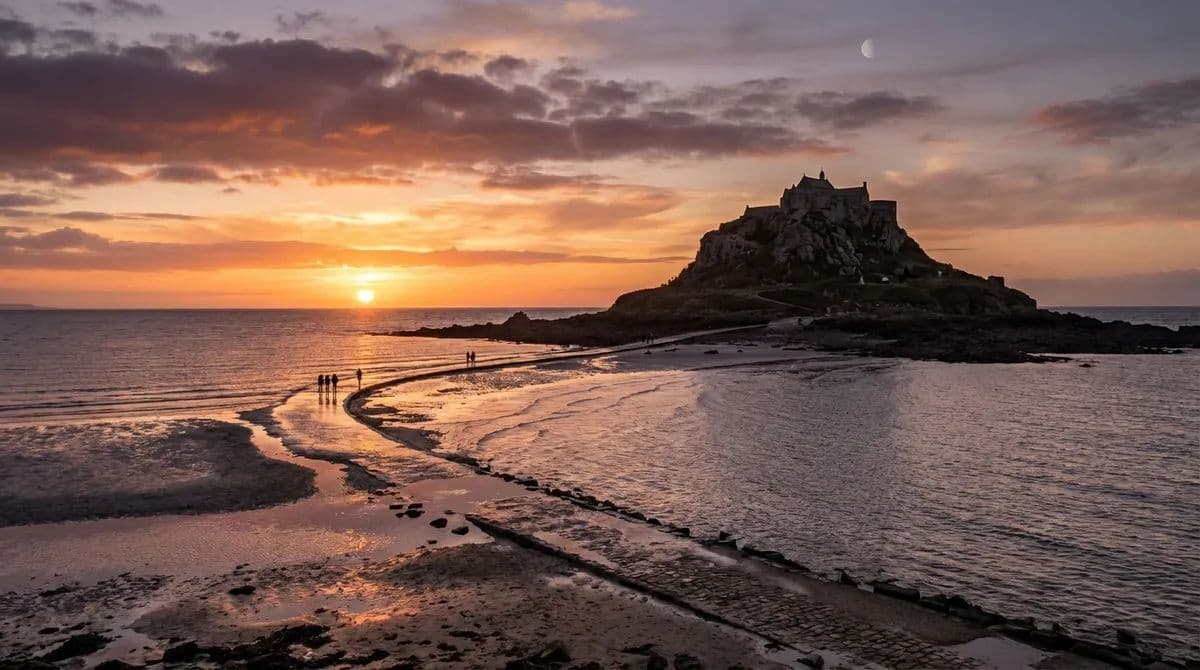
Mont Saint-Michel is the most famous tidal island in the world, and it earns that fame honestly. The granite island rises from the flat expanse of the Norman-Breton bay like a hallucination -- a pyramid of medieval architecture crowned by a golden archangel, surrounded by sand or water depending on the hour. The tidal range here is among the largest in Europe, exceeding fourteen meters during spring tides, and the speed of the incoming tide across the nearly flat bay floor has been poetically compared to a galloping horse. The reality is less dramatic but still impressive: the water advances at roughly walking speed, which means that anyone caught on the sand flats at the wrong moment faces a genuinely dangerous situation.
The abbey at the summit has been a site of pilgrimage since the eighth century, and the tidal approach was always part of the spiritual experience. Medieval pilgrims crossed the sand at low tide, timing their journey to the rhythm of the sea, arriving at the island with wet feet and a heightened awareness of their own mortality. The crossing was a liminal act -- a passage between the secular mainland and the sacred island that required faith not just in God but in the tide tables. Some pilgrims did not survive. The quicksand that lurks in certain areas of the bay has claimed lives for centuries.
Today, a modern causeway connects Mont Saint-Michel to the mainland, and the tidal drama has been somewhat domesticated. But the essential experience remains intact, especially during the grandes marees -- the spring tides that occur around the equinoxes, when the tidal range is at its maximum and the water surrounds the island completely, restoring it to the isolation that defined it for a thousand years. Watching the tide come in during a grande maree, the water arriving silently and with alarming speed across kilometers of sand, is one of the great nature walks destinations experiences available in Europe: a demonstration of natural force that is neither violent nor gentle but simply, overwhelmingly indifferent.
Jindo's Sea Parting: A Miracle on Schedule
Every spring, at the island of Jindo off the southwestern tip of South Korea, the sea parts. This is not a metaphor. During the lowest spring tides of March and April, a natural land bridge approximately 2.8 kilometers long and 40 meters wide emerges from the sea between Jindo Island and the small island of Modo, remaining exposed for roughly an hour before the returning tide reclaims it.
The event, known as the Jindo Sea Parting Festival, draws hundreds of thousands of visitors who walk across the exposed seabed, gathering shellfish and seaweed from the temporarily revealed ocean floor. The atmosphere is festive, communal, and slightly surreal -- a crowd of people in rubber boots striding across a surface that was underwater an hour ago and will be underwater again within the hour, harvesting the sea's pantry in the brief window when the ocean allows access to its shelves.
The local legend attributes the sea parting to the prayers of an elderly woman named Grandmother Ppong, who was separated from her family when they evacuated to Modo during a tiger attack. She prayed so fervently that the sea obliged by opening a path for her. The story is charming and, in its way, accurate: the sea does open a path, reliably and predictably, for anyone willing to time their visit to the tidal calendar. The miracle is not supernatural. It is lunar.
What makes the Jindo Sea Parting genuinely remarkable as an off the beaten path destination is the temporary community it creates. For one hour, on a strip of seabed that did not exist an hour ago and will not exist an hour hence, strangers walk together, share tools, show each other interesting finds, and photograph each other against a backdrop of exposed ocean. It is a community that the tide builds and the tide dissolves, a social structure as temporary and as real as the land bridge that makes it possible.
Lindisfarne: The Tide as Gatekeeper
Holy Island, also known as Lindisfarne, off the coast of Northumberland in northeastern England, is accessible by causeway only during the six hours surrounding low tide. The rest of the time, the North Sea covers the road, and the island -- with its ruined priory, its castle, its population of roughly 180, and its extraordinary population of migrating seabirds -- is entirely cut off.
The experience of visiting Lindisfarne is shaped, more than anything else, by this tidal isolation. You check the tide tables. You time your drive. You cross the causeway with the sea visible on both sides, distant but present, a reminder that you are entering a space that the ocean controls. And then, for the hours you have been allotted, you walk the island -- the priory ruins where the Lindisfarne Gospels were illuminated in the seventh century, the fishing boats upturned on the beach to serve as storage sheds, the lime kilns that processed seaweed into fertilizer -- with an awareness that your visit has an expiration date set not by closing time but by the moon.
There is a refuge tower on the causeway, similar to those on the Passage du Gois, for drivers who misjudge the tide. It is used with depressing regularity -- several times a year, visitors who either ignored or miscalculated the tide tables find themselves stranded on a rapidly submerging road and must abandon their cars and climb the tower to wait for rescue. The local coastguard, by all accounts, is patient about this but not sympathetic. The tide tables are published, posted, and available on multiple websites. The sea is not hiding its schedule. It is merely asking you to read it.
Lindisfarne's tidal isolation is not a bug but a feature -- arguably the defining feature that has shaped its history. The monks who founded the priory in 635 CE chose the island precisely because the tide provided a natural defense, a twice-daily moat that protected their work of prayer and scholarship from the violence of the mainland. When Viking raiders attacked in 793 CE -- an event traditionally considered the beginning of the Viking Age -- it was the island's isolation, its apparent invulnerability, that made the attack so shocking. The tide had failed as a defense, and the Christian world was horrified.
The Wadden Sea: Walking on the Ocean Floor
The Wadden Sea, stretching along the coasts of the Netherlands, Germany, and Denmark, is the largest unbroken tidal flat system in the world -- a UNESCO World Heritage Site covering approximately 11,500 square kilometers that is alternately land and sea, twice a day, every day, without exception.
Mudflat hiking -- wadlopen in Dutch, wattwandern in German -- is the practice of walking across the exposed seabed at low tide, and it is one of the strangest and most rewarding nature walks destinations in northern Europe. You set out from the mainland coast with a guide, wearing rubber boots and old clothes, and you walk into the sea. Or rather, you walk where the sea was, and will be again, across a vast, flat, grey-brown expanse of sand and mud that extends to the horizon in every direction.
The landscape of the tidal flats is simultaneously monotonous and intensely detailed. From a distance, it looks like nothing -- a featureless plain of wet sediment. Up close, it is teeming with life. Lugworm casts coil from the surface in patterns of mathematical regularity. Cockles and mussels filter water in their millions beneath your feet. Crabs scuttle into shallow pools that the retreating tide has left behind. And the birds -- dunlins, oystercatchers, grey plovers, bar-tailed godwits -- are present in numbers that defy belief, the Wadden Sea being the single most important staging ground for migratory shorebirds on the East Atlantic Flyway.
The experience of walking on the ocean floor is uncanny in the strict Freudian sense: it is simultaneously familiar and utterly strange. You are walking, which is familiar. You are walking on a surface that should be underwater, which is not. The horizon line where sea meets sky is visible in every direction, but the sea itself is somewhere else, temporarily, biding its time in the deeper channels, and you are occupying the space it vacated with a confidence that the tidal schedule justifies but the lizard brain does not entirely trust.
Time, Tides, and the Illusion of Control
What all tidal destinations share -- from the grandeur of Mont Saint-Michel to the muddy intimacy of the Wadden Sea -- is a confrontation with a temporal rhythm that humans can observe but cannot control. The tide is driven by the gravitational interaction of the moon, the sun, and the rotating earth, a system of such immense scale and such precise predictability that it has been used as a metaphor for fate since the earliest recorded literature.
And yet the tide is not fate. It is physics, and it can be calculated with extraordinary accuracy centuries in advance. The UKHO (United Kingdom Hydrographic Office) publishes tide tables that predict the height of every tide at every port in the British Isles for years into the future, and these predictions are accurate to within a few centimeters. The tide is the most predictable natural phenomenon on earth -- more predictable than the weather, more reliable than the seasons, as precise as an astronomical clock because it is, in fact, driven by astronomy.
This predictability is what makes tidal destinations so philosophically interesting. They are not dangerous in the way that earthquakes or storms are dangerous -- you can know, to the minute, when the sea will arrive and when it will depart. The risk comes not from the unpredictable but from the unheeded. People are stranded on causeways and sand flats not because the tide surprises them but because they believe they can negotiate with it, delay their departure, push their luck. The tide does not negotiate. It arrives on schedule, and schedule is a word that derives from the Latin scheda, meaning "strip of papyrus" -- a reminder that we have been writing down the tide's appointments for as long as we have been writing at all.