The Weight of Doorways: Thresholds That Changed History

Priya Sharma
Writer
Every doorway is a proposition. Step through, and you become someone slightly different -- a guest instead of a stranger, an insider instead of an outsider, a person who has arrived instead of a person still traveling. Most of the time we pass through doorways without noticing this transformation, the same way we breathe without noticing the air. But some doorways refuse to be ignored. They are too old, too large, too saturated with the weight of what has passed through them. They stop you at the threshold and make you reckon with the act of crossing.
I have stood in many such doorways over the years, and each time I am struck by the same paradox: a doorway is essentially nothing. It is an opening, a void, an absence of wall. It has no substance of its own. And yet certain doorways carry more historical gravity than the buildings they serve. They are places where the hidden history of cities concentrates, where the flow of human passage has worn meaning into stone the way a river wears a canyon into rock.
This is a meditation on some of those doorways -- not an exhaustive catalog, but a personal itinerary of thresholds that changed the way I understand what it means to enter, to exit, to cross from one state of being into another. These are historical sites travel at its most intimate: not the grand panorama of a battlefield or the sweep of a skyline, but the narrow, human-scaled space where everything pivots.
The Lion Gate: Where History Begins to Remember Itself
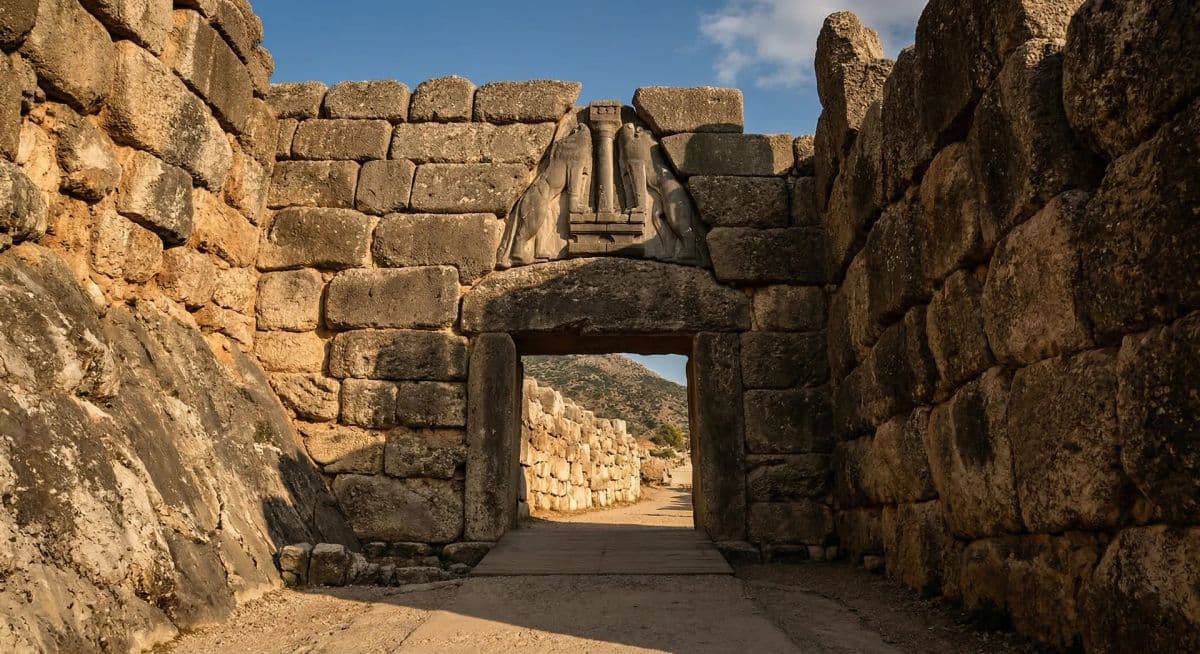
The Lion Gate at Mycenae is, by most reckonings, the oldest monumental doorway in Europe. Erected around 1250 BCE, it served as the main entrance to the citadel of Agamemnon -- or at least, of whoever ruled the Mycenaean civilization that Homer would later immortalize as the architects of the Trojan War.
The gate is massive: the lintel stone alone weighs approximately twenty tons and spans a gap of three meters. Above it, a triangular relieving triangle contains the famous lion relief -- two lions (or possibly griffins, the heads having been lost) flanking a central column in a pose of heraldic symmetry. The lions are the oldest monumental sculpture in Europe, and they stare down at you from their thirty-two-century perch with an authority that has not diminished by a single degree.
What makes the Lion Gate extraordinary as a threshold, rather than merely as an artifact, is the approach. The road to the gate is deliberately narrowed between the citadel wall on one side and a projecting bastion on the other, creating a corridor that funnels visitors into an increasingly compressed space before releasing them through the gate into the citadel beyond. This is architecture as choreography: the Mycenaean builders understood that the experience of passing through a doorway is determined not just by the doorway itself but by the journey that precedes it.
Standing at the Lion Gate, you feel the compression. The walls lean in. The sky narrows to a strip above your head. The massive lintel hangs overhead with a weight that you feel in your chest. And then you step through, and the space opens, and the view across the Argive Plain unfolds, and you understand viscerally what every ruler who ever built a monumental gate understood: that a doorway is a tool for the manipulation of human emotion. You enter humble. You exit awed.
The hidden history of cities often begins at their gates, and Mycenae is no exception. Heinrich Schliemann, who excavated the site in 1876, was so convinced that Homer's descriptions were literally true that he identified every find with a specific Homeric character. The gold death mask he found in a shaft grave just inside the Lion Gate, he declared, was the face of Agamemnon himself. It was not -- the mask predates the traditional date of the Trojan War by several centuries -- but Schliemann's error reveals something true about the power of thresholds. Standing at the Lion Gate, the boundary between history and myth becomes as permeable as the boundary between inside and outside. You half believe that Agamemnon did walk through this doorway, golden mask and all, because the space makes the mythic feel plausible.
The Door of No Return
On the westernmost point of Goree Island, off the coast of Dakar, Senegal, there is a doorway that opens onto the Atlantic Ocean. It is small -- perhaps two meters high and a meter wide -- and it frames nothing but water and sky. A plaque identifies it as the Door of No Return, the point from which enslaved Africans were loaded onto ships bound for the Americas.
The historical accuracy of this specific doorway as a departure point for the slave trade is debated by scholars. The Maison des Esclaves, the building in which the door is set, may have served primarily as a merchant's residence, and the bulk of Goree Island's slave trade may have been conducted from other locations on the island or from the mainland. But the scholarly debate, however important for the historical record, is almost irrelevant to the experience of standing at the threshold.
Because what the Door of No Return represents -- what it has come to embody through decades of pilgrimage by people of the African diaspora -- is not a specific logistical fact but a universal human catastrophe. The Atlantic slave trade involved approximately twelve million people, transported through hundreds of departure points along the West African coast. The Door of No Return on Goree Island has become the symbolic threshold for all of them -- the point where Africa ended and the Middle Passage began, where names were lost, languages were silenced, and human beings were reduced to cargo.
I visited Goree Island on a day of extraordinary beauty -- azure water, golden light, bougainvillea cascading over colonial facades. The contrast between the beauty of the setting and the horror of its history is not incidental. It is the point. The slave trade was conducted in beautiful places by people who considered themselves civilized. The Door of No Return frames this contradiction perfectly: a lovely view of a lovely ocean, seen from a place of absolute human degradation.
Standing at that threshold, you feel the weight of all the crossings that can never be uncrossed. A doorway, as I said, is a proposition: step through and become someone different. The Door of No Return is the doorway that made the proposition irreversible. Those who passed through it became something the world had never seen before -- a diaspora scattered across continents, carrying cultures and memories and griefs that would shape the modern world in ways we are still reckoning with.
The Brandenburg Gate: A Threshold That Keeps Changing Its Mind
Some doorways accumulate meaning through a single, devastating event. The Brandenburg Gate in Berlin has accumulated meaning through the sheer volume and variety of history that has marched through it, each era overwriting the previous one without erasing it entirely.
Built in 1791 as a neoclassical triumphal arch -- modeled on the Propylaea, the gateway to the Acropolis in Athens -- the Brandenburg Gate was originally a customs gate and symbol of Prussian peace. Napoleon marched through it in 1806 and took the Quadriga, the chariot sculpture atop the gate, back to Paris as a trophy. After Napoleon's defeat, the Quadriga was returned and the gate was rededicated as a symbol of Prussian victory.
The Nazis staged torchlight parades through it. The Soviets raised their flag over it. The Berlin Wall ran directly behind it, turning the gate from a threshold into a dead end -- perhaps the most potent symbol of the Cold War's division of Europe into two irreconcilable worlds. And then, on November 9, 1989, the Wall fell, and the Brandenburg Gate became a threshold again, and people streamed through it in both directions, weeping and embracing and popping champagne, and the architecture tour Europe narrative acquired its most powerful chapter.
What makes the Brandenburg Gate unique among the world's great doorways is this palimpsest quality -- the way each historical layer remains visible beneath the next. Stand in front of it today and you see a neoclassical monument. Look harder and you see a Nazi rally ground. Look harder still and you see a Wall, and then the absence of a Wall, and then the jubilant crowds pouring through the gap. The gate has not changed in two hundred and thirty-five years. Its meaning has changed half a dozen times.
This mutability is the essence of what makes a doorway different from a wall or a tower or a dome. A wall divides. A tower surveys. A dome encloses. A doorway connects, and its meaning is determined not by what it is but by who passes through it and in which direction. The Brandenburg Gate is the same arrangement of Doric columns and sandstone blocks that Carl Gotthard Langhans designed in the late eighteenth century. But each generation has walked through it into a different world.
Janus and the Sacred Threshold
The Romans understood the metaphysics of doorways better than anyone. They dedicated an entire god to the concept: Janus, the two-faced deity who presided over beginnings, endings, transitions, and -- most literally -- doorways. The word "January" derives from Janus, because the first month of the year is itself a threshold between what has been and what will be. The word "janitor" derives from him too, a reminder that the guardian of the threshold was once considered a sacred role.
Every Roman house had a janua, a formal entrance that was both architectural and ritual. To cross the threshold of a Roman home uninvited was not merely rude; it was a violation of sacred space, an offense against the lares and penates -- the household gods -- who protected the boundary between public and private. Brides were carried over the threshold to avoid the inauspicious act of stumbling on it, a custom that survives in attenuated form in modern Western weddings.
The Pantheon's doorway -- the original, not the Renaissance addition -- may be the greatest surviving example of Roman threshold architecture. The bronze doors, each weighing twenty tons, are the largest ancient doors still in use. They are flanked by enormous granite columns and set within a portico of such monumental proportions that the act of passing through them feels genuinely transitional -- you leave the noisy, secular chaos of the Piazza della Rotonda and enter the circular silence of the rotunda the way a diver leaves the surface and enters the deep.
The oculus above, open to the sky, completes the transition. Having crossed the threshold from outside to inside, you discover that inside contains outside -- that the building is open to the rain, the sun, the stars. The doorway promised enclosure. The interior delivers something closer to revelation. It is the architectural equivalent of a koan, a paradox that resolves itself not through logic but through direct experience.
Istanbul's Layers of Entry
No city on earth has more historically weighted doorways than Istanbul, because no city has been more obsessively entered, exited, conquered, and reconquered. The land walls of Constantinople, built by Theodosius II in the fifth century, contained ninety-six towers and numerous gates, each with its own history and character.
The Golden Gate, the ceremonial entrance through which emperors returned in triumph, was flanked by towers of white marble and decorated with sculptures and inscriptions that celebrated the invincibility of Constantinople. That invincibility lasted a thousand years -- an impressive run -- before the Ottoman sultan Mehmed II breached the walls in 1453 and entered the city through a different gate entirely, the Edirne Gate to the north, where the walls had been weakened by cannon fire.
Mehmed's first act upon entering Constantinople was to ride to the Hagia Sophia and order it converted from a church to a mosque. The doorway of the Hagia Sophia thus became, in a single afternoon, a threshold between two civilizations, two religions, two ways of understanding the world. The building itself was unchanged. Only the meaning of entering it was transformed -- and that transformation, that moment of crossing, reverberates through Istanbul's identity to this day.
The Topkapi Palace, which Mehmed built on the promontory where Constantinople meets the Bosphorus, is a masterclass in the architecture of successive thresholds. You pass through the Imperial Gate into the First Court, which was public, then through the Gate of Salutation into the Second Court, which was administrative, then through the Gate of Felicity into the Third Court, which was private, each gate smaller and more ornate than the last, each transition deepening your penetration into the heart of Ottoman power. The architecture teaches you, doorway by doorway, that access is earned, not given, and that the most important spaces are the ones that are hardest to enter.