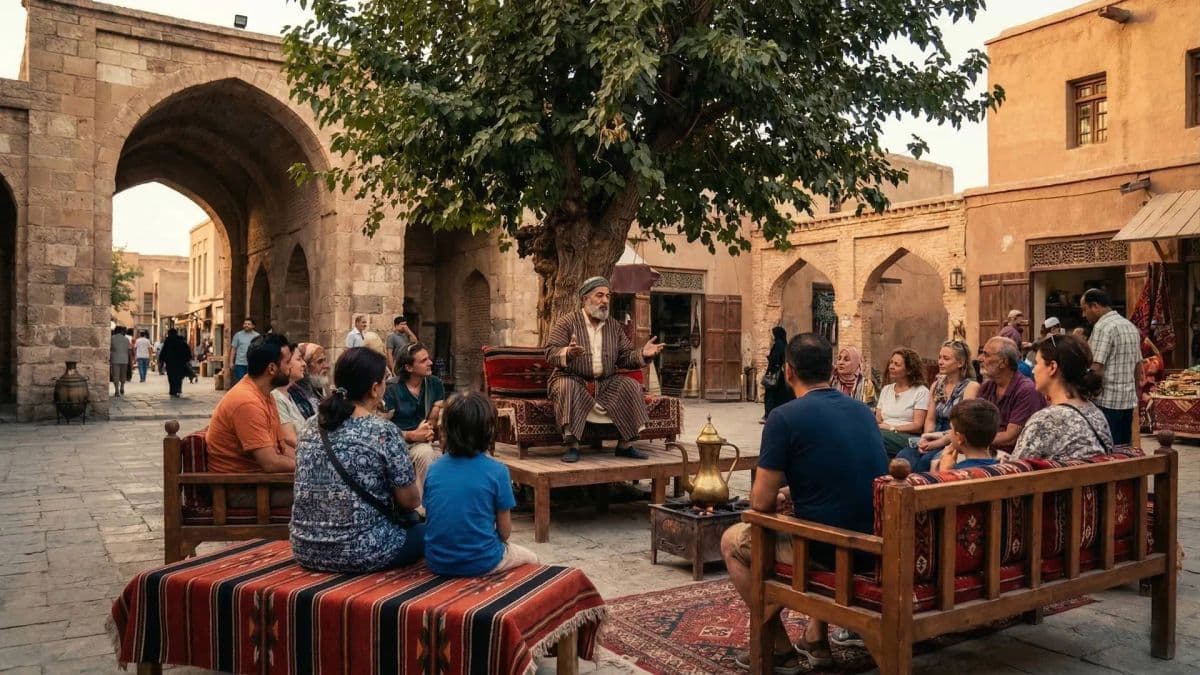
The Storyteller's Corner: Oral Traditions That Survive in Public Spaces

Priya Sharma
Writer
In a coffeehouse in the old city of Damascus -- before the war, before everything -- a hakawati was telling the story of Antar and Abla. He sat on a raised platform at the back of the room, a glass of tea at his elbow and a cane in his hand, which he struck against the floor for emphasis at moments of particular drama. The audience -- thirty or forty men, seated on low stools, smoking nargileh and drinking coffee -- knew the story already. Antar and Abla is a seventh-century tale of love, war, and tribal honor that every Arabic speaker knows the way every English speaker knows Romeo and Juliet. But they were not there for the plot. They were there for the telling.
The hakawati's voice rose and fell with a musicality that was neither speech nor song but something in between -- a rhythmic, ornamented delivery that used repetition, alliteration, and strategic silence to transform a familiar narrative into something that felt, each time, both ancient and immediate. He voiced all the characters: the warrior Antar with a bass rumble, the beloved Abla with a falsetto that walked the line between parody and tenderness, the villains with a snarl that made children in the back row press closer to their fathers. The cane punctuated the action: a sharp crack for a sword blow, a gentle tap for a kiss, a sustained drumroll for a cavalry charge.
This was oral histories storytelling tourism before the phrase existed. It was also, simply, entertainment -- the oldest form of entertainment in human history, predating writing, predating theater, predating every technology of narrative reproduction. A person telling a story to a gathered audience. Nothing else required. No screen, no stage, no ticket, no special effects. Just a voice, a story, and the attention of the room.
The hakawati tradition of Damascus coffeehouses has been disrupted by war and displacement, but it has not been destroyed. Hakawatis still perform in Beirut, Amman, and the Syrian diaspora communities of Istanbul and Berlin. The tradition survives because it serves a need that no technology can replace: the need to hear a story told by a living human being, in real time, with all the improvisation, error, and emotional authenticity that live performance provides and that recorded media cannot.
The Griot: West Africa's Living Archive
In Senegal, Mali, Guinea, and the wider Manding cultural sphere, the griot is not merely a storyteller. The griot is the community's memory -- the keeper of genealogies, histories, legal precedents, and cultural knowledge that, in a predominantly oral culture, exists nowhere except in the griot's trained mind.
The griot tradition is hereditary: you are born a griot, into a griot family, and your training begins in childhood and continues for decades. The training is not merely the memorization of stories, though memorization is central to it. It is the cultivation of a set of performative skills -- voice modulation, instrumental accompaniment (typically on the kora, a 21-string harp), audience management, and the ability to improvise and adapt traditional material to the specific audience and occasion -- that together constitute a professional art form of formidable sophistication.
The living history experiences of encountering a griot performance in Senegal are among the most powerful cultural experiences travel has to offer. I attended a performance in the courtyard of a family compound in Saint-Louis, the old colonial capital on the Senegal River, where a griot named Ablaye Cissoko sang the epic of Sundiata Keita -- the thirteenth-century founder of the Mali Empire -- while playing the kora with a fluency that made the instrument seem less played than inhabited.
The performance lasted over two hours, and its structure was nothing like a Western concert. There was no separation between performer and audience. People came and went. Children played in the periphery. Conversations continued in low voices during quieter passages and fell silent during dramatic ones. The griot adjusted his performance to the room: speeding up when attention waned, slowing down when a passage clearly moved the audience, inserting asides that referenced local events and individuals with a specificity that drew laughter and approvals from those who knew what he was talking about.
This responsiveness -- this constant, real-time dialogue between performer and audience -- is the essence of oral tradition and the quality that recording technology cannot capture. A recorded griot performance is to a live performance what a photograph of a meal is to the meal itself: it preserves the surface while losing the substance.
Rakugo: Tokyo's Sitting Comedy
In the yose theaters of Tokyo -- small, intimate venues seating between fifty and three hundred people -- the art of rakugo has been practiced continuously since the seventeenth century. Rakugo is, in formal terms, a solo comic storytelling art in which a single performer, seated on a cushion (zabuton) on a raised platform, plays all the characters in a story using only a fan and a small cloth as props.
In practice, rakugo is one of the most demanding performance arts in the world. The performer -- the rakugoka -- must memorize a repertoire of traditional stories (some dating to the Edo period), master the vocal and physical techniques for distinguishing between multiple characters (turning the head to the left for one character and the right for another, modifying voice, posture, and tempo for each), and -- most critically -- develop the ability to read an audience and adjust the pacing, emphasis, and improvisational asides to maximize the story's impact in that particular room, at that particular moment.
The oral histories storytelling tourism dimension of rakugo is surprisingly accessible to non-Japanese speakers. Several yose in Tokyo -- notably the Suehirotei in Shinjuku and the Asakusa Engei Hall -- offer regular performances, and while the verbal humor is obviously lost on non-speakers, the physical comedy, the vocal pyrotechnics, and the audience's reactions are universally comprehensible. More importantly, several contemporary rakugoka perform in English, and the experience of hearing a traditional Japanese comic story told in English by a master performer is a living history experience of genuine hilarity and insight.
What rakugo preserves that other storytelling traditions have lost is the formal structure of apprenticeship. A rakugoka begins as a zenza (opening act), performing only the simplest stories while serving as a personal assistant to their master. After ten to fifteen years, they progress to futatsume (second rank), and eventually, if their skill warrants it, to shin'uchi (master rank). The system is brutal, hierarchical, and extraordinarily effective at producing performers of exceptional skill, because the skill is not merely technical but relational -- the ability to establish, maintain, and modulate a relationship with an audience over the course of a thirty-minute monologue using nothing but voice, gesture, and story.
The Seanchai: Ireland's Fireside Voice
The seanchai -- pronounced "shan-a-key" -- is the traditional Irish storyteller, and the tradition, though diminished, is not dead. In pubs, at festivals, and in the dwindling number of private homes where the practice survives, seanchaithe still tell stories drawn from the vast reservoir of Irish oral literature: fairy tales, hero tales, local legends, historical narratives, and the peculiarly Irish form of humorous exaggeration that is neither lie nor truth but an artful occupation of the territory between them.
The cultural experiences travel of encountering a seanchai in a pub in County Kerry or on the Aran Islands is qualitatively different from attending a theater performance. The pub seanchai does not perform from a stage. He (the tradition is, historically, primarily though not exclusively male) sits at the bar or in a corner, and the story begins without preamble or announcement -- often in the middle of a conversation, as if the story were simply a longer and more elaborate contribution to the evening's chat. The audience does not fall silent out of respect. It falls silent out of interest, drawn in by the seanchai's voice and the story's momentum, the way you are drawn into a whirlpool not by choice but by current.
The seanchai tradition is rooted in a specific acoustic environment: the low-ceilinged, fire-lit room where the human voice is the only sound source and the audience is close enough to see the storyteller's face by firelight. This environment produces an intimacy that no amplified performance can match. The seanchai does not project. He speaks at conversational volume, and the audience leans in. The lean is crucial -- it is the physical expression of attention, the body's way of saying "I am listening," and it creates a feedback loop between teller and listener that intensifies the story's effect.
The living history experiences of hearing a seanchai in context -- in a pub, by a fire, in a community where the stories being told are about local places and local people -- are increasingly rare, but they are not extinct. The Cape Clear Island Storytelling Festival, held annually on a small island off the Cork coast, brings together traditional and contemporary storytellers in a setting that approximates the original conditions of the art. And in pubs scattered across the west of Ireland -- particularly in County Kerry, the Burren, and Connemara -- the tradition persists in informal, unpublicized, and therefore authentic form.
The Meddah of Turkey
The meddah -- the traditional Turkish public storyteller -- was declared a Masterpiece of the Oral and Intangible Heritage of Humanity by UNESCO in 2003, a recognition that was both an honor and, implicitly, an acknowledgment that the tradition was endangered. The meddah once performed in coffeehouses across the Ottoman Empire, providing entertainment, news, social commentary, and moral instruction in a single-performer format that combined storytelling with mimicry, music, and audience interaction.
The meddah's repertoire was drawn from the vast body of Turkish folk literature -- the adventures of Nasreddin Hodja, the epic of Koroglu, the love stories of the Thousand and One Nights -- but the performer's skill lay not in the faithful reproduction of traditional material but in its creative adaptation. A skilled meddah could take a familiar story and transform it into a commentary on current events, using the traditional characters as masks for contemporary figures and the traditional plot as a vehicle for observations that would have been dangerous to make directly.
Today, meddah performances can be encountered in Istanbul's cultural centers and at festivals, though the coffeehouse context that gave the art its original energy has largely disappeared. The experience is nonetheless powerful: a single performer, armed with nothing but a chair, a staff, and a voice of remarkable range, holding an audience for an hour or more through the sheer force of narrative skill.
Why Live Storytelling Survives
The persistence of oral storytelling traditions in an age of infinite digital content is not merely nostalgic. It is functional. Live storytelling provides something that no recorded or written medium can: the experience of shared, synchronized attention.
When a hakawati tells a story, every person in the coffeehouse is hearing the same words at the same moment. When a griot sings, every person in the courtyard is vibrating to the same rhythm. This synchronization is not metaphorical. Research on audience neuroscience has shown that listeners' brain waves literally synchronize during live narrative -- a phenomenon called "neural coupling" -- and that the degree of synchronization correlates with the depth of comprehension and emotional response. The more synchronized the audience, the more deeply they understand and feel the story.
This neural coupling does not occur with recorded media to the same degree. The live performance creates a feedback loop between performer and audience that modulates the narrative in real time, creating a version of the story that is unique to that room, that moment, that gathering of specific human beings. The story is never the same twice, because the audience is never the same twice, and the performer's genius lies in the ability to sense, respond to, and shape the attention of the room.