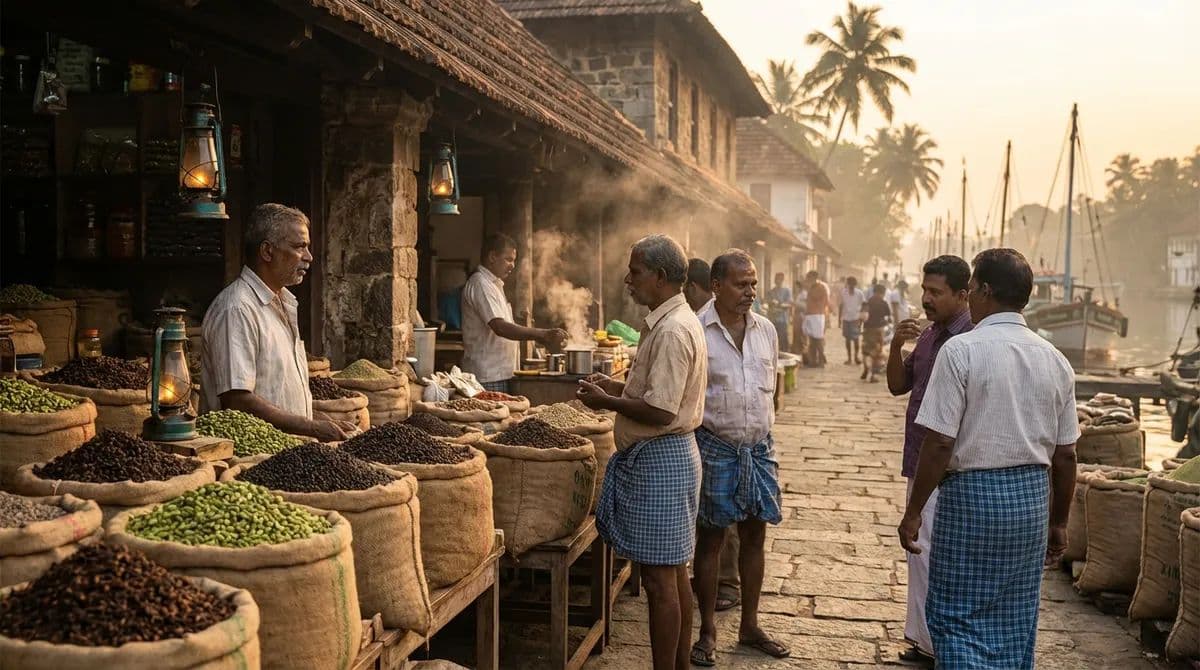
The Spice Route's Living Memory: Kerala's Markets at Dawn

Marcus Webb
Writer
The air finds you before anything else. It arrives thick and layered, a kind of aromatic archaeology: the top note of cardamom, green and almost mentholated, gives way to the deeper warmth of black pepper, then the sweet resinous bass of clove. You have not yet opened your eyes properly. The sun has barely cleared the warehouses along Jew Town Road in Kochi's Mattancherry district, and already the spice markets are conducting their ancient morning ceremony. A woman in a blue sari is spreading peppercorns across a tarpaulin in a courtyard that has been used for this exact purpose since the Portuguese first dropped anchor in this harbor five hundred years ago. She does not look up. She does not need to. Her hands know the work the way a pianist's hands know a nocturne — by a memory older than thought.
This is what spice markets travel reveals at its most honest: not a quaint spectacle arranged for visitors, but a living continuity so deep it has become invisible to itself. The culinary heritage of Kerala is not preserved in museums or reenactment festivals. It is preserved in the muscle memory of women sorting cardamom pods by size, in the mental arithmetic of merchants who can price a sack of turmeric by its color alone, in the specific way a shopkeeper folds a banana leaf around a measure of cinnamon bark. The heritage is not behind glass. It is at room temperature, slightly humid, and it will stain your fingers yellow if you are not careful.
Where the World Came Looking
To understand why this particular stretch of the Malabar Coast became one of the most consequential places on earth, you have to understand what black pepper meant to the ancient world. It was not a condiment. It was a currency, a preservative, a medicine, a status symbol, and — at various points in history — worth more by weight than gold. Roman senators paid their taxes in pepper. Alaric the Visigoth demanded three thousand pounds of it as ransom for lifting his siege of Rome in 408 AD. The pepper that made this possible grew, as it still grows, on woody vines climbing the jack and mango trees of Kerala's Western Ghats, in the warm monsoon-fed forests that cascade down toward the Arabian Sea.
The spice trade did not begin with Europeans. Arab merchants were sailing to the Malabar Coast at least two thousand years before Vasco da Gama rounded the Cape of Good Hope. Jewish traders established communities in Kochi that endured for millennia. Chinese merchants left behind fishing nets — the cantilevered structures that still line the Fort Kochi waterfront — and a taste for wok-cooked food that quietly infiltrated Kerala's cuisine. Each of these presences left a sedimentary layer in the culture, and in the markets you can still read the strata if you know how to look.
The European arrival was different only in its violence and its ambition. The Portuguese came in 1498, built forts, established monopolies, and attempted to control the entire pepper trade at gunpoint. The Dutch displaced them. The British displaced the Dutch. Each colonial power left its mark on the architecture of the warehouses — the heavy-beamed godowns along the backwaters, the tile-roofed counting houses in Mattancherry — but the spice trade itself, the actual daily commerce, remained stubbornly local. The merchants adapted. They always adapted. They are still adapting now, in a world where bulk commodity trading happens on screens in Singapore, by offering something the screens cannot: provenance, story, and the irreplaceable theater of a market at dawn.
The Grammar of Cardamom
Walk deeper into the market, past the storefronts with their burlap sacks spilling over like cornucopias staged for a Renaissance painting, and you reach the auction houses. Kerala produces most of the world's cardamom — the "queen of spices," as the trade calls it, to pepper's "king" — and during harvest season, the auction rooms in towns like Kumily and Vandanmedu hum with a particular energy. The lots are laid out in small cloth bags, each bearing a code. Buyers circulate, cracking open individual pods between their thumbnails, inhaling, assessing. The best cardamom is plump, intensely green, and releases an aroma so concentrated it seems to rewrite the air around it.
What strikes an outsider is the specificity of the vocabulary. There are words for the precise shade of green that indicates peak harvest. Words for the particular rattle a well-dried pod makes when shaken. Words for the resinous tackiness of fresh clove buds that tells you they were picked at the right moment, when the flower was still closed but the oil content had peaked. This is not jargon for its own sake. It is the accumulated language of a food history walking tour that has been conducting itself, generation after generation, for longer than most nations have existed. The language encodes knowledge that no laboratory analysis can fully replace — the knowledge of hands, noses, and tongues trained from childhood.
In one auction room, an elderly man named Kurian explained the grading system to me with the patience of someone who has explained it many times before but still finds it interesting. "First sort, second sort, third sort," he said, lining up the bags. "But within first sort, there are — " he paused, searching for the English — "there are moods. This one is bold. This one is delicate. The buyer in Dubai wants bold. The buyer in Scandinavia wants delicate. We remember." He tapped his temple. The database is biological.
Pepper and the Shape of History
Back in Kochi, in the older warehouses where pepper is still stored in massive sacks stacked to the ceiling, the air is different. Pepper is a sharper presence than cardamom, more aggressive, almost confrontational. It makes you sneeze and then makes you curious. The warehouses themselves are museums of a sort, though no one has curated them. The walls bear the marks of high-water floods. The wooden beams show the bore-holes of shipworms, a reminder that these buildings were constructed from the same timber as the trading vessels. In one corner, a faded stencil reads "TELLICHERRY EXTRA BOLD" — the grade name for the largest, most aromatic peppercorns, named after the port town of Thalassery, which is itself named from a Malayalam word meaning "luminous land."
The pepper trade shaped Kerala in ways that go far beyond economics. The income from spices funded the region's extraordinary investment in education and healthcare, which gave Kerala the highest literacy rate in India decades before the rest of the country caught up. The cosmopolitanism of the trade — the constant arrival of foreigners with unfamiliar gods, languages, and cuisines — produced a culture of unusual tolerance. Kerala's famous religious plurality, its tradition of welcoming communities that faced persecution elsewhere, is not some abstract philosophical achievement. It is the practical consequence of running an international trading hub for two thousand years. You learn to get along with people when getting along with people is good for the pepper business.
Clove, Cinnamon, and the Smaller Voices
Not everything in the market speaks at pepper's volume. Some spices are quieter, and their stories require closer attention. Clove, for instance, is native to the Maluku Islands of Indonesia, but it has been cultivated in Kerala for centuries, grafted onto the landscape so thoroughly that most locals consider it indigenous. The clove trees in the plantations above Munnar bloom in a way that turns entire hillsides pale pink, and the harvesting — picking each bud by hand before it opens into a flower — is one of the most labor-intensive processes in agriculture. A single kilogram of dried cloves represents hundreds of individual buds, each one plucked at the precise moment of maximum oil content.
Cinnamon — or more accurately, cassia, its bolder cousin — occupies another register entirely. The bark is stripped from young branches, and as it dries it curls into the familiar quills that have been a unit of trade since the Egyptians used them in embalming. In the market, the cassia sellers tend to occupy a specific corner, and their wares are stacked in bundles that look, from a distance, like rolled manuscripts. There is something scriptural about cinnamon, something archival. It is a spice that insists on its own history.
Then there is turmeric, the quiet workhorse, the spice so embedded in daily life that it barely registers as a commodity. In Kerala, turmeric is not exotic. It is domestic, familial, almost invisible — used in cooking, medicine, cosmetics, and religious ritual with an ease that suggests it has always been there, which it more or less has. The turmeric sellers in the market are the least theatrical vendors. They sit behind mounds of golden powder with the calm of people selling something everyone already knows they need.
The Market's Internal Clock
A spice market operates on a different temporality than the rest of the city. The workday begins before dawn, when the wholesale transactions happen — the serious business conducted between men who have known each other for decades, where a handshake still seals a deal worth tens of thousands of dollars. By mid-morning, the retail layer activates: the tourist-facing shops with their neatly labeled jars, the demonstration grinding of fresh spices, the offers of chai spiced with the house blend. By noon, the heat has settled over everything like a blanket, and the market enters a somnolent phase, the vendors dozing behind their wares, the spices themselves seeming to exhale more intensely in the warmth.
But the most revealing hour is the one just before closing, when the sweeping begins. A boy pushes a broom across a stone floor, and the dust that rises is not ordinary dust. It is the combined particulate of dozens of spices, a micro-cloud of flavor that represents, in physical form, the market's entire inventory. Breathe it in and you are inhaling a cross-section of global trade history, pulverized and airborne, settling on every surface, lodging in the weave of your clothing, following you back to your hotel room like a scent memory that will, months later, ambush you in the spice aisle of a supermarket ten thousand miles away and make you suddenly, viscerally homesick for a place that was never your home.