The Sound of a Market Waking Up

Ingrid Olsen
Writer
The first sound is not a voice. It is the scrape of a metal shutter being rolled upward, a sound so universally associated with the beginning of commerce that your brain processes it as a kind of clock chime — the market's version of a rooster crow. Then comes the slap of a crate on stone, the hollow percussion of empty containers being stacked, the particular music of a space being prepared for the day's performance. If you are standing in Tokyo's outer market district near the old Tsukiji site at four-thirty in the morning, or in the predawn corridors of Barcelona's Boqueria, or among the first arrivals at Mexico City's Central de Abasto, you are hearing the best food markets in the moments before they become the places tourists know. You are hearing a market wake up.
The acoustic life of a market before opening is one of the great sensory travel experiences available to anyone willing to set an alarm. It requires no ticket, no reservation, no special access. It requires only the willingness to be present at an hour when most visitors are still sleeping, and the patience to stand quietly in a space that is not yet performing for you. Because a market at dawn is not performing. It is rehearsing. It is warming up. And the sounds of that warm-up — layered, rhythmic, gradually increasing in complexity — tell you more about a place than any curated food tour conducted in the middle of the day.
The Hour Before the Hour
In Mexico City's Central de Abasto, the largest wholesale market in the Western Hemisphere, the predawn shift is a world unto itself. The market covers an area larger than three hundred football fields, and the logistics of filling it with produce every night is one of the great unsung feats of urban coordination. Trucks begin arriving around midnight, and by three in the morning the loading docks are a continuous wall of diesel engines and reversing alarms, the beep-beep-beep of trucks backing into bays that is the market's bassline, its foundational rhythm.
Walk past the docks and into the interior, and the soundscape shifts. The citrus hall is already active — Mexico produces more limes than any country on earth, and the volume of limes passing through this building every night is staggering. The sound here is softer than you expect: the tumble of fruit being poured from crates into display pyramids, a sound like muffled applause. Workers call to each other in quick bursts of Spanish that echo off the corrugated metal ceiling. A radio plays somewhere, tinny and distant, the cumbia rhythm an almost subliminal pulse beneath the commerce.
The chile section has its own acoustic signature. Dried chiles are lighter than most produce, and they rustle when moved — a papery whisper that is somehow both quiet and insistent, like a library of very small books being shelved in a hurry. The men who work the chile stalls move through chest-high mounds of guajillo, ancho, and pasilla with the confidence of people wading through a familiar sea. They scoop and weigh and bag with a speed that turns the transaction into percussion: scoop, pour, rustle, thump of the bag on the counter, tear of the receipt from the printer.
Tokyo: The Choreography of Fish
In the blocks surrounding what was once the Tsukiji wholesale market — the inner market has moved to Toyosu, but the outer market remains, a dense constellation of shops and stalls that serves as Tokyo's culinary nervous system — the dawn sounds are sharper, more precise. Tokyo markets do not rumble; they click. The sound of a knife on a cutting board, the particular wet thock of a fish being sectioned, the wooden clatter of geta sandals on concrete — these are the sounds of a culture that values edge and exactitude even in its noise.
The tuna auction at Toyosu, held in the early hours before public access begins, has its own famous acoustics. The auctioneer's chant — a rapid, rhythmic recitation of numbers that is part arithmetic and part incantation — fills the refrigerated hall with a sound that belongs to no other context. The bidders signal with hand gestures inherited from a system so old that its origins are debated. The frozen tuna lie in rows on the floor like polished torpedoes, each one bearing a slice in the tail where buyers have examined the flesh, reading the color and fat content the way a jeweler reads a stone. The sound of a buyer's flashlight clicking on and off as he inspects one fish after another is the smallest, most intimate sound in the building — a private conversation between a man and a fish about quality and price.
Outside, in the outer market's narrow lanes, the street food stories begin to accumulate. A vendor fires up a grill and the first smoke rises in the cold air, carrying the scent of charred mochi rice cakes. The hiss of a tamagoyaki omelet being rolled on a hot griddle. The clank of a metal ladle against the rim of a stockpot filled with dashi, the kelp-and-bonito broth that is the foundational flavor of Japanese cuisine. Each sound is a sentence in the market's ongoing monologue about what it means to feed a city of fourteen million people, every day, without fail.
Barcelona: Stone and Voice
The Boqueria, Barcelona's most famous market, occupies a building on La Rambla that has been a site of food commerce since the thirteenth century, when vendors sold meat outside the old city gate. The building itself — a grand iron-and-glass structure completed in 1853 — has acoustics that no architect designed but that centuries of use have perfected. The high ceiling catches voices and disperses them into a general hum, a human murmur that is the market's resting state, its ambient temperature of sound.
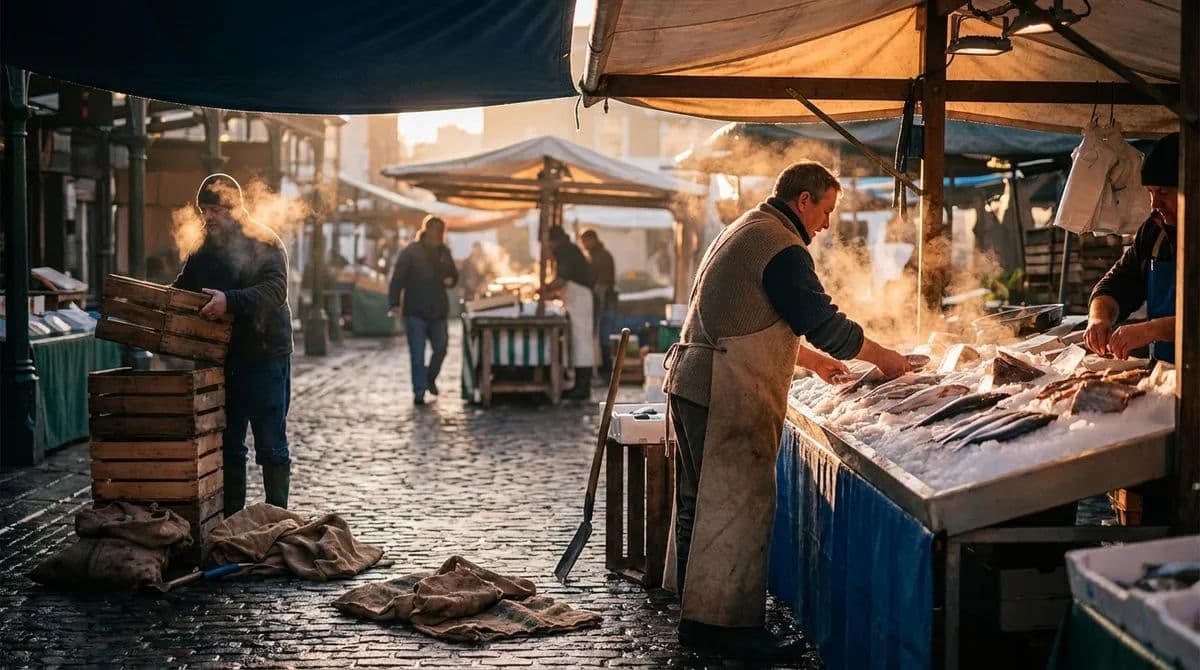
At dawn, before this hum reaches its daytime density, you can hear the market's individual instruments. The fishmongers are loudest, not because they shout — Barcelona's fish sellers are more reserved than their counterparts in, say, Istanbul's Karakoy fish market — but because fish on ice is a noisy proposition. The crack of ice being shoveled from bins. The wet slap of a whole sea bass being laid on the marble counter, a sound that is somehow both violent and tender, like a doctor delivering a baby. The scrape of a blade descaling a bream, a rapid back-and-forth that sends translucent discs of scale flying into the light like tiny mirrors.
The fruit and vegetable stalls wake more quietly. A vendor arranges tomatoes by size and color, and the only sound is the soft contact of skin against skin — fruit touching fruit, hands touching fruit, the gentle negotiation of placement that will determine the display's visual appeal for the next twelve hours. These vendors are artists in a medium that has a half-life, and their silence during the arrangement process has the concentration of a painter before a canvas.
In the back corridors, where deliveries arrive and trash departs, the market's utilitarian sounds dominate: the hydraulic sigh of a loading dock, the rattle of a hand truck over uneven stone floors, the shout of a man who needs someone to move a pallet. These sounds are not picturesque. They are the infrastructure of pleasure, the unglamorous labor that makes the glamorous stall possible.
Istanbul: The Call and the Commerce
Markets in Istanbul operate in acoustic layers that reflect the city's own layered history. At dawn, the first sound above the Spice Bazaar is the call to prayer from a nearby mosque — a sound so integral to the city's rhythm that vendors time their morning preparations by it. The muezzin's voice, amplified and slightly distorted by the speakers mounted on the minaret, floats over the rooftop and settles into the empty market corridors like a benediction. It is not separate from the commerce. It is the frame around it.
Inside, the Spice Bazaar's vaulted ceilings produce an echo that makes every sound feel ancient, even the beep of a credit card terminal. The spice merchants arrange their wares in pyramidal mounds — sumac the color of dried blood, turmeric like powdered sunlight, pul biber flakes in varying shades of red — and the sound of a metal scoop entering a mound of spice is a soft, yielding hush, as if the spice itself were sighing.
Tea is the market's social lubricant, and the sound of tea being made — the clink of small tulip-shaped glasses on a brass tray, the pour of dark Turkish tea from the double-stacked caydanlik, the rattle of sugar cubes in a bowl — is the market's background conversation, its continuous low-level social exchange. Before the first sale of the day, there is tea. During a negotiation, there is tea. After a deal is struck, there is tea. The sound of tea service is the sound of the market agreeing with itself that the day is proceeding as it should.
The Grammar of Waking
What all these markets share, beneath their surface differences, is a grammar of awakening that follows a universal pattern. First, the infrastructure sounds: shutters, crates, ice, water. Then, the preparation sounds: knives, arrangements, the ritualistic placement of goods. Then, the social sounds: greetings, first conversations, the negotiation of territory between neighboring stalls. And finally, the performance sounds: the vendor calls, the sales pitches, the laughter and argument that constitute a market's public life.
This grammar is ancient. It predates the buildings that house these markets. It predates the particular goods being sold. It is the sound of human beings organizing themselves around food, which is to say around survival, which is to say around each other. A market waking up is a community rehearsing its own existence, running through the steps one more time, confirming that the pattern still holds.
The transition from dawn to day is not sudden. It is a gradual increase in density, a slow crescendo that you notice only if you have been there since the beginning. At some point — around seven or eight, depending on the latitude and the culture — the market tips from preparation into performance, from private to public, and the particular magic of the early hour is lost in the general noise of commerce. This is not a loss, exactly. The daytime market has its own pleasures. But it is a different thing. It is the concert. The dawn was the tuning of the instruments.