The Quiet Art of Noticing

Priya Sharma
Writer
There is a moment, usually on the second or third day in an unfamiliar city, when something shifts. The visual overwhelm recedes — the facades, the signage, the urgent choreography of strangers crossing streets — and a quieter channel opens. You begin to hear the place. Not just its obvious sounds, the car horns and construction and distant music, but the particular grain of its silence, the way footsteps behave differently on limestone than on asphalt, the cadence of conversation that tells you something about a culture before you understand a single word. This is mindful listening while traveling, and once you learn it, no city ever feels quite the same.
I first noticed it in Rome, standing in the Piazza della Rotonda on a January evening. The Pantheon's oculus was a dark circle against a darker sky, and the square had mostly emptied. What remained was sound: water spilling from the fountain's basin in a continuous, asymmetric rhythm. A motorino somewhere behind the buildings, its engine note bouncing off the walls in a pattern that traced the geometry of the streets. The murmur of two women smoking outside a bar, their Italian rising and falling in intervals that felt almost musical. And beneath it all, something I can only describe as the acoustic signature of stone — a faint resonance that old cities carry, the accumulated hum of centuries of human presence absorbed into marble and travertine and tufa.
It was not a revelation so much as a remembering. We are born listeners. The ear is the first sense organ to fully develop in the womb, and the last to shut down at death. For most of human history, hearing was our primary survival sense — we listened for predators, for weather, for the approach of strangers. But modernity has made us eye-dominant creatures, and travel has followed suit. We photograph. We scroll. We orient ourselves by maps and screens. The ear, that ancient instrument of attention, goes largely unused. Learning how to really experience a city means learning to reverse that hierarchy, even if only for a few hours at a time.
The Listening Traveler's Advantage
The case for contemplative travel through sound is not merely aesthetic — though it is deeply that. Research in environmental psychology has shown that conscious listening activates different neural pathways than passive hearing, engaging the same brain regions associated with empathy and spatial memory. When you actively listen to a place, you encode it more deeply. The memory sticks differently. Ask any traveler to describe a city they visited five years ago, and they will likely recall images — the color of a building, the shape of a bridge. But play them a recording of that city's ambient sound, and the response is visceral, immediate, almost physical. Sound bypasses the intellect and reaches something older.
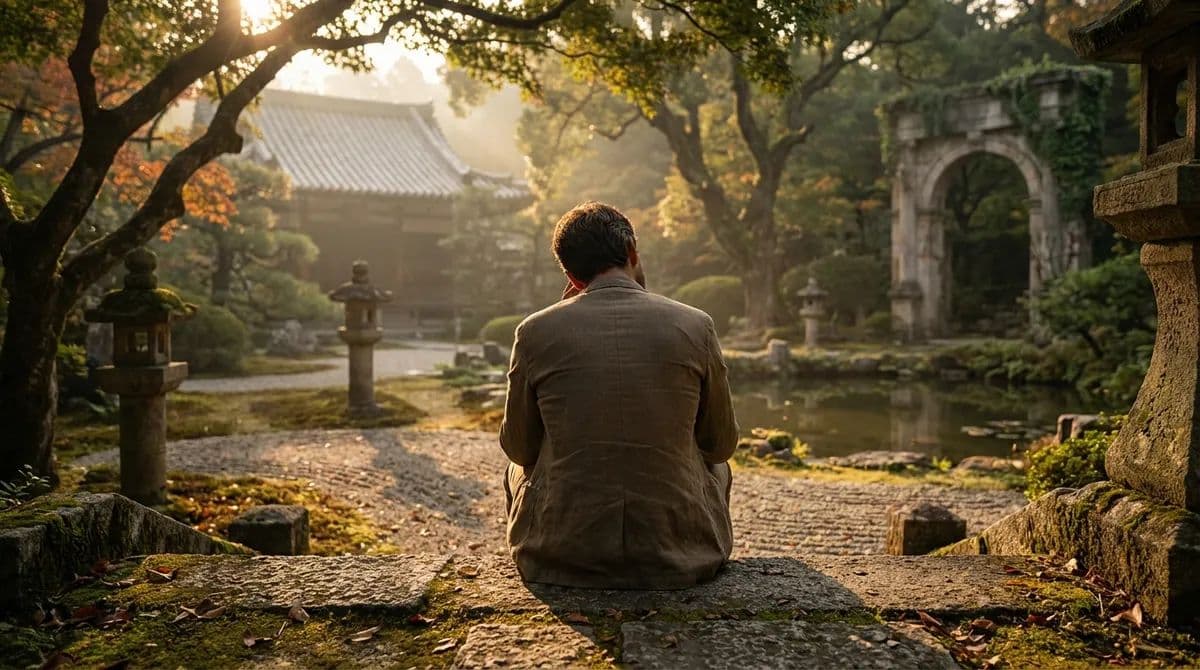
This is why the practice of mindful listening while traveling is more than a charming affectation. It is a tool for deeper presence. The ear cannot multitask the way the eye can. You cannot listen to two conversations simultaneously — you must choose one stream and commit to it. This forced selectivity is, paradoxically, what makes listening so restful in an age of distraction. To stand in a Kyoto temple garden and follow the hollow knock of a shishi-odoshi — the bamboo water feature that fills, tips, and strikes stone in intervals of roughly forty-five seconds — is to practice a form of meditation without any of meditation's self-conscious apparatus.
Retraining the Ear
How does one begin? The composer and acoustic ecologist R. Murray Schafer, who coined the term "soundscape" in the late 1960s, proposed a deceptively simple exercise: sit in any environment for ten minutes and list every sound you hear. Not categorize, not judge — just notice. His students at Simon Fraser University, sent to catalog the sounds of Vancouver, consistently reported that they heard more on their fifth attempt than their first. The ear, like any instrument, improves with practice.
For the traveler, the equivalent exercise might look like this: on your first morning in a new city, before you consult the guidebook, before you plan anything, open the window of your room and listen for five minutes. What do you hear? Traffic, yes — but what kind? The diesel clatter of old buses suggests one kind of city; the electric hum of trams suggests another. Are there birds? What species? The hooded crows of Istanbul sound nothing like the parakeets of Barcelona, and those parakeets — escapees from a pet shipment in the 1970s that established an improbably thriving colony — tell you something about the city's character that no museum can.
Listen for the human layer. The rhythms of street sweeping, the particular acoustic event of a metal shopfront being rolled up at 7 a.m. in Mediterranean cities, the call-and-response of vendors in a market. Listen for water — fountains, gutters, rain on awnings, the distant suggestion of a river. Listen for the mechanical signature of the city: air conditioning units, elevator shafts, the subway rumbling underfoot. Each sound is data, and together they compose a portrait as specific as a fingerprint.
The Architecture of Sound
Cities are not just heard — they are acoustically designed, whether their builders intended it or not. The narrow streets of Fez's medina create a natural amplification effect that carries the muezzin's call across the entire old city without electronic assistance. The piazzas of Italian cities function as acoustic bowls, gathering sound and reflecting it back to the center. The wide boulevards of Haussmann's Paris were designed partly for military movement, but their acoustic consequence — a spacious, echoey soundfield — gives the city its distinctive aural grandeur.
Modern architecture, by contrast, tends toward acoustic flatness. Glass, steel, and concrete absorb less and reflect more, creating environments where sound becomes noise — undifferentiated, unpleasant, exhausting. This is one reason why travelers instinctively prefer old cities. It is not mere nostalgia. The acoustic environment of a medieval quarter, with its irregular surfaces, stone walls, and narrow passages, is genuinely more complex and more interesting to the ear. The sound diffuses, wraps, and decays in patterns that feel organic because they evolved the same way the streets did — over centuries, shaped by use rather than by plan.
Pay attention to thresholds. The moment you step from a busy street into a courtyard, the sound changes completely — the volume drops, the reverb lengthens, and suddenly you can hear individual sounds with a clarity that the street denied. These acoustic transitions are among the most pleasurable experiences a city offers, and they are entirely free. The great mosques of Istanbul were designed with this in mind: the transition from the noisy street through the courtyard to the vast, hushed interior of the prayer hall is a carefully choreographed journey through acoustic space.
Sound as Cultural Identity
Every culture has what Schafer called "soundmarks" — the acoustic equivalents of landmarks. The sound of Big Ben is a soundmark. So is the particular whistle of a New York City taxi, the two-tone horn of a Parisian police car, the wooden clappers of a Tokyo fire watchman making his rounds. These sounds are not incidental. They are as central to a place's identity as its cuisine or its architecture, and they are vanishing at an alarming rate.
The global homogenization of sound is one of the least discussed consequences of modernization. As cities adopt the same traffic systems, the same construction equipment, the same commercial music played through the same speakers, the acoustic differences between places are eroding. The traveler who listens is, in a small way, documenting what remains — bearing witness to sonic identities that may not survive another generation of development.
This is not a call for preservationism so much as for attention. You cannot save what you do not notice. And the paradox of sound is that it is simultaneously the most immersive and the most ignored dimension of experience. We swim in it constantly, and for that reason we have learned to tune it out. The mindful listener simply reverses that habit — chooses, for a few hours, to let the ear lead.
A Practice, Not a Destination
Mindful listening is not something you do at specific tourist sites. There is no "top ten sounds to hear before you die" — or if there is, it misses the point entirely. The practice is transferable, applicable anywhere, and its rewards compound over time. The traveler who listens in Rome will hear more in Marrakech. The one who listens in Marrakech will hear more in Tokyo. Each city trains the ear for the next.
The discipline, if it can be called that, is simply this: periodically, throughout the day, stop moving. Close your eyes if you can. Let the visual world recede. And for two minutes — just two — give your full attention to what you hear. The results will surprise you. A city that seemed familiar will suddenly reveal layers you had been walking through without noticing. A quiet street will turn out to be full of sound. A noisy intersection will resolve into distinct, identifiable streams — each one a thread you can follow into the life of the place.