The Palimpsest Beneath Your Feet: Cities Built on Cities

Marcus Webb
Writer
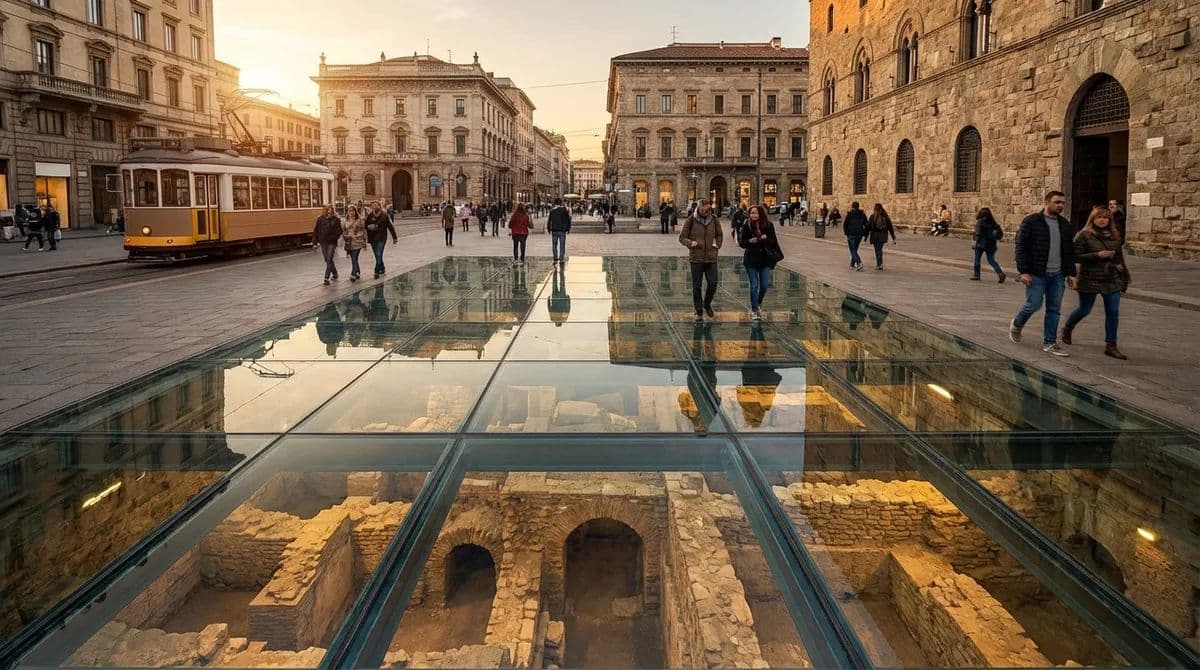
In the basement of a McDonald's on Via dei Pastini in Rome, about two hundred meters from the Pantheon, there is an ancient Roman road. It sits behind a pane of glass, lit by fluorescent light, visible to anyone who takes the stairs down to the restrooms. The road is roughly two thousand years old. The cobblestones are worn smooth by cart wheels. A drainage channel runs along one side, still perfectly graded. Customers shuffle past it carrying trays of Big Macs and Filet-o-Fish, and most of them barely glance at it — the layers of history in cities like Rome have become so commonplace that a two-millennium-old road in a fast-food basement registers as mildly interesting rather than vertigo-inducing. But stand there for a moment, with the hum of the ice machine behind you and the ancient stone beneath the glass, and the sensation arrives: you are standing in two centuries simultaneously, and the distance between them is the depth of a single floor.
This is the experience of the palimpsest city — a place where the past is not behind you, stored safely in museums and textbooks, but beneath you, layered in strata like geological deposits, occasionally breaking through the surface. The word "palimpsest" originally referred to a manuscript that had been scraped clean and written over, but where the earlier text remained faintly visible beneath the new. It is the perfect metaphor for cities that have been continuously inhabited for millennia, where each civilization built on the rubble of the last, and where a construction crew digging a foundation for a parking garage can halt a city's development for years by accidentally uncovering a temple, a necropolis, or an entire neighborhood that nobody knew was there.
Hidden history travel is, at its most visceral, the experience of this vertigo — the dizzying recognition that the ground you walk on is not solid but layered, and that every layer was someone's present tense. The tourist who takes a historical walking tour of Rome's Forum sees the past as a spectacle, safely cordoned and interpreted. The traveler who descends into the excavations beneath San Clemente basilica — from the twelfth-century church down through the fourth-century church beneath it to the first-century Roman apartment building beneath that to the Mithraic temple beneath that — experiences the past as a physical descent, each layer pressing down on the one below with the accumulated weight of everything that came after.
Rome: Seven Cities Deep
Rome's seven layers are not a metaphor. They are a measurable, archaeological fact. The modern city sits, on average, seven to ten meters above the level of ancient Rome, and the intervening space is filled with the compressed remains of twenty-eight centuries of continuous habitation. Dig anywhere in the historic center and you will find something — a mosaic, a wall, an amphora, a coin. The city's metro system, begun in the 1930s, is still unfinished largely because every new tunnel produces new discoveries that require years of documentation before construction can resume. Line C, the newest, has been under construction for over two decades. It has yielded, among other things, a second-century barracks for the imperial guard, complete with frescoed walls and a courtyard, discovered thirty meters below the modern street level near the Colosseum.
The most accessible descent into Rome's layers is the Basilica di San Clemente, a short walk from the Colosseum. The current church, a handsome twelfth-century basilica with glittering apse mosaics, sits atop a fourth-century church that was itself built inside a first-century Roman insula — a multi-story apartment building. Below the insula, at a depth of roughly eighteen meters, is a small Mithraic temple from the second century, its altar still intact, the carved relief of Mithras slaying the bull still visible in the dim light. Water runs through the lowest level — the Cloaca Maxima, Rome's ancient sewer system, still functioning after 2,500 years, carrying water to the Tiber as it did when Rome was a republic.
The descent takes perhaps twenty minutes. In that time, you pass through twelve centuries. The temperature drops. The light changes. The sounds of the street vanish. And at the bottom, in the dripping darkness beside a pagan altar, the modern city feels not distant but irrelevant — a thin, temporary layer resting on something much older and much more durable.
Istanbul: The City of Nine Layers
If Rome's layers are the most famous, Istanbul's are the most complex. The city has been continuously inhabited for approximately 8,500 years — it was Byzantion, then Constantinople, then Istanbul, each name representing not just a change of rulers but a wholesale reconstruction of the urban fabric. The Byzantine emperors built over the Roman city. The Ottomans built over the Byzantine city. The modern Turkish republic built over the Ottoman city. And beneath all of them, barely explored, lie the remains of Neolithic, Chalcolithic, and Bronze Age settlements that predate written history entirely.
The Basilica Cistern, the most visited of Istanbul's underground spaces, is the one that most tourists encounter — a vast, cathedral-like reservoir built by Justinian in the sixth century, its 336 marble columns salvaged from ruined temples across the empire, including two famous Medusa heads repurposed as column bases. But the cistern is only the beginning. Istanbul has over a hundred known underground cisterns, many of them unexplored, and the city's subterranean life extends far deeper.
Beneath the streets of Sultanahmet, recent excavations have revealed the remains of the Great Palace of Constantinople — a sprawling complex of courtyards, throne rooms, and mosaic floors that once covered an area larger than the modern neighborhood above it. Fragments of the palace's mosaic floor, depicting hunting scenes and mythological creatures in vivid polychrome, are visible in the Mosaic Museum, but the vast majority of the palace remains buried, its layout inferred from Byzantine literary descriptions rather than archaeological evidence. Somewhere beneath the hotels and carpet shops of Sultanahmet, entire rooms of the palace wait, their mosaics face-down in the dark, undisturbed for fifteen hundred years.
The Marmaray rail tunnel, completed in 2013 and running beneath the Bosphorus, produced one of the most significant archaeological discoveries of the twenty-first century: the remains of the Port of Theodosius, a fourth-century harbor that had silted up and been built over. The excavation revealed 37 Byzantine shipwrecks — the largest collection of ancient vessels ever found in a single site — along with the harbor's stone quays, warehouses, and the personal effects of the sailors who worked there. The discovery was so vast that it delayed the tunnel's completion by four years and required the construction of a dedicated museum.
Mexico City: Walking on Water, Walking on Temples
The palimpsest of Mexico City is unique because what lies beneath is not merely a previous version of the same city but a fundamentally different one — a city built on water. Tenochtitlan, the Aztec capital that Spanish conquistadors destroyed in 1521, was constructed on an island in Lake Texcoco and connected to the mainland by causeways. Its population of over 200,000 made it one of the largest cities in the world. Hernan Cortes, in his letters to Charles V, described it as more beautiful than anything in Europe. Then he demolished it, stone by stone, and used the rubble to fill the canals and build a Spanish colonial city on top.
Modern Mexico City sits on the drained lakebed, and the memory of water asserts itself constantly. The city sinks — unevenly, relentlessly — as the clay beneath its foundations compresses, a process accelerated by the pumping of groundwater. Buildings tilt. Streets buckle. The cathedral in the Zocalo, built directly on top of the Templo Mayor, lists visibly, its floor a landscape of slopes and corrections. And from this sinking, sometimes, the past resurfaces. In 1978, electrical workers digging a trench near the cathedral struck a massive carved stone — the Coyolxauhqui monolith, depicting the dismembered moon goddess — and the discovery triggered the excavation of the Templo Mayor itself, the great twin pyramid that had been the spiritual center of the Aztec empire and that had been buried under colonial buildings for 457 years.
Today the Templo Mayor sits in an open excavation pit beside the cathedral, seven construction phases visible in cross-section like the rings of a tree. Each phase represents a new pyramid built over the old one, each larger than the last, each dedicated with increasingly elaborate ceremonies. The earliest phase dates to approximately 1325. The final phase, the one Cortes saw and destroyed, was sixty meters tall. Standing at the edge of the pit, looking down at the layers, and then looking up at the colonial cathedral looming immediately adjacent, the palimpsest is not subtle. It is brutal, political, and unresolved.
Naples: Greek Beneath Baroque
Naples may be the most intensely layered city in Europe. Founded as Neapolis by Greek colonists in the fifth century BCE, it was subsequently Roman, Byzantine, Norman, Angevin, Aragonese, Spanish, Bourbon, and Italian — each era leaving its architectural sediment on the one before. The result is a city where a Baroque church facade may conceal a Gothic interior, which rests on Roman foundations, which were cut into Greek bedrock. The historical walking tour in Naples is necessarily vertical.
The most dramatic descent is into the Napoli Sotterranea — the underground city that runs beneath the historic center. Carved from the soft tufa stone that underlies the entire city, this network of tunnels and chambers has served, over two and a half millennia, as a Greek quarry, a Roman aqueduct, a medieval cistern system, and a World War II air-raid shelter. The shelters are the most haunting: you can still see the graffiti left by Neapolitan families who lived underground for months during Allied bombing campaigns, their drawings and messages scratched into walls that were quarried by Greeks 2,400 years earlier.
Above ground, the layering is visible in the street grid itself. The Spaccanapoli — the long, straight street that bisects the old city — follows the line of a Greek road laid down in the fifth century BCE. The side streets, running perpendicular at regular intervals, preserve the Greek grid plan with a fidelity that no subsequent civilization saw fit to alter. Walk the Spaccanapoli and you are walking the oldest continuously used urban pathway in Europe, your footsteps tracing the same line as Greek colonists, Roman citizens, medieval monks, Renaissance princes, and the teeming Neapolitan street life that has occupied these stones, in essentially the same manner, for twenty-five centuries.
The Vertigo of Layers
What all palimpsest cities share is not just archaeological depth but a particular emotional quality — a vertigo that arises from the recognition that the present is thin. Standing in the Basilica Cistern in Istanbul, or descending into San Clemente in Rome, or looking down into the Templo Mayor excavation in Mexico City, the traveler confronts a disorienting truth: that the world we inhabit is a surface, and that beneath it lie other surfaces, equally real, equally inhabited, equally convinced of their own permanence, now compressed into the darkness of the underground.
This is not a melancholy insight, or not only that. It is also a liberation. The palimpsest city teaches a kind of temporal humility — a recognition that our own century is just another layer, and that the things we build will eventually become foundations for what comes next. The Roman road in the McDonald's basement was, once, the most modern infrastructure in the world. Now it is an archaeological curiosity in a fast-food restaurant. The cycle will continue. The golden arches, too, will one day be beneath someone's feet.