The Nightwalker's Companion: Solo After Dark in Unfamiliar Cities

Carmen Ruiz
Writer
There is a particular freedom that arrives about forty-five minutes after sunset in a city you do not know. The obligation to sightsee has been dissolved by darkness. The monuments are closed. The recommended itinerary has expired. The guidebook, which had opinions about what you should do with your afternoon, has nothing to say about what you should do with your night. And in that absence of instruction, a different kind of travel becomes possible — not the purposeful march from landmark to landmark, but the purposeless drift through streets whose names you cannot read, past buildings whose histories you do not know, toward no destination in particular. A nighttime walking tour of a city need not have a route. It needs only a willingness to be lost, a tolerance for ambiguity, and a pair of comfortable shoes.
I have walked alone at night in more cities than I can count, and what I have learned is this: every city has an acoustic architecture that is audible only after the daytime noise subsides. During the day, cities roar. Traffic, construction, voices, music, the cumulative drone of millions of small machines — these sounds merge into a wall of white noise that obliterates the subtler frequencies. At night, when the traffic thins and the construction stops and the shops close their shutters, the city's bones become audible. You hear the echo of your own footsteps and learn, from the quality of that echo, the height of the buildings and the width of the street. You hear the hum of a transformer in a basement. You hear a dog bark three blocks away with a clarity that daylight would have swallowed. The city is the same city. But your ears, released from the tyranny of noise, are hearing it for the first time.
Kyoto: The Geometry of Silence
Kyoto at night is a city of geometries. The grid of streets — laid out in the eighth century on a Chinese model, and largely preserved through twelve centuries of history by the fortunate accident of being spared from Allied bombing — produces a regularity that darkness simplifies into pure pattern. Walking north along one of the narrow machiya-lined streets of the Nishijin weaving district, the wooden facades of the townhouses form parallel walls that channel your gaze toward a vanishing point somewhere in the darkness ahead. The only light comes from the paper-screened windows of the machiya — a warm, amber glow that has the same quality it had three hundred years ago, when these streets were lit by candlelight and oil lamps, and a nighttime walking tour through these neighborhoods would have revealed essentially the same visual experience you are having now.
The silence of Kyoto at night is not the silence of absence. It is the silence of presence — of people inside the houses, of monks in the temples, of the city holding its breath between the evening temple bells and the morning ones. The stone gardens of the Zen temples, which during the day are subject to a constant murmur of tourist commentary, achieve at night a silence so complete that the sound of gravel under your feet feels almost transgressive, as though you are disturbing a conversation that the stones were having with each other.
The geisha district of Gion offers the nightwalker a particular lesson in attention. The geiko and maiko who move through these streets in the evening are visible as flashes of color and the soft percussion of wooden geta sandals on stone, appearing and disappearing between the teahouses with a speed that makes photography difficult and appreciation easy. They are not performing for you. They are going to work, and the discretion of their passage — the lowered eyes, the quick turn through a doorway, the curtain falling closed behind them — is itself a form of communication. It says: this world exists, and you are welcome to witness it, but you are not invited inside. The nightwalker's relationship to Gion is the nightwalker's relationship to all cities after dark: you are a witness, not a participant, and the beauty of the experience lies precisely in that distance.
Prague: Stone and Shadow
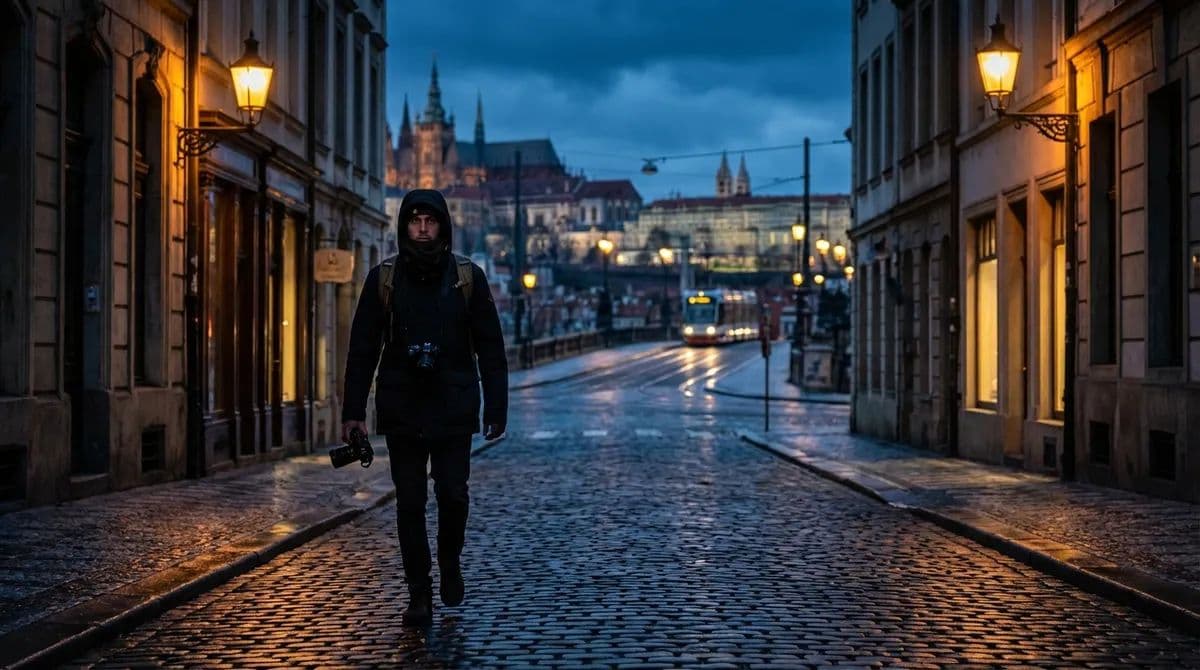
Prague is a city built for walking at night. Its Gothic and Baroque architecture — the spires of Tyn Church, the blackened statues on the Charles Bridge, the castle complex looming above the Vltava — was designed for a world without electric light, and it looks better in darkness than in daylight. This is not a subjective opinion. It is a consequence of the architecture's relationship with shadow. Gothic architecture uses verticality and deep relief to create patterns of light and shadow that change with the angle of illumination, and the low, oblique light of streetlamps produces more dramatic shadow than the flat overhead light of the sun.
Walking across the Charles Bridge at midnight is one of the great urban experiences in Europe. The bridge's thirty baroque statues — saints, martyrs, and religious scenes frozen in attitudes of ecstasy and agony — cast long shadows across the pavement, and the effect is genuinely theatrical, a stage set designed by centuries of accumulated darkness. The Vltava below reflects the lights of the castle and the old town, and the water's surface, disturbed by the current, breaks these reflections into moving fragments that look like the river is trying to reassemble images it has shattered.
City exploration at night in Prague inevitably leads to the Jewish Quarter, Josefov, where the oldest surviving synagogue in Europe — the Old-New Synagogue, built in 1270 — stands in a darkness that feels historical rather than merely nocturnal. The legend of the Golem — the clay figure animated by Rabbi Loew to protect the Jews of Prague — belongs to this darkness. It is a story about what happens in a city at night, when the normal rules are suspended and the boundary between the living and the made becomes uncertain. Walking through Josefov after midnight, past the tombstones of the Old Jewish Cemetery packed so tightly they lean against each other like exhausted soldiers, is to feel the city's accumulation of stories pressing against you from all sides.
Havana: Music Leaking Through Walls
Havana at night is an auditory experience before it is a visual one. The city's colonial architecture — the grand but crumbling mansions of Vedado, the narrow streets of Habana Vieja with their iron balconies and faded pastel facades — creates an urban fabric that is porous to sound in a way that modern construction, with its sealed windows and insulated walls, is not. Music leaks through the walls of Havana. It escapes through open doorways and jalousie windows and the gaps in shutters that no longer close properly, and it pools in the streets like water collecting in the low points of an uneven floor.
Walk through Centro Habana after eleven and you will hear, within the space of a single block, a son montuno being rehearsed in a second-floor apartment, a reggaeton track blasting from a ground-floor bar, and the quiet plucking of a guitar on a rooftop where someone is practicing alone. The sounds overlap and compete and occasionally harmonize, producing a composite soundscape that is not noise but music of a different order — the music of a city that cannot stop making music, even in its sleep.
The Malecon — the five-mile seawall that curves along Havana's waterfront — is the nightwalker's natural habitat. After dark, the Malecon becomes a linear piazza, a continuous social space where Havana's residents gather to sit on the wall, drink rum, fish, argue, kiss, and stare at the dark water where the Gulf Stream pushes past the island on its way north. The sound of the waves against the seawall provides a bass note beneath the human activity, and the salt air carries voices farther than you would expect, so that conversations you did not intend to overhear arrive in fragments — a laugh, a name, a phrase of a song — like transmissions from a radio you cannot tune.
Fez: The Labyrinth After Dark
The medina of Fez is the largest car-free urban area in the world, a labyrinth of nine thousand streets that has been continuously inhabited since the ninth century. During the day, it is one of the most intensely sensory environments on earth — the narrow alleys packed with commerce, the air thick with the smells of leather from the tanneries and spices from the market stalls, the constant negotiation between pedestrians and donkey-borne deliveries in passages barely wide enough for two people to pass. At night, the medina does not shut down. It transforms.
The commercial corridors close, their metal shutters pulled down and padlocked, and the medina reveals its residential substrate — the network of dead-end alleys, private courtyards, and neighborhood mosques that constitute the actual life of the old city. The light is sparse: a bare bulb above a doorway, a fluorescent tube in a teahouse where old men play cards, the blue glow of a television flickering behind a curtain. The shadows are deep enough to be physical presences, and the alleys — some of them roofed over, some of them open to the sky — create a claustrophobic intimacy that is the medina's greatest gift to the nightwalker.
Navigation in the Fez medina at night is an exercise in trust. The streets do not follow logic. They curve, dead-end, split, reconnect, rise and fall with the terrain, and offer no sightlines longer than twenty meters. During the day, you can follow the flow of people. At night, the flow has ceased, and you must rely on instinct, on the downhill pull of gravity toward the river, on the sound of a fountain that marks a neighborhood center, on the occasional appearance of a cat — the medina's cats are the only creatures that truly know the labyrinth, and they move through it with a proprietorial ease that suggests they have been navigating these streets for as many generations as the human residents.
The sound of the Fez medina at night is the sound of privacy. Behind the heavy wooden doors of the riads — the traditional courtyard houses — families are eating, talking, watching television. You hear these sounds in fragments as you pass, each doorway offering a brief acoustic window into a domestic scene before the next stretch of alley wall closes it off. The call to prayer, when it comes, fills the entire medina at once, the muezzin's voice amplified from dozens of minarets and reflected off the close walls until it seems to come from everywhere and nowhere, a sound without a source, the medina itself singing.
The Permission of Darkness
What all these cities share — Kyoto, Prague, Havana, Fez — is a quality that darkness confers on the walker: permission. Permission to move slowly, because there is nothing to rush toward. Permission to look closely, because the reduced visual field makes close looking natural. Permission to be purposeless, because the daytime imperative of efficiency — see this, photograph that, check the box — has been dissolved by the closing of the attractions. And, most importantly, permission to be alone, because darkness is the one environment in which solitude is not loneliness but a form of intimacy with the place itself.
Solo travel at night is not for everyone. It requires comfort with uncertainty, tolerance for the unknown, and the physical confidence to move through unfamiliar spaces in reduced visibility. But for those who are drawn to it, the nighttime city offers something no daytime experience can match: the sense of a place undressed, unrehearsed, speaking to itself rather than to you, and allowing you — because you are quiet, because you are few, because you are dark — to overhear.