The Last Artisan: Crafts on the Edge of Disappearing

Thomas Hardy
Writer
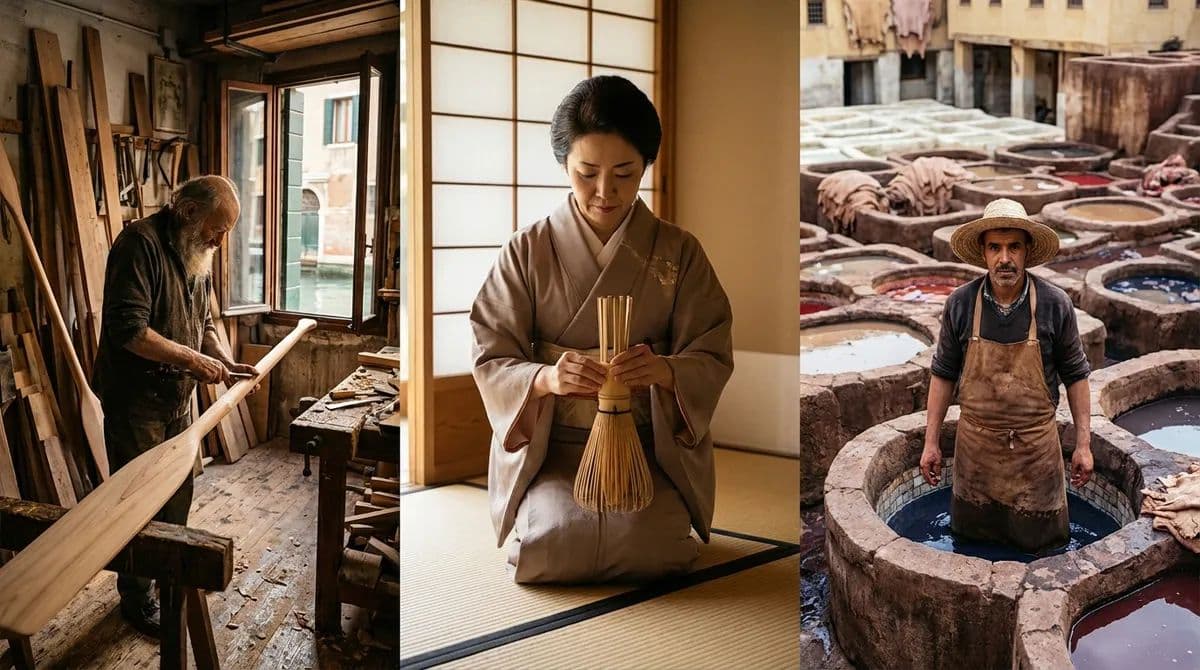
The workshop of Saverio Pastor, one of the last remer -- gondola oar and forcola carvers -- in Venice, occupies a ground-floor space on the Fondamenta Soranzo in Dorsoduro. It smells of walnut shavings and linseed oil and the particular damp of a Venetian building whose foundations have been arguing with the lagoon for four centuries. Pastor works alone, as his predecessors have worked for at least eight generations, shaping the S-curved forcola -- the elaborately sculpted oarlock that allows a gondolier to execute eight different rowing strokes from a single piece of wood -- using hand tools that have not changed in design since the Renaissance.
The traditional crafts travel experience of watching Pastor work is not comfortable. His workshop is cramped, cold in winter, and insufficiently lit by a single window that faces a canal. He does not perform for visitors. He works, and if you are quiet and respectful, he allows you to watch. The forcola emerging from the walnut block does so with agonizing slowness -- each curve tested against a gondolier's body, each surface smoothed to a finish that a museum would envy -- and the process makes visible what mass production has made invisible: the amount of human knowledge, accumulated over centuries, that a single handmade object contains.
Pastor is seventy-one. He has no apprentice. When he stops working, the tradition of remer carving -- which dates to the thirteenth century, when the Venetian Republic regulated it as a distinct guild -- will not exactly die, because a handful of other carvers exist. But it will diminish by one practitioner, one workshop, one particular interpretation of a form that has as many variations as there are carvers. Each remer brings a slightly different aesthetic, a slightly different understanding of the relationship between wood and water, and when a remer retires or dies, that understanding is lost in a way that no YouTube tutorial or museum exhibit can recover.
This is the crisis at the heart of artisan experiences travel: the traditions worth preserving are the ones most likely to disappear, precisely because they are rooted in individual human beings rather than replicable processes.
The Tea Whisk Maker of Takayama
In the hills of Nara Prefecture, Japan, a single village -- Takayama -- produces virtually all of the world's chasen, the hand-carved bamboo tea whisks used in Japanese tea ceremony. The craft is five hundred years old. Eighteen families currently practice it. The youngest practitioner is in his forties.
The chasen is a deceptively simple object: a cylinder of bamboo, split into between sixty and one hundred and twenty fine tines, each tine individually shaped with a small knife and curled inward to create the whisk's distinctive bulb. The splitting is done by hand, by feel, reading the grain of each individual piece of bamboo -- bamboo that has been specifically cultivated, harvested in winter, and cured for two years before carving. The process takes approximately three hours per whisk, and a skilled craftsman produces three to four per day.
What makes the Takayama chasen a cultural immersion experience of particular poignancy is the gap between the object's ubiquity and the tradition's fragility. Tea ceremony is practiced by millions worldwide. The chasen is essential to it. And yet the entire global supply depends on a few dozen people in a single Japanese village, working with hand tools in workshops that have changed less in five centuries than the world around them has changed in five years.
The craftsmen I visited -- Tanimura Tango, a twentieth-generation chasen maker -- demonstrated the splitting technique with a precision that was almost musical: each cut placed by feel, the blade guided by a knowledge of bamboo fiber that was not in his hands but was his hands, a somatic expertise that cannot be transmitted by any means other than years of practice. Watching him work, I understood that the chasen is not merely a tool. It is a fossil record of a particular relationship between a human community and a plant, refined over half a millennium into something that is simultaneously functional, beautiful, and irreplaceable.
Fez: The Tanneries and the Question of Preservation
The Chouara tannery in Fez, Morocco, is one of the oldest continuously operating leather tanneries in the world. The iconic stone vats -- filled with natural dyes of saffron, henna, indigo, and poppy -- have been in use since the eleventh century, and the tanning process, which uses pigeon dung and quicklime instead of modern chemicals, is essentially identical to the process described in medieval Moroccan trade documents.
The tanneries are a major tourist attraction, and this creates an uncomfortable tension. The work is punishing -- the men who stand waist-deep in the dye vats, kneading hides in chemical baths that burn the skin and overwhelm the nostrils, are performing labor that no guidebook's atmospheric prose can romanticize. The traditional crafts travel visitor stands on a balcony above the vats, sprig of mint held to the nose against the smell, photographing men at work in conditions that are, by any contemporary labor standard, medieval in the literal sense.
And yet the tannery workers I spoke with -- through a translator, in the narrow streets outside the medina -- did not want the tanneries to close. They wanted better working conditions, better pay, and the recognition that their trade is a skilled one, not merely manual labor. Several had been offered factory jobs and refused them. The tannery, they said, was part of who they were. Their fathers had worked there, and their grandfathers. The knowledge of how to read a hide -- which areas will take dye and which will resist, how long to soak and when to pull, the thousand micro-judgments that transform raw skin into Moroccan leather -- was a heritage they valued, even when the conditions of practicing it were difficult.
The question of how to preserve a traditional craft without preserving the conditions that make it brutal is one that the cultural immersion experiences industry has not adequately addressed. The answer, if there is one, probably lies in a model closer to Japan's Living National Treasure system, which provides financial support to master craftspeople and recognizes their work as a form of cultural patrimony rather than a market commodity.
Murano: Glass and the Weight of Reputation
The glassmakers of Murano, the island in the Venetian lagoon where glassblowing has been practiced since the thirteenth century, face a different threat than the remer or the chasen maker. Their tradition is not disappearing because no one wants to practice it. It is disappearing because the market has undercut it.
Murano glass is one of the most imitated products in the global craft market. Chinese, Indian, and Eastern European factories produce glass objects marketed as "Murano style" or, in many cases, simply "Murano" -- despite having no connection to the island. The real Murano glassmakers, whose work involves a complexity of technique that takes decades to master, cannot compete on price with factories that replicate the surface appearance of their work without replicating the expertise.
The artisan experiences travel opportunity on Murano is genuine and extraordinary. Watching a maestro vetraio shape a vase from molten glass -- the gather of orange-white material on the end of the blowpipe, the breath that inflates it, the tools and gravity and timing that transform it from a blob into a form of precise beauty -- is one of the great spectacles of human craft. The heat, the speed, the absolute certainty of each movement (you cannot hesitate with molten glass; it cools in seconds) combine to produce something closer to a performance than a manufacturing process.
But the economics are dire. Of the roughly one hundred furnaces that operated on Murano in the 1990s, fewer than thirty remain. The younger generation, facing the choice between years of demanding apprenticeship with uncertain financial returns and the reliable income of a job on the mainland, is largely choosing the mainland. The tradition is sustained by a shrinking cohort of master glassmakers in their fifties and sixties, and the pipeline of successors is thin.
The Shibori Dyers of Arimatsu
Arimatsu, a small town on the old Tokaido road between Nagoya and Kyoto, has been the center of shibori -- the Japanese art of resist-dyeing textiles using binding, stitching, folding, and clamping techniques -- since 1608. The town's founding is precisely documented because the artisan tradition was established deliberately by the lord of Owari Province, who settled a community of dyers there to provide indigo-dyed cloth for travelers on the Tokaido road.
Shibori is one of the most technically diverse textile traditions in the world, encompassing over a hundred distinct binding and stitching patterns, each producing a different design when the fabric is dyed and unbound. The complexity of the higher techniques -- particularly kumo (spiderweb) shibori and nui (stitched) shibori -- requires decades of practice to master, and the precision of the finest shibori cloth is microscopic: individual stitches placed less than a millimeter apart, each one pulling the fabric into a fold that will resist the dye with surgical accuracy.
The artisan experiences travel scene in Arimatsu is modest but deeply rewarding. Several workshops offer demonstrations and, in some cases, hands-on sessions where visitors can try basic binding techniques. The gap between your clumsy first attempt and the master dyer's effortless precision is humbling and instructive -- it makes viscerally clear that this is not a craft you can learn from a book or a video but one that requires the sustained, physical, repetitive practice that only apprenticeship provides.
The shibori tradition of Arimatsu is better positioned than many artisan crafts, partly because of the global fashion industry's periodic interest in shibori techniques (which are cheaper and faster when done by machine, but whose hand-done versions are recognizably superior) and partly because of the Japanese government's support for traditional crafts. But the number of practitioners has still declined steadily, and the average age of the remaining master dyers continues to rise.
Why Visiting Matters
There is a school of thought that says the disappearance of traditional crafts is natural, even inevitable -- that technologies become obsolete, that markets evolve, that sentimentalizing pre-industrial production methods is a form of nostalgia that serves the romantic needs of the tourist more than the practical needs of the craftsperson. This argument has merit. No artisan should be preserved in amber for the benefit of visitors, performing their trade like a living exhibit in a museum of the past.
But the argument misses something crucial: traditional crafts are not technologies. Technologies solve problems, and when better solutions emerge, the old technology rightly becomes obsolete. Crafts solve problems too, but they also embody knowledge -- specific, embodied, place-based knowledge about the relationship between a material and a human hand that cannot be extracted from the practice and preserved in any other form. When the last chasen maker dies, the knowledge of how bamboo fibers behave under a blade, accumulated over five hundred years of daily practice, dies with him. That knowledge is not obsolete. It is irreplaceable.
This is why visiting artisan workshops is not tourism in the conventional sense. It is an act of witness. The traveler who sits in Saverio Pastor's workshop for an afternoon, watching the forcola take shape, is not merely consuming an experience. They are acknowledging that this knowledge exists, that it matters, and that its disappearance would be a loss. The acknowledgment does not, by itself, save the tradition. But it creates the conditions -- the attention, the interest, the economic demand -- under which saving becomes possible.