The Invisible Architecture of Smell: Following Your Nose Through a City

Elena Mori
Writer
You smell Lisbon before you see it. Stepping off the plane at Humberto Delgado airport, before you have cleared customs, before you have glimpsed the red rooftops or the Tagus River or the castle on the hill, the city announces itself through your nose: the warm, caramelized scent of roasting chestnuts that pervades the arrivals hall from the vendor outside the door. It is October, chestnut season, and the smell is so specific, so immediately and unmistakably Lisboan, that returning residents smile at it the way you might smile at a friend's voice on the phone. The smell is the city saying hello. And it is only the first layer of an olfactory architecture as complex, as distinctive, and as culturally revealing as anything you will see or hear in the days ahead. Sensory travel experiences begin, far more often than we acknowledge, with the nose.
Smell is the traveler's most neglected sense and the most powerful. Research in neuroscience has established that olfactory memory is processed differently from visual or auditory memory — smell bypasses the thalamus, the brain's usual sensory relay station, and connects directly to the hippocampus (where memories are formed) and the amygdala (where emotions are processed). This direct neural pathway is why a smell can trigger a memory with an immediacy and emotional intensity that no photograph can match. The scent of incense can transport you to a temple in Kyoto twenty years after you visited it. The smell of diesel and jasmine can return you to a Bangkok evening in a way that looking at photographs of the same evening cannot. Smell does not remind you of a place. It puts you back there.
And yet we travel almost entirely by eye. Guidebooks describe what you will see. Photography records what you saw. Instagram displays what you want others to see. The traveler's nose — that ancient, extraordinary instrument of environmental intelligence — goes largely unused, its data unrecorded, its contribution to the experience of place almost entirely unacknowledged. To experience places through senses beyond vision is to discover a dimension of travel that is simultaneously the most intimate and the most universal: every city has a smell, and every smell has a story.
The Olfactory Map
Every city has an olfactory map — a geography of smells as structured and as navigable as its street grid. The map is not random. It follows the logic of land use, climate, vegetation, industry, cuisine, and the particular history of how the city was built and who has lived in it. Learning to read this map is one of the most rewarding forms of immersive travel without rushing — a practice that requires no equipment, no guide, and no expertise beyond the willingness to pay attention to what your nose is telling you.
Lisbon's olfactory map is organized around its topography. The river neighborhoods — Cais do Sodre, Santos, Alcantara — smell of salt water, diesel, and the particular metallic tang of tidal mud. The Alfama, climbing steeply above the river, smells of grilled sardines (in summer), wood smoke (in winter), and the permanent background scent of damp limestone that gives old stone neighborhoods their characteristic mustiness. The Bairro Alto smells of spilled beer, cigarette smoke, and frying garlic — the olfactory signature of a nightlife district that doubles as a residential neighborhood. And everywhere, penetrating every other layer, the smell of coffee — not the bland, generic smell of commercial roasting but the sharp, almost burnt intensity of Portuguese-roast espresso, which is darker and more pungent than Italian espresso and which escapes from every pastelaria in clouds that can be detected a block away.
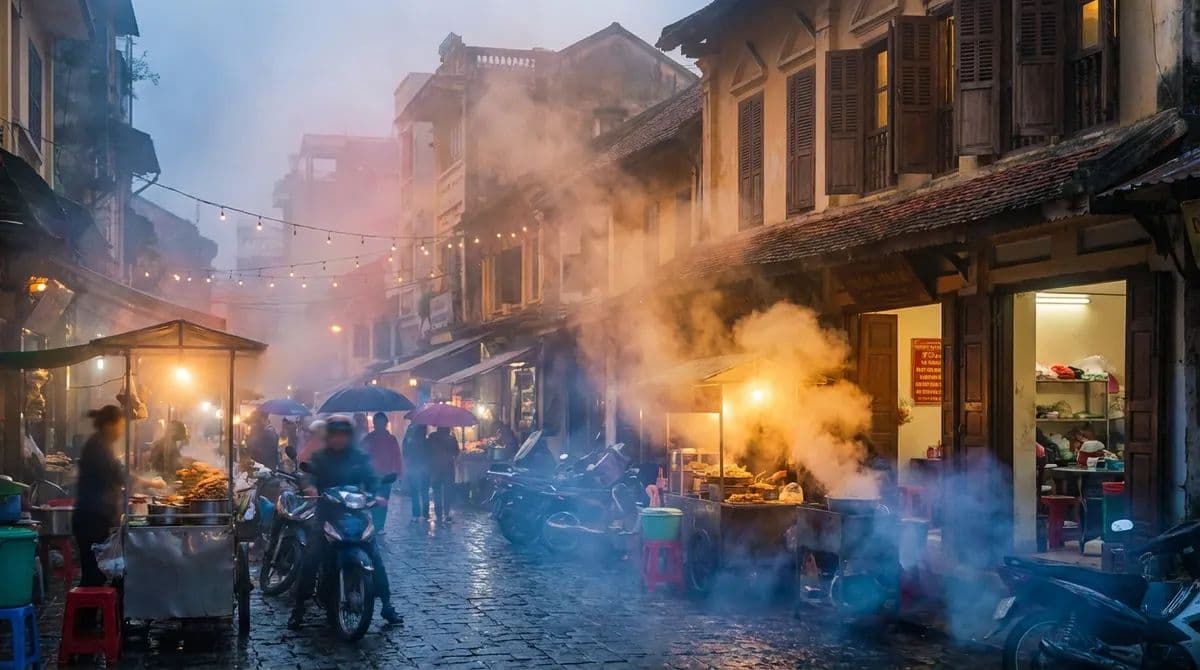
Bangkok's olfactory map is more complex and more confrontational. The city's smells are intense, layered, and constantly shifting, and they operate at a density that can overwhelm the Western nose. The baseline is tropical humidity — a warm, heavy, slightly sweet air that carries every other scent with amplified intensity. Over this baseline, the city layers its specific signals: the jasmine garlands sold at every spirit house and traffic island, filling the exhaust-heavy air with a sweetness that seems almost hallucinatory. The chili and lemongrass and fish sauce of street food, so intense at a night market that the air itself seems edible. The incense from the temples. The diesel from the tuk-tuks. The khlong water — the canals that thread through the old city, their water carrying the accumulated chemistry of ten million people's daily lives. Bangkok does not have a single smell. It has an orchestra, and it plays at full volume.
Why Cities Smell the Way They Do
A city's smell is determined by the same factors that determine its character: climate, geography, industry, cuisine, and history. Tropical cities smell more intensely than temperate ones because heat increases the volatility of organic compounds — the same fruit that is mildly fragrant in a London market is powerfully aromatic in a Kinshasa one. Coastal cities carry the mineral smell of salt water and the biological smell of marine life — the particular iodine-and-seaweed tang that distinguishes Marseille from Munich. Industrial cities carry the chemical signatures of their factories — the rubber smell of Akron, the yeast smell of Milwaukee, the sulfur-and-hops smell of Burton upon Trent.
Cuisine is perhaps the most powerful determinant of urban smell. The cities of India smell of cumin, turmeric, and ghee — the aromatic triad that underlies most North Indian cooking and that escapes from every kitchen, restaurant, and street stall in concentrations that can be detected from a moving train. The cities of Ethiopia smell of berbere spice and injera bread, the sourdough tang of the fermented teff flatbread that accompanies every meal. The cities of Japan smell of dashi — the kelp-and-bonito broth that is the foundation of Japanese cuisine and that gives Japanese streets a faintly oceanic, umami-rich baseline that is subtle but pervasive.
Religion, too, leaves its olfactory mark. The cities of the Catholic Mediterranean smell of incense — frankincense and myrrh, the same resins that have been burned in churches since the earliest centuries of Christianity. The cities of Southeast Asia smell of joss sticks — the sandalwood and agarwood incense that accompanies Buddhist and Hindu worship. The cities of the Middle East smell of oud — the dense, complex fragrance extracted from the resinous heartwood of the Aquilaria tree, burned in homes and shops and mosques as both religious offering and social courtesy.
Beirut: The City of Layered Scents
Beirut is the most olfactorily complex city I have ever entered. The Lebanese capital sits on a narrow coastal plain between the Mediterranean and the mountains of Mount Lebanon, and the geography creates a compression of microclimates and land uses that produces an extraordinarily dense olfactory landscape.
The morning chapter is the bakery chapter. The scent of manoushe — the flatbread spread with za'atar (thyme, sesame, and sumac) and olive oil that is Lebanon's national breakfast — escapes from every neighborhood bakery at 6 a.m. and fills the streets with a warm, herbal, slightly nutty fragrance that is impossible to resist. Alongside the manoushe, the smell of Arabic coffee — cardamom-spiced, brewed strong, served in small cups — drifts from the kitchens and the sidewalk cafes. The combination of za'atar and cardamom is Beirut's morning smell, as specific to the city as the taste of a croissant is to Paris.
By midday, the cedar and pine of the mountain air — carried down the slopes by the afternoon breeze — mixes with the salt air from the sea, and the city smells simultaneously of forest and coast. The spice shops of the old souks contribute their own complex layer: sumac, Aleppo pepper, cinnamon, mahlab, the heavy sweetness of dried roses used in desserts and teas. And in the evening, the smell of grilled meat — kafta, shish taouk, lamb chops — rises from a thousand restaurants and mixes with the jasmine and bougainvillea that climb the walls of the residential streets, producing an olfactory experience so rich and so layered that it functions almost as a form of nourishment in itself.
Tokyo: The Scent of Restraint
If Beirut is olfactory maximalism, Tokyo is olfactory minimalism — a city that has organized its smells with the same precision and restraint that it applies to everything else. Tokyo is, for a city of 14 million people, remarkably low-odor. The streets are clean. The garbage is collected at precise times and sealed in prescribed bags. The public spaces are maintained with an attention to hygiene that borders on the devotional.
But Tokyo is not scentless. It is subtly scented, and the subtlety is the point. The incense shop on a backstreet in Yanaka, where the fragrance of agarwood and sandalwood is detectable from ten meters away but no farther — a controlled, precise aromatic presence that respects the boundary between the shop's space and the public street. The wagashi confectionery, where the seasonal sweets — cherry blossom mochi in spring, chestnut paste in autumn — emit a delicate sweetness that is more suggestion than statement. The hinoki cypress of a shrine's torii gate, releasing its resinous, faintly citrus scent when the sun warms the wood. Tokyo's smells are designed to be noticed, not imposed. They operate at a register that rewards attention and punishes inattention — exactly like the city itself.
How to Follow Your Nose
The practice of olfactory travel requires the same commitment as any other form of attentive exploration: the willingness to slow down, to notice, and to resist the temptation to prioritize the visual. Begin by standing still. Close your eyes. Breathe through your nose, slowly and deeply. Identify the dominant smell — traffic, cooking, vegetation, sea. Then listen for the secondary smells, the ones that emerge when the dominant layer is acknowledged and set aside: the soap from an open laundry, the wood polish from a furniture shop, the particular mineral smell of stone that has been warmed by the sun and is now cooling in the evening.
Walk slowly. Smell changes over short distances, and the olfactory map of a city is fine-grained — a bakery here, a flower shop there, a sewer grate releasing a blast of underground air, a garden whose jasmine can be smelled for an entire block. The nose is faster than the eye at detecting change — you will smell a new neighborhood before you see it — and this speed is one of the pleasures of olfactory travel. The nose is always slightly ahead of you, scouting the territory, reporting back.
Pay attention to weather. Rain transforms a city's smell completely, releasing petrichor — the earthy, clean scent produced by rainwater activating oils in dry soil and stone — and suppressing the usual traffic and cooking smells. Heat amplifies everything. Cold mutes everything. The same street smells different at 8 a.m. and 8 p.m., in July and in January, in sunshine and in rain. The olfactory map is not static. It is a living document, redrawn daily by weather, season, and the rhythms of human activity.