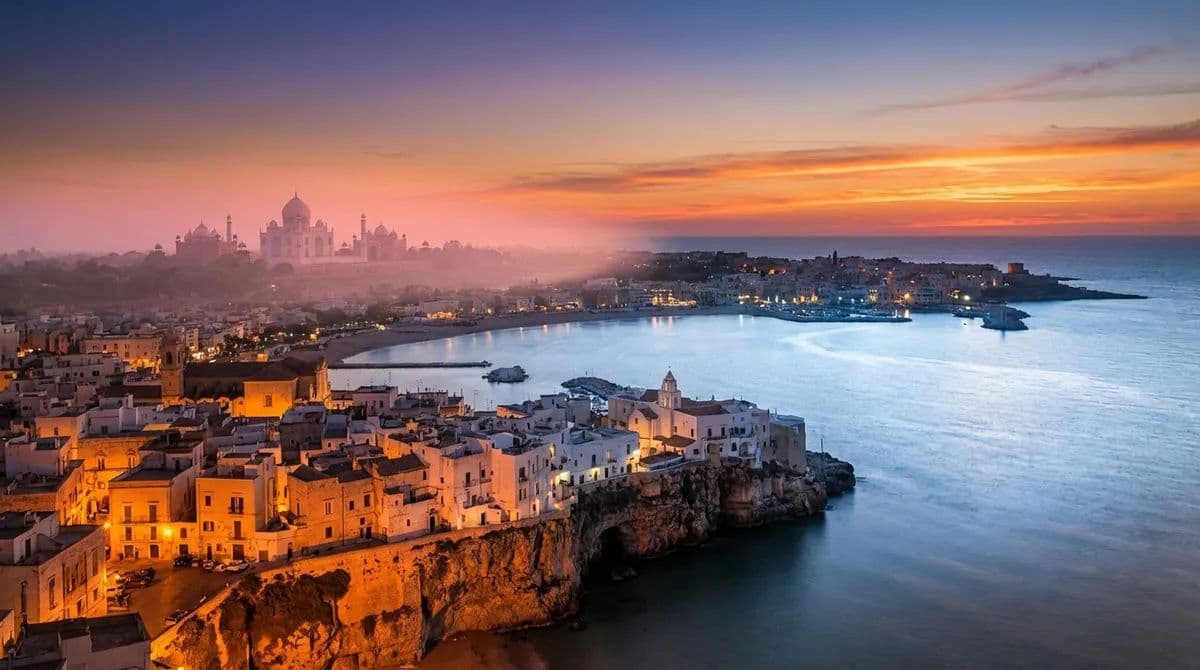
The Golden Hour Everywhere: How Light Defines a Destination

Carmen Ruiz
Writer
The light in Santorini at seven o'clock on a July evening is not yellow. It is not orange. It is a color for which English has no precise word — a warm, saturated amber that stains the whitewashed walls of Oia a shade somewhere between honey and molten copper, and turns the caldera below into a bowl of liquid gold. Photographers call this travel photography golden hour, and they chase it with the dedication of birdwatchers tracking a rare species. But the golden hour is not a photographer's invention. It is a physical phenomenon — the result of sunlight traveling through a greater thickness of atmosphere as the sun approaches the horizon, scattering the shorter blue wavelengths and allowing the longer reds and golds to dominate — and it happens everywhere on earth, twice a day, every day, producing in each location a quality of light so specific that it functions as a kind of atmospheric fingerprint. The light of Santorini at golden hour is not the light of Jaipur at golden hour, which is not the light of Stockholm or Havana or Marrakech. Each place has its own gold, and learning to see it is one of the deepest pleasures of travel.
This is what makes light an atmospheric travel destination in its own right — not a backdrop to the experience, but the experience itself. We plan trips around architecture, food, museums, landscapes. We rarely plan trips around light, though light is the medium through which all of these other things are perceived. A cathedral seen in the flat overcast of a February afternoon and the same cathedral seen in the raking gold of an October sunset are not merely different views. They are different buildings. The light has changed the stone. And the traveler who understands this — who learns to read light the way a sommelier reads wine, noticing the color, the intensity, the direction, the quality — has access to a dimension of place that most visitors walk through without seeing.
The Physics of Gold
The golden hour is not, strictly speaking, an hour. It varies with latitude, season, and atmospheric conditions, lasting anywhere from twenty minutes near the equator to several hours near the poles. The phenomenon begins when the sun is approximately six degrees above the horizon and continues until it sets (or, in the morning, from sunrise until it has climbed six degrees). During this window, the sunlight's path through the atmosphere is longest, and the scattering effect — technically called Rayleigh scattering, the same mechanism that makes the sky blue during the day — shifts the spectrum toward the warm end, filtering out the blues and greens and leaving the reds, oranges, and golds.
But physics alone does not explain why the golden hour light in Santorini differs from the golden hour light in, say, Reykjavik. The local atmosphere contributes its own character. Santorini's light is shaped by the reflection off the sea, the whitewashed buildings that bounce light in every direction, and the volcanic dust that still lingers in the Aegean air from eruptions thousands of years ago — microscopic particles that add a faint warmth to the scattering. Reykjavik's golden hour, by contrast, is cooler, more silver than gold, filtered through the moisture-laden air of the North Atlantic and reflected off glaciers and volcanic rock that absorb rather than reflect. Same physics, different materials, radically different light.
The sense of place in travel is constructed from dozens of sensory inputs, but light is the one that operates beneath conscious awareness. You may not notice the quality of the light in a place until you see a photograph taken there and think: yes, that looks right. That is the color of that city. The ochre warmth of Rome. The crystalline sharpness of Capetown. The milky diffusion of London. These are not poetic descriptions. They are accurate observations about the behavior of photons in specific atmospheric and architectural environments.
Jaipur: The Pink That Moves
Jaipur is called the Pink City, and the name refers to the terracotta-pink sandstone of its old city walls and buildings, painted pink in 1876 to welcome the Prince of Wales. But the pink of Jaipur is not constant. It migrates through the spectrum across the course of a day, and tracking its movement is a masterclass in how light defines a destination.
At dawn, the pink is almost lavender — the buildings catching the first indirect light of a sun still below the horizon, the sky above them a pale rose that deepens as you look toward the east. This is the softest Jaipur, the quietest, the one that the early-rising chai wallahs and yoga practitioners know. By mid-morning, the sun has climbed high enough to light the buildings directly, and the pink becomes a warm terracotta, solid and assertive, the color of the earth from which the stone was quarried. This is the Jaipur of the travel posters: vivid, saturated, definite.
But at golden hour, the pink of Jaipur catches fire. The amber sunlight hits the already-warm stone and amplifies it into something that is no longer pink but a deep, glowing coral — a color so warm it seems to radiate heat of its own. The Hawa Mahal, the Palace of Winds, with its nine hundred and fifty-three small windows arranged in a honeycomb facade, becomes a wall of luminous cells, each window catching the light at a slightly different angle, the whole structure flickering with a warmth that makes it look less like a building and more like a living organism breathing light. Stand across the street at this hour and you understand why the Rajput architects chose this stone: not for its daytime appearance, which is pleasant but not extraordinary, but for what it does at sunset, which is to turn the city into something that resembles a vision.
Stockholm: The Blue Hour Extended
Stockholm's relationship with light is defined by extremes. In midsummer, the sun barely sets — it dips below the horizon for a few hours, producing a prolonged twilight that Swedes call the "white nights," during which the sky never fully darkens and the city is bathed in a perpetual silvery glow. In midwinter, the situation reverses: the sun appears for barely six hours, rising late and setting early, and the golden hour stretches to fill most of the available daylight.
The winter light of Stockholm is the city's best-kept secret. Visitors flock to Stockholm in summer for the long days and the archipelago, but the December light is something rarer and more beautiful — a blue-silver luminosity that persists for hours before and after the brief appearance of the sun. The Swedes call this the "blue hour," and in Stockholm's latitude it is not an hour but a condition, a state of light that occupies most of the December day. The sky is the color of brushed steel. The water of Riddarfjarden reflects it. The buildings of Gamla Stan, the old town, with their ochre and rust facades, glow with a warmth that seems to come from within, as though the architecture is generating its own light against the ambient blue.
This contrast — warm buildings against a cool sky — is what gives Stockholm its winter character. It is a city designed for candlelight, and the Swedish tradition of placing candles in every window during the dark months is not merely decorative. It is a response to the light conditions, a way of inserting warmth into the blue. The cafes of Sodermalm, with their glowing interiors visible through steamed windows, become lanterns in the early-afternoon darkness, and the practice of fika — the ritualized coffee break that is Sweden's contribution to civilized living — takes on an almost liturgical quality in winter, a ceremony of warmth and light conducted against the encroaching dark.
Marrakech: Dust and Gold
The light of Marrakech is the light of dust. Not dirty dust, not pollution, but the fine mineral particulate that drifts into the air from the Atlas Mountains and the Sahara beyond, creating an atmospheric filter that gives the city's light a quality found almost nowhere else on earth. Marrakech does not have a golden hour so much as a golden atmosphere — the dust diffuses the sunlight at all hours, producing a warmth and softness that makes the city look, from any angle and at any time, as though it has been photographed through a filter of hammered gold.
At dawn, the dust catches the first light and distributes it across the city in a wash of pale amber that makes the terracotta walls of the medina glow as though they were still warm from the kiln. The minarets of the mosques — the Koutoubia, the tallest, visible from anywhere in the city — rise into the dusty air like fingers pointing at a sky that is not quite blue but a deep, warm turquoise. By noon, the light is almost white, the dust scattering it so completely that shadows lose their edges and the city takes on a flat, dreamy quality, as though it were a painting executed in a limited palette of sand and ochre and pale blue.
But at sunset, the dust earns its keep. The Djemaa el-Fna, the great central square, fills with smoke from the food stalls and the charcoal grills, and this smoke mixes with the ambient dust to create an atmosphere so thick with golden light that the figures moving through it — the storytellers, the musicians, the snake charmers, the crowds — seem to be wading through liquid amber. The light does not illuminate them. It absorbs them. They become part of the light, figures dissolved into a golden medium, and the square becomes less a place than a condition — a state of luminous chaos that exists nowhere else and that no photograph, however technically excellent, can fully convey, because the light of Marrakech is not only seen. It is felt on the skin, tasted in the air, breathed into the lungs with every inhalation.
Havana: The Decay of Light
Havana's light tells a different story. The city's colonial architecture — the grand facades of the Prado, the crumbling mansions of Centro Habana, the pastel-painted houses of Vedado — was built for a tropical sun, designed with high ceilings, deep overhangs, and interior courtyards that manage the intense Caribbean light. But decades of deferred maintenance have altered the way the buildings interact with light. Paint peels to reveal layers of previous colors. Plaster crumbles to expose brick. Shutters hang at angles that were never intended, letting light into spaces that were designed to be shaded.
The result is a light environment of extraordinary complexity and beauty. In Havana, every surface is a palimpsest of color and texture, and the golden hour light, raking across these surfaces at a low angle, reveals every layer. A wall that appears to be blue is, at golden hour, revealed to be blue over green over pink over bare plaster over brick — a geological cross-section of the building's decorative history, each layer a different decade, each decade a different idea about what color this wall should be. The light is an archaeologist, and the city is its excavation site.
The atmospheric travel quality of Havana is inseparable from this decay. The city's beauty is not in spite of its disrepair but because of it. The crumbling facades scatter light in ways that intact surfaces cannot, producing shadows with soft edges, reflections with irregular textures, and an overall luminosity that is warm, complex, and slightly melancholy — the light of a beautiful thing in the process of being reclaimed by time. At golden hour, this quality intensifies, and the city becomes a meditation on impermanence conducted entirely in color and light.
Learning to See Light
The travelers who love light — who plan arrivals and departures around sunrise and sunset, who choose west-facing hotel rooms, who wake early and stay out late for the sole purpose of watching the way a particular city catches the day's first and last photons — are practicing a form of attention that enriches every other aspect of travel. Once you learn to see light, you cannot unsee it. You notice that the cafe you chose for lunch has a north-facing window that produces a cold, flat light, while the one across the street has a south-facing window that fills the room with warmth. You notice that the museum you visited in the morning has skylights that produce a completely different color on the paintings than the artificial spotlights that take over when clouds cover the sun. You notice, in short, the medium through which all experience is transmitted, and this noticing transforms the experience itself.