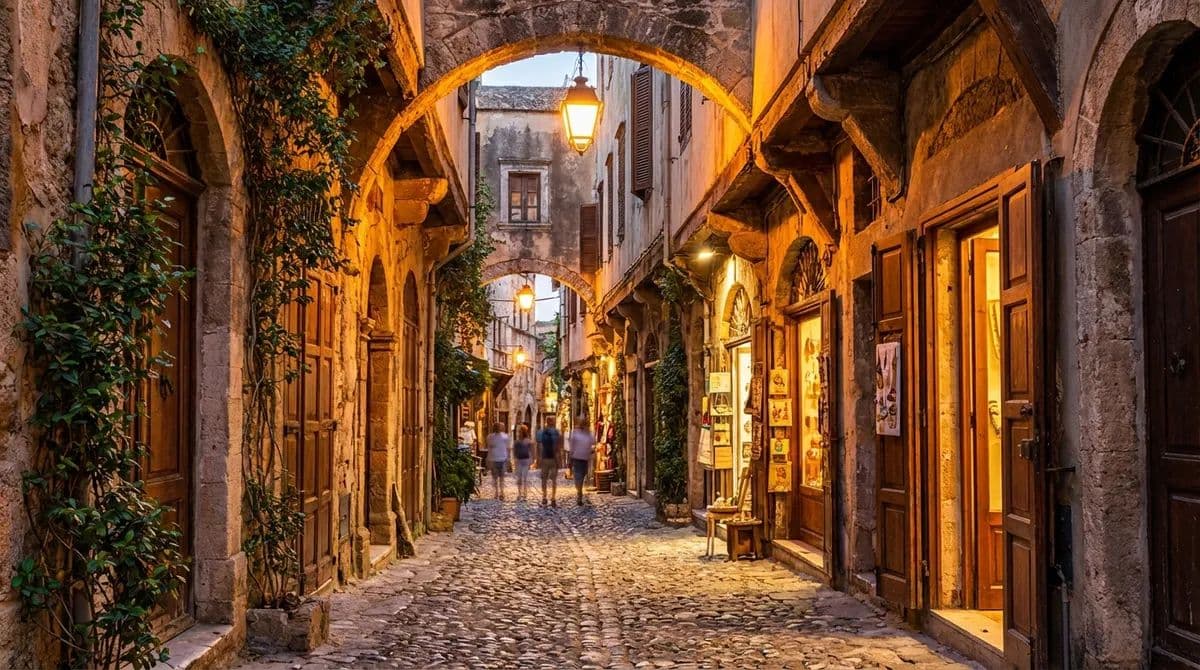
The Geometry of Alleyways: Why the Narrowest Streets Hold the Deepest Stories

Thomas Hardy
Writer
The narrowest street in the medina of Fez is roughly sixty centimeters wide. You can touch both walls simultaneously without extending your arms. The light reaches the ground only at noon, when the sun is directly overhead, and for the rest of the day the street exists in a permanent twilight, the walls so close that they create their own microclimate — cooler in summer, warmer in winter, always smelling of the plaster and cedar and spice and leather that have saturated the stone over nine centuries. A loaded donkey cannot pass through it. A person with a backpack must turn sideways. And yet this street is not a dead end or an afterthought. It is a functioning urban artery, connecting the dyers' quarter to the leather souk, and it has been walked daily for longer than most European nations have existed. This is where hidden gems in travel cities are found — not on the boulevards, not on the promenades, not on the streets wide enough for tour buses, but in the alleyways, the passages, the narrow capillaries of the urban fabric where the city contracts to its most intimate and most essential scale.
The alleyway is the city's original street. Before wheeled traffic, before urban planning, before the Enlightenment imposed its grid and the automobile imposed its width requirements, streets were paths — organic, winding, narrow, shaped by use rather than by design. They followed the contours of the land, curved around obstacles, widened where commerce demanded it and narrowed where it did not. The walking tour off the beaten path, in any city old enough to have one, is a walk into this pre-modern geometry — a return to the human-scaled city that the automobile erased from most of the world but that persists, miraculously, in the alleyways of places that were too old, too dense, or too politically resistant to be demolished and rebuilt.
Why do the narrowest streets hold the deepest stories? The answer is partly practical and partly anthropological. Narrow streets are, by definition, streets that cars cannot enter. And streets that cars cannot enter are streets where pedestrian life — the original, default mode of urban existence — has been preserved. In the alleyway, people walk at human speed. They stop. They talk. They shop at stalls that are within arm's reach. They hear conversations from open windows above. The street is not a transit corridor but a social space, and the social density it generates — the sheer number of human interactions per meter of street — is orders of magnitude higher than anything a four-lane boulevard can produce.
Fez: The City That Refused the Car
The medina of Fez el-Bali — Fez the Old — is the world's largest car-free urban area, home to approximately 150,000 people living in a medieval city that has been continuously inhabited since the ninth century. The city was not designed to exclude cars. It was designed before cars existed, and its streets are simply too narrow, too steep, and too winding to admit them. Motor vehicles stop at the gates. Inside, the only transport is human and animal: pedestrians, donkeys, and the occasional hand-pulled cart.
The result is an urban environment that functions, acoustically and socially, much as it did in the Middle Ages. The souks are organized by trade — coppersmiths in one quarter, leather workers in another, dyers in a third — and the sound of each trade carries through the narrow streets with an intensity that wide streets would dissipate. The rhythmic hammering of the coppersmiths is audible from three streets away. The splash and slap of the dyers wringing fabric can be heard from the adjacent alley. The call of the vendors — each one a practiced, rhythmic chant — echoes off the walls in patterns that change as you move, so that navigating the medina by ear is almost as effective as navigating by sight.
The narrowness of Fez's streets is not incidental to its culture. It is constitutive. The narrow street forces physical proximity. It eliminates the possibility of anonymity. In the medina, you are seen by everyone — by the shopkeepers in their doorways, by the residents on their balconies, by the children playing in the passages. This visibility is a form of social control — the medina has one of the lowest crime rates in Morocco — but it is also a form of community. The narrow street creates the conditions for the kind of dense, face-to-face social life that sociologists associate with strong communities, and that the wide streets and suburban sprawl of modern cities have systematically destroyed.
Venice: Alleyways on Water
Venice's calli — the narrow pedestrian streets that thread between the city's canals — are the European equivalent of Fez's medina streets, and they produce a similar effect: a city experienced at human scale, without the noise, speed, or spatial dominance of motor traffic. The narrowest calle in Venice is the Calletta Varisco, near Campo Santi Apostoli, which measures 53 centimeters at its narrowest point. It is not a tourist attraction. It is a functioning street, used daily by residents who know it as a shortcut between their apartment and the nearest vaporetto stop.
Venice's alleyways are distinguished from those of other cities by their relationship to water. Almost every calle terminates at, or crosses, a canal, and the transition from narrow stone passage to open water — the sudden expansion of space, the change in light, the appearance of the sky — is one of Venice's most distinctive and pleasurable spatial experiences. The calle compresses. The canal releases. And the rhythm of compression and release, repeated hundreds of times in the course of a day's walking, creates a spatial experience that is more complex and more emotionally varied than any city built on a grid can provide.
The stories that Venice's calli hold are stories of a city built on the principle that every square meter matters. In a city with no cars and limited space, the alleyway is not wasted space. It is the connective tissue of urban life — the passage through which everything and everyone must move. The sottoportego, the covered passage that runs through the ground floor of a building, is Venice's most distinctive alleyway feature: a tunnel of stone, often only a few meters long, that connects one campo to another through the interior of a block. Walking through a sottoportego is like walking through a keyhole — a moment of enclosure followed by a moment of opening, the city revealing itself in controlled glimpses that suggest a filmmaker's sense of dramatic pacing.
Beijing's Hutongs: The Disappearing Grid
The hutongs of Beijing are the narrow alleyways that form the traditional residential fabric of the city — a grid of gray-walled, single-story courtyard houses (siheyuan) connected by passages that range from a few meters wide to barely a meter. The hutongs predate the modern city by centuries. Some of them date to the Yuan Dynasty (1271-1368), and their names — often derived from the trades, temples, or features that once occupied them — constitute an oral history of the city: Brick Tower Hutong, Chrysanthemum Lane, Copper Temple Alley.
The hutongs are disappearing. Beijing's explosive development over the past three decades has demolished entire neighborhoods of hutong housing, replacing the single-story courtyard grid with high-rise apartment blocks and commercial developments. The destruction has been controversial and contested. The hutong neighborhoods that remain — concentrated around the Drum Tower and the lakes of Shichahai — are now protected, but their survival is precarious, and the culture they support — the alleyway life of elderly residents playing chess on folding tables, children running between courtyard gates, and vendors selling candied hawthorn from bicycle carts — is under constant pressure from gentrification and development.
Walking the surviving hutongs is an urban exploration travel experience that carries the weight of impermanence. Every hutong you walk may not exist in five years. The narrow alley that connects two courtyard houses may be a parking garage by the time you return. The elderly man who sits in his doorway every afternoon, watching the alley with the proprietary calm of someone who has watched it for sixty years, may be the last person to do so. The hutong's stories are not just deep. They are urgent.
The Ginnels of Northern England
England's contribution to the world's alleyway traditions is the ginnel — a narrow passage, often roofed, that connects two streets or runs between the backs of terraced houses. The word is specific to Northern England (Southern England uses "alley," "twitchel," or "snicket," depending on the county), and the ginnels themselves are specific to the Victorian industrial towns where terraced housing was built in dense, repetitive rows with narrow passages running between them for access, ventilation, and the collection of night soil.
The ginnels of cities like Leeds, Sheffield, Manchester, and York are not beautiful in the conventional sense. They are functional, utilitarian, and often neglected. But they are culturally significant in a way that their ordinariness disguises. The ginnel was the working-class equivalent of the Italian piazza — the social space where children played, where neighbors gossiped, where the daily life of the community unfolded in the narrow gap between the backs of houses. The ginnel was where you hung your washing, stored your coal, kept your outside toilet, and conducted the hundred small transactions of domestic life that the Victorian terrace, with its tiny rooms and thin walls, could not accommodate.
Today, the ginnels are mostly quiet — the social functions they served have migrated indoors and online — but they persist in the fabric of Northern English cities, and walking them is a way of reading the social history of the Industrial Revolution at ground level. The width of a ginnel tells you when it was built (earlier ginnels are narrower). The material of its walls tells you what was being manufactured nearby (brick for general housing, stone for mill workers' terraces). The height of its walls tells you about the privacy expectations of its era. The ginnel is a text, and like all texts, it rewards the reader who brings knowledge and attention.
Why Narrow Streets Matter
The alleyway is not merely a charming remnant of pre-modern urbanism. It is a functioning demonstration of what urban life could be — and, in the places where it survives, still is. The narrow street produces density without high-rises. It produces community without social engineering. It produces commerce without malls. It produces beauty without architects. It does all of this simply by contracting space to the human scale, so that every encounter is close, every sound is audible, and every surface is within reach.
The modern city has largely abandoned the alleyway in favor of the wide street, the setback, the parking lot, and the mall. The consequences are visible in every suburb and every new development: social isolation, car dependence, the death of street life, and the replacement of organic urban texture with planned, sterile, and fundamentally inhuman environments. The alleyway is not the solution to these problems. But it is a reminder that they are not inevitable — that cities were built differently once, and could be again.