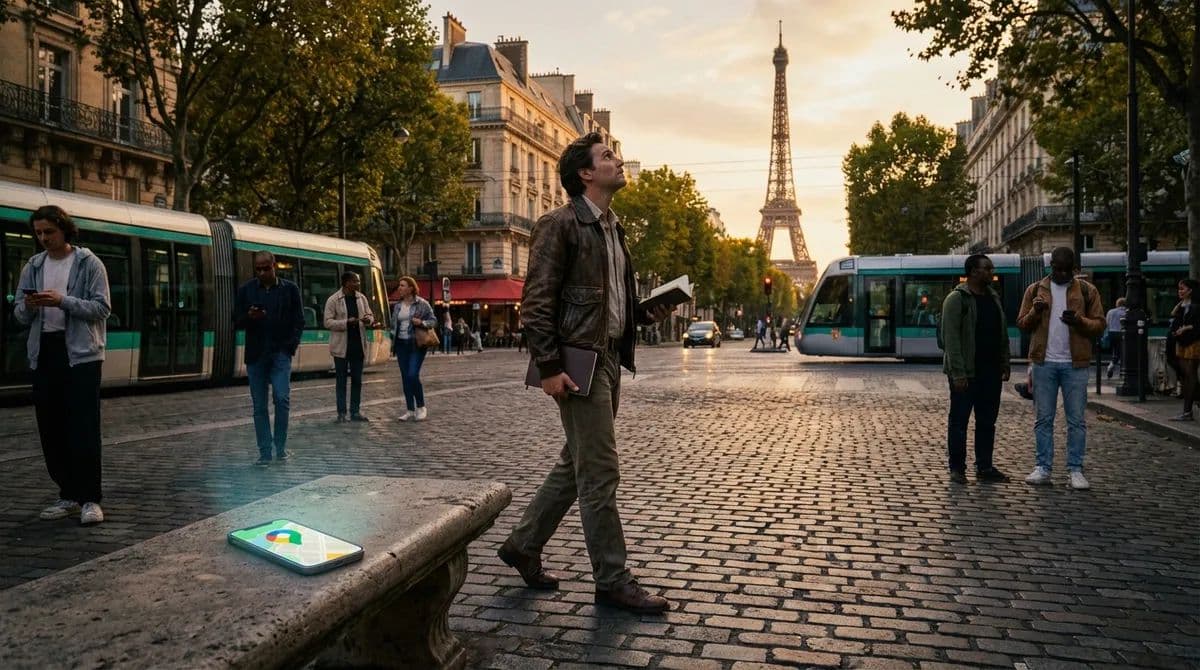
The Flâneur's Return: Walking Without Purpose in the Age of GPS

Ingrid Olsen
Writer
In 1863, Charles Baudelaire described a figure who would haunt the imagination of writers, philosophers, and urban theorists for the next century and a half: the flâneur. The flâneur was a walker, but not an ordinary one. He walked without destination, without schedule, without purpose beyond the act of observation itself. He moved through the arcades and boulevards of Paris as a connoisseur of surfaces, a collector of impressions, a man for whom the city was not a system of routes between points of obligation but a vast, endlessly interesting text to be read at leisure. The flâneur walking experience was, in Baudelaire's telling, the highest form of urban engagement: not the merchant's purposeful stride, not the laborer's weary trudge, but the artist's deliberate, pleasure-seeking drift through the spectacle of modern life.
The flâneur has been declared dead many times. Walter Benjamin, writing in the 1930s, argued that mass consumerism had killed him. The Situationists, in the 1960s, tried to resurrect him as a political agent. Postmodern critics have questioned whether he was ever more than a fantasy of bourgeois privilege. And yet the flâneur persists — not as a historical figure but as an aspiration, a mode of attention that feels more radical in the age of GPS and Google Maps than it ever did in the age of Haussmann's boulevards. How to really experience a city has become, paradoxically, more difficult in an era when every city is exhaustively mapped, reviewed, and algorithmically optimized for efficient consumption. The flâneur's proposition — that the best way to know a city is to walk it without knowing where you are going — is no longer quaint. It is subversive.
The Tyranny of the Blue Dot
The smartphone has transformed urban navigation so completely that it is difficult to remember what walking in a city felt like before it. The blue dot on the screen — your position, updated in real time, moving through a digital map that scrolls to keep you centered — has become the default interface between the pedestrian and the city. And the blue dot, for all its utility, has consequences for the quality of attention you bring to the walk.
The most significant consequence is that the blue dot eliminates the possibility of being lost. And being lost, the psychogeography travel tradition argues, is not a problem to be solved but a condition to be sought. To be lost in a city is to be freed from the tyranny of the route. It is to encounter the city not as a series of destinations connected by efficient paths but as a continuous, undifferentiated field of experience in which every street is equally interesting because you do not know where any of them lead. The lost walker is alert in a way that the navigated walker is not. She notices the texture of the pavement, the quality of the light, the sound of a street musician three blocks away, the smell of bread from an invisible bakery. She is, in Baudelaire's sense, a reader of the city — decoding its signs not for directions but for meaning.
The blue dot short-circuits this process. With the map open, your attention is split between the physical city and its digital representation. You watch the screen to confirm that you are on track. You glance up to verify that the intersection matches. The city becomes a series of checkpoints, and the space between checkpoints — the actual, physical, sensory environment you are walking through — recedes into the background. You arrive at your destination efficiently. You have not experienced the walk. You have merely survived it.
Paris: Walking Where the Arcades Were
The flâneur was born in Paris, and Paris remains the ideal city for his return. The city's structure — the wide boulevards radiating from central nodes, the dense medieval neighborhoods that survived Haussmann's renovations, the covered passages and hidden courtyards — creates a walking environment of extraordinary variety and surprise. A wrong turn in the Marais reveals a seventeenth-century courtyard garden. A passage off the Grands Boulevards leads to a vaulted arcade lined with antiquarian bookshops and stamp dealers. The city rewards the walker who does not know where she is going with discoveries that the navigated walker, following the blue dot to the next reviewed restaurant, will never find.
The practice of psychogeography — a term coined by Guy Debord in 1955 to describe "the study of the specific effects of the geographical environment on the emotions and behavior of individuals" — was developed as a tool for this kind of purposeless exploration. The Situationists' technique of the derive, or "drift," prescribed walking through a city guided not by maps or destinations but by the emotional pull of the environment itself. Turn left because the street looks interesting. Cross the boulevard because something on the other side catches your ear. Follow the sound of music, the smell of coffee, the quality of light in a particular passage. The derive is navigation by feeling, and its product is not a route but an emotional map — a record of how the city felt rather than how it looked.
In Paris, the derive is still practiced by a small but devoted community of psychogeographers, and the city's architecture continues to support it. The covered passages — the Passage des Panoramas, the Galerie Vivienne, the Passage du Grand Cerf — are the original arcades that inspired Benjamin's unfinished masterwork, and walking through them today feels like walking through the flâneur's own century: the gaslight replaced by electricity, the top hats by hoodies, but the fundamental experience of enclosed, intimate, commercially charged space preserved almost intact.
Berlin: The City That Invites Getting Lost
If Paris is the flâneur's birthplace, Berlin is his playground. The city's history of division and reunification has created an urban fabric full of gaps, contradictions, and abrupt transitions that make purposeful navigation feel almost beside the point. A walk through Berlin is a walk through ideological strata: Prussian formality gives way to Weimar-era expressionism, which gives way to Nazi monumentality, which gives way to Cold War division, which gives way to post-reunification improvisation. The transitions are not gradual. They are sudden, jarring, and endlessly interesting.
The former path of the Berlin Wall is the city's most powerful psychogeographic line. Walking it — not as a tourist following the marked memorial trail, but as a flâneur following the line where it is unmarked, where it passes through neighborhoods that have been rebuilt and in some cases completely transformed — is an exercise in reading absence. The wall is gone. But its trace persists in the width of certain streets, the age of certain buildings, the sudden change in architectural style that marks the border between what was East and what was West. The city has healed, but the scar is legible to anyone who walks slowly enough to read it.
Melbourne: The Laneway Labyrinth
Melbourne's contribution to the flâneur tradition is its laneways — the narrow alleys and back passages that riddle the central business district like capillaries through muscle. The laneways were originally service corridors for the city's Victorian-era buildings, designed for deliveries and waste removal. In the 1990s, they began to be colonized by cafes, bars, galleries, and street artists, and today they constitute an alternative city within the city — a hidden network of social and cultural activity that is almost invisible from the main streets.
The laneways are the opposite of the blue dot. They resist navigation. They are too narrow for Google's Street View cars. Many of them are unnamed, or named only by the locals who use them. They branch and dead-end and reconnect in patterns that no map represents accurately. Walking Melbourne's laneways is, by necessity, an exercise in psychogeography: you go where the passage takes you, you discover what you discover, and the experience is different every time because the laneways themselves are constantly changing — new cafes opening, new murals appearing, old spaces transforming into something that did not exist the week before.
Mexico City: The Derive at Altitude
Mexico City, at 2,240 meters above sea level, is one of the world's great walking cities — not despite its size (it is home to over 21 million people) but because of the density and variety of its neighborhoods. A derive through the Roma and Condesa neighborhoods — the adjacent, tree-lined districts that constitute Mexico City's most walkable zone — passes through art-deco apartment buildings, public parks filled with free-ranging squirrels, corner taco stands that are open from 6 a.m. to midnight, independent bookshops, and the occasional architectural anomaly: a Brutalist apartment block beside a Porfirian mansion beside a contemporary glass cube.
The Mexico City derive teaches something that the Paris derive also teaches: that psychogeography is not an intellectual exercise but a sensory one. The flâneur does not analyze the city. He absorbs it. He lets it in through all the senses — the smell of fresh tortillas from a comal on the corner, the sound of organ grinders in the park, the particular quality of light that the altitude and the pollution combine to produce: a soft, golden haze that makes the city look, in the late afternoon, like a nineteenth-century painting of itself.
How to Walk Without Purpose
The practice of flânerie requires no training, no equipment, and no special knowledge. It requires only the willingness to do something that the modern city, with its maps and apps and algorithmic recommendations, actively discourages: to walk without knowing where you are going, and to treat that not-knowing not as a problem but as a gift.
Begin by turning off the phone. Not silencing it — turning it off, or leaving it in your bag. The blue dot is the enemy of the drift. Without it, you will feel a brief anxiety — the vertigo of unlocated-ness that is, in the twenty-first century, almost indistinguishable from the feeling of being lost. Sit with that anxiety. It will pass. And when it does, you will find that the city, which had been a series of routes between known destinations, has become something larger, more mysterious, and more interesting: a place you do not know, and therefore a place that can surprise you.
Walk slowly. Slower than you think. The flâneur does not stride. He ambles. He pauses. He stands at corners and looks. He enters shops he did not intend to enter and leaves by doors he did not know existed. His pace is determined not by his schedule but by the city's invitation — the interesting facade that demands a longer look, the sound from a courtyard that demands investigation, the alley that seems to lead nowhere and therefore demands following.