The Fado Singer's Lisbon

Thomas Hardy
Writer
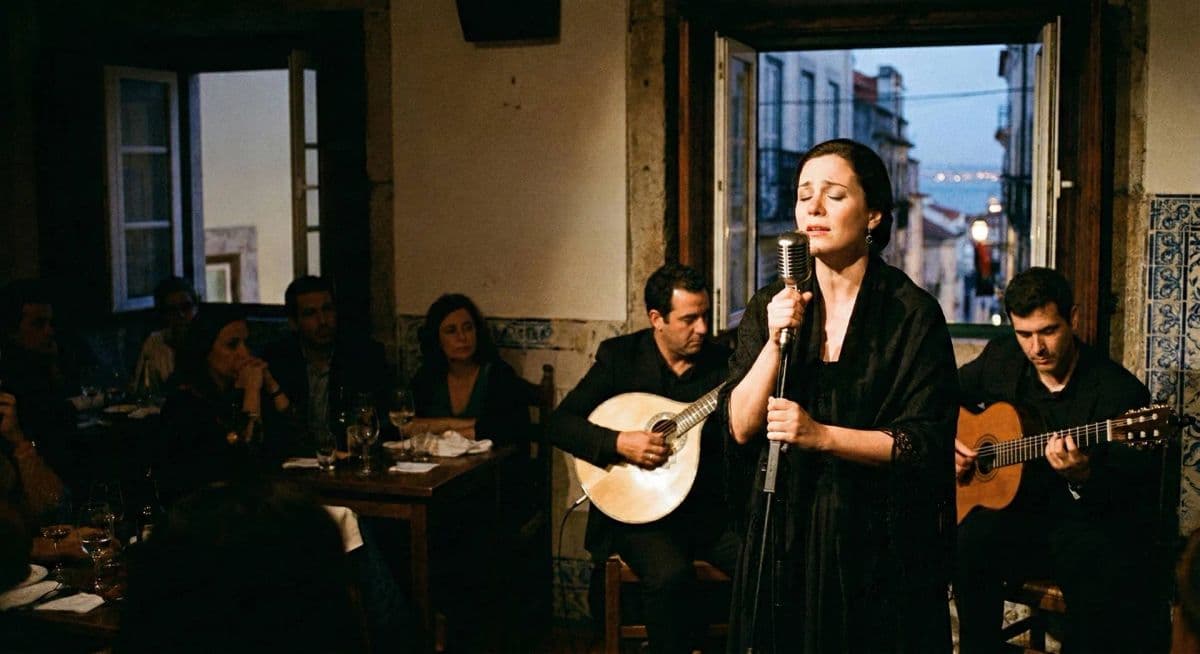
The singer closes her eyes. The room — a casa de fado in the Alfama, Lisbon's oldest quarter — closes its mouth. There are perhaps forty people seated at small tables in a space designed for thirty, their dinners half-eaten, their wine glasses half-full, their conversations abandoned mid-sentence at the first note of the Portuguese guitar. The guitarra portuguesa has twelve strings arranged in six courses, and its sound — bright, metallic, liquid, aching — is one of the most immediately recognisable instrumental voices in world music. It does not strum. It trembles. The notes arrive in rapid succession, each one distinct, each one decaying into the next, like drops of water falling into a still pool, each creating its own ripple before the next drop arrives. The singer waits for the guitar to establish the mood — the key, the tempo, the emotional weather — and then she begins, and the room becomes a church.
Fado means fate. The word comes from the Latin fatum, and the music that carries the name is, at its core, a music of acceptance — acceptance of loss, of longing, of the distance between what is desired and what is possible. The Portuguese have a word for this feeling: saudade, a term that has no precise English equivalent and that is often described as a longing for something absent, a nostalgia for something that may never have existed, a sweet sadness that is not quite grief and not quite joy but something in between — the emotional state that arises when you love something you cannot have or have lost something you cannot replace. Saudade is the soul of fado, and fado is the soul of Lisbon, and to understand either one, you must come to the Alfama at night and sit in a small room and listen.
The Geography of Fado
Fado is not merely a Lisbon music. It is an Alfama music — rooted in the specific geography, history, and social fabric of the neighborhood that clings to the hillside between the Castelo de Sao Jorge and the Tagus River. The Alfama is Lisbon's oldest district, a labyrinth of narrow alleys, steep stairways, and small squares that survived the great earthquake of 1755 because it is built on bedrock rather than the alluvial soil that collapsed beneath the rest of the city. The Alfama is pre-earthquake Lisbon — Moorish Lisbon, medieval Lisbon — and its streets, too narrow for cars, too steep for bicycles, too winding for efficient navigation, create a geography of intimacy that is essential to fado's character.
Fado emerged in the Alfama in the early nineteenth century, in the taverns and boarding houses of a neighborhood that was, at the time, one of Lisbon's poorest and most marginal. The music's origins are debated — some scholars trace it to the Moorish occupation, others to the lundum, a Brazilian dance brought to Lisbon by returning colonists, others to the troubadour traditions of medieval Portugal — but its social context is clear. Fado was the music of the poor, the displaced, the heartbroken, and the homesick. It was the music of sailors' wives waiting for ships that might not return. It was the music of emigrants who had left for Brazil or Africa and who sang of the Lisbon they carried in their memories. It was the music of the neighborhood itself — its gossip, its tragedies, its love affairs, its grudges — set to a melody that made the particular universal.
The casas de fado — the fado houses — are the music's natural habitat. A casa de fado is not a concert hall. It is a restaurant, typically small, typically in the Alfama or the adjacent neighborhoods of Mouraria and Bairro Alto, where fado is performed after dinner in conditions of enforced intimacy and enforced silence. The silence is not optional. When a fadista sings, conversation stops. Cutlery is set down. Phones are put away. The room contracts to the dimensions of the voice and the guitar, and the audience — locals and tourists together — participates in a collective act of listening that is closer to a ritual than to entertainment.
The Casas de Fado: Where to Listen
The fado houses of Lisbon range from the famous to the hidden, and the quality of the experience is not always correlated with the fame of the venue. The most celebrated houses — A Severa on Rua das Gaveas, named after the legendary nineteenth-century fadista Maria Severa; Clube de Fado on Rua de Sao Joao da Praca; Mesa de Frades in a converted chapel on Rua dos Remedios — offer polished performances by professional fadistas, often accompanied by excellent food and wine, in settings that are atmospheric and well-maintained. These houses are expensive and often require reservations, and the audience is predominantly tourist, but the quality of the musicianship is high and the experience is genuine.
For something rawer, you must look further. Tasca do Chico, a tiny bar in the Bairro Alto, hosts fado vadio — amateur fado nights — where anyone can sing. The bar is too small, the tables are too close, the wine is cheap, and the singers are ordinary people — a taxi driver, a shop assistant, a retired fisherman — who have been singing fado since childhood and who bring to their performances a quality of personal investment that professional fadistas, for all their technical superiority, do not always match. When the taxi driver sings a fado about a man who lost his wife to illness and his son to emigration, and his voice cracks on the high note, and the room goes completely still, you understand something about fado that no professional performance can teach you: that the music is not about the quality of the voice. It is about the truth of the feeling.
In Mouraria — the neighborhood adjacent to the Alfama, historically the Moorish quarter — the fado tradition is, if anything, even more deeply rooted. Mouraria is where fado was born, and the neighborhood's fado houses — Maria da Mouraria, Tasco da Pipa — preserve a style of fado that is less polished and more gritty than the Alfama version. The fadistas here sing with an intensity that can be uncomfortable, their voices pushed to the edge of their range, their faces contorted with the effort of expressing emotions that are too large for the small rooms in which they are expressed.
The Guitarra and the Viola
Fado is accompanied by two instruments: the guitarra portuguesa, a twelve-string instrument descended from the English guitar of the eighteenth century, and the viola, a standard six-string classical guitar. The guitarra plays the melody and the ornamentation — the rapid tremolos and arpeggios that give fado its distinctive shimmering sound — while the viola provides the harmonic and rhythmic foundation. The two instruments together create a sound that is at once sparse and rich, the guitarra's brightness floating above the viola's warmth like silver on velvet.
The guitarristas — the guitarra players — are fado's unsung heroes. While the fadista commands the room's attention with voice and presence, the guitarrista creates the musical landscape in which the voice operates. A great guitarrista — and Lisbon has produced many, from Armandinho to Carlos Paredes to the contemporary master Ricardo Rocha — can make the guitarra sound like water, like wind, like light, like the thing that saudade would sound like if saudade had a sound. The instrument's twelve strings, arranged in six courses of two, produce a natural chorus effect that gives every note a slight shimmer, a doubling that makes the sound seem to come from two places at once — from the instrument and from somewhere behind the instrument, as though the music is being echoed by the room itself.
Amalia and After
The history of fado in the twentieth century is, to a large extent, the history of one woman: Amalia Rodrigues, who was born in Lisbon in 1920, who began singing fado in the casas de fado of the Alfama as a teenager, and who, over a career that spanned six decades, transformed fado from a neighborhood tradition into a world music. Amalia's voice was extraordinary — a deep, dark contralto with a vibrato that could widen to a full tone and a capacity for expressing anguish that was not performed but felt, a distinction that is central to fado aesthetics.
Amalia's relationship with the Salazar dictatorship — the Estado Novo that ruled Portugal from 1933 to 1974 — complicated her legacy. The regime promoted fado as a symbol of Portuguese identity, and Amalia, as fado's greatest star, was inevitably associated with the regime's cultural project. After the Carnation Revolution of 1974, fado fell out of fashion — tainted, in the minds of many Portuguese, by its association with the dictatorship and its conservative values. For two decades, fado was regarded by younger Portuguese as their parents' music — reactionary, sentimental, and backward-looking.
The revival began in the 1990s, led by a generation of fadistas who were young enough to be free of the dictatorship's shadow and educated enough to reimagine the tradition without abandoning it. Mariza, born in Mozambique and raised in the Mouraria, brought a vocal power and a stage presence that made fado exciting in a way it had not been since Amalia's youth. Ana Moura introduced elements of pop and world music without diluting the essential saudade. Camane, the finest male fadista of his generation, demonstrated that the male voice — deeper, rougher, less immediately beautiful than the female — could carry fado's emotional weight with equal authority.
And then came Carminho, who is perhaps the most complete fadista of the current generation — a singer whose voice combines Amalia's darkness with a lighter, more agile quality, and whose choice of material ranges from traditional fado to original compositions that push the form's boundaries while remaining unmistakably within its tradition. Carminho performs regularly in Lisbon, and to hear her in a small casa de fado — her voice filling a room that holds forty people, her eyes closed, her hands gripping the microphone stand as though it were the only thing preventing her from falling — is to understand why fado has survived every attempt to kill it and why it will survive every attempt to preserve it. The music does not need preservation. It needs only a voice, a guitar, and a room small enough that the sound cannot escape.
Walking Fado's Lisbon
To walk fado's Lisbon is to walk the Alfama, the Mouraria, and the Bairro Alto — the three neighborhoods that form the fado triangle. The walk begins at the Feira da Ladra, the flea market at the top of the Alfama, and descends through streets that are sometimes steps and sometimes ramps and sometimes merely paths worn into the hillside by centuries of feet. The buildings are old, their facades tiled in azulejos — the painted ceramic tiles that are Lisbon's most distinctive architectural element — in patterns of blue and white and yellow that brighten even the narrowest alley.
The sounds of the Alfama are fado's raw material. The clatter of dishes from an open kitchen window. The call of a vendor selling cherries from a cart. The screech of a tram — the famous number 28, which threads through the Alfama's streets with a clearance of centimeters on either side — as it rounds a corner so tight that the sound of its wheels on the rails becomes a sustained, metallic cry. The murmur of television through an open door. The barking of a dog. The laughter of children playing in a square the size of a living room. These are the sounds that fado absorbs and transforms — the ordinary noises of a neighborhood that has been making music out of its daily life for two hundred years.
The walk passes the birthplace of Amalia Rodrigues on Rua de Sao Tiago. It passes the Museu do Fado on Largo do Chafariz de Dentro, where the history of the music is documented with recordings, photographs, instruments, and the black shawl that Amalia wore on stage. It passes the Panteao Nacional, where Amalia is buried alongside Portugal's kings and heroes — a recognition of fado's status as national heritage that would have been unthinkable in the years immediately after the revolution.