The Dish That Stayed: How One Recipe Survives Empires

Ingrid Olsen
Writer
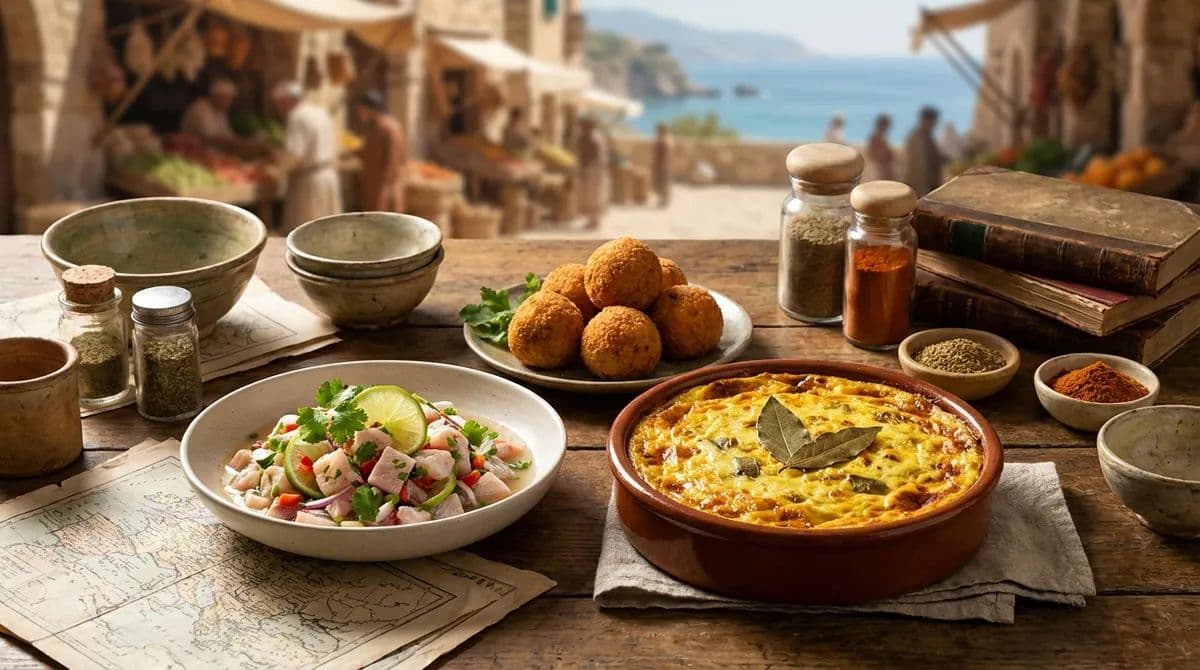
Consider the arancini. A ball of rice, stuffed with ragu and peas, coated in breadcrumbs, and deep-fried until the exterior achieves a golden shell that shatters under your teeth to reveal the soft, savory interior. You can buy one for a euro at any bar in Palermo, eaten standing at the counter with a paper napkin, consumed in four bites between appointments. It is a snack. It is fast food. It is also, if you know how to read it, a compressed history of every civilization that has occupied Sicily for the last twelve hundred years — Arab, Norman, Spanish, French — each one leaving a fingerprint in the recipe that the next empire did not bother to erase. Stories behind traditional recipes are always, at their deepest level, stories about survival: not the survival of people, but the survival of flavor in the face of everything that should have destroyed it.
This is the mystery at the heart of culinary heritage travel. Empires fall. Languages are suppressed. Religions are imposed and then replaced. But the dish stays. It adapts, absorbs, camouflages itself, drops an ingredient when that ingredient becomes unavailable, picks up a new one when a new trade route opens — and yet remains, in some essential way, recognizable. The arancini your grandmother made and the arancini you buy at the airport are separated by decades and vast differences in context, but the gesture — rice, filling, fry — persists. Something in the recipe is more durable than the civilization that created it.
The Arab Gift
The arancini begins with rice, and rice begins, in Sicily, with the Arabs. The Aghlabid dynasty conquered Sicily in 827 AD and held it for over two centuries, during which they transformed the island's agriculture, introducing irrigation systems, citrus orchards, sugarcane, and — crucially — rice cultivation. The Arabic name for the little orange (naranj) likely gives arancini its name: the fried rice balls, golden and round, were said to resemble small oranges, the same oranges the Arabs had planted in the gardens of Palermo.
But the Arab contribution to arancini goes deeper than the rice and the name. The concept of enclosing a savory filling inside a starch shell and frying it is a technique that runs throughout the medieval Arab culinary tradition. Sanbusak, the filled pastries documented in tenth-century Abbasid cookbooks, use the same structural logic: an outer layer that protects and conceals an inner layer, a food designed to be portable, self-contained, and eaten without utensils. The Arabs did not invent frying, but they refined it into an art, and when they brought that art to Sicily, they planted the technical seed from which arancini would eventually grow.
The Arab period also established saffron in Sicilian cooking — the golden color of a proper arancino comes from saffron-tinted rice, another inheritance so deeply embedded that most Sicilians do not think of it as foreign. And the spice trade connections that the Arabs maintained with India and Southeast Asia introduced flavors and techniques that filtered into Sicilian cuisine so gradually that their origins became invisible. The food history of travel through Sicily is, in this sense, a food history of the entire medieval Mediterranean: every flavor is a footnote to a trade route.
The Norman Appetite
The Normans conquered Sicily from the Arabs in 1061, and their contribution to arancini is the ragu — the slow-cooked meat sauce that became the standard filling for the eastern Sicilian version of the dish. (In Palermo, arancini are round and often filled with ragu; in Catania, they are cone-shaped and may contain a wider variety of fillings. The shape debate is a matter of intense regional pride that no outsider should attempt to adjudicate.)
The Norman ragu reflects a Northern European sensibility grafted onto a Mediterranean kitchen. The long, slow cooking of meat in wine — a technique the Normans brought from France — merged with the existing Arab infrastructure of spices and aromatics to produce a sauce that is neither wholly French nor wholly Arab but irreducibly Sicilian. The Normans also brought a taste for cheese that transformed Sicilian dairy production, and the mozzarella or caciocavallo that melts inside an arancino is another layer in this geological sandwich of culinary influence.
What is remarkable about the Norman period is not that the conquerors imposed their food culture — all conquerors do that — but that the existing Arab culinary framework was so robust that it absorbed the Norman additions without losing its own character. The rice remained. The frying remained. The saffron remained. The ragu was added as a new filling, a new interior, but the structure — the Arab structure of starch enclosing flavor — remained intact. The dish survived its first conquest.
The Spanish Centuries
Spanish rule over Sicily, beginning in the late thirteenth century and lasting in various forms until the eighteenth, introduced the tomato — which arrived in Europe from the Americas via Spain and fundamentally altered the flavor profile of Sicilian cuisine. The ragu inside the arancino became a tomato-based ragu, red and rich, and the culinary heritage of the dish acquired yet another continental fingerprint. A recipe that had begun with Arab rice and Norman meat now carried the New World inside it, wrapped in breadcrumbs that themselves reflected the wheat culture of the Mediterranean, fried in olive oil that the Greeks had introduced to Sicily a thousand years before the Arabs arrived.
The Spanish also consolidated the culture of street food that makes arancini what they are today. The institution of the friggitoria — the fry shop, the street-corner establishment where working people could buy a hot, filling meal for a few coins — flourished under Spanish commercial influence, and arancini became a staple of this urban food economy. The dish that had begun as something elaborate enough to appear in aristocratic cookbooks became, under Spanish commercial pressure, a democratic food, available to anyone with a coin and a hunger.
This downward migration — from elite tables to street corners — is a pattern that repeats across culinary heritage travel. Many of the foods we now consider humble street food began as aristocratic or ceremonial dishes that gradually democratized as ingredients became cheaper, techniques became simpler, and the economic pressures of feeding urban populations transformed elaborate recipes into portable, affordable versions of themselves. The arancino at the Palermo bar counter is the endpoint of this journey: a dish that has been simplified, economized, and democratized over centuries without losing its essential character.
Ceviche: The Pacific Argument
On the other side of the world, a similar drama of culinary persistence plays out in a bowl of ceviche. The dish — raw fish cured in citrus juice, seasoned with chili, onion, and cilantro — is claimed by Peru as a national treasure, but its origins are the subject of a debate that spans continents and centuries.
The pre-Columbian Moche civilization, which flourished on Peru's northern coast around 200 AD, consumed fish marinated in the juice of tumbo, a tart local fruit. When the Spanish arrived in the sixteenth century, they brought limes from the Arab-influenced orchards of Andalusia — the same citrus circuit that connects Kerala's spice trade to the Mediterranean — and the lime replaced tumbo as the curing agent. The onion came from Spain. The chili was already there, domesticated in the Americas thousands of years earlier. The cilantro arrived with the Spanish but may have been reinforced by Chinese immigrants who came to Peru in the nineteenth century and whose culinary influence is visible throughout Peruvian cuisine in the tradition known as chifa.
Each layer of influence altered the dish without destroying it. The fundamental gesture — raw fish, acid, heat from chili — persisted through every change of empire, every wave of immigration, every introduction of a new ingredient. Modern Peruvian ceviche, with its leche de tigre (the citrus-chili marinade, now often augmented with fish stock and ginger), is a document of five hundred years of cultural collision, readable in a single bite. The stories behind traditional recipes are never simple, and ceviche's story is a reminder that "authenticity" is not a fixed point but a moving target, a flavor that is always in the process of becoming.
Bobotie: The Cape of Many Kitchens
South African bobotie — a baked dish of spiced minced meat topped with an egg-and-milk custard — is perhaps the most explicit example of a recipe that carries the DNA of every culture that touched it. The dish's name likely derives from the Indonesian word "bobotok," a reference to the Cape Malay community whose ancestors were brought to the Cape Colony as slaves and political exiles by the Dutch East India Company in the seventeenth and eighteenth centuries.
The spice profile of bobotie — turmeric, cumin, coriander, curry leaves, and a distinctive sweetness from dried fruit — reflects the Cape Malay community's Indonesian and Indian Ocean heritage. The custard topping is Dutch, a colonial contribution that transformed what was essentially a Southeast Asian curry into something distinctly South African. The dried fruit — raisins, apricots — suggests a connection to the Cape's Huguenot wine-farming communities, French Protestants who fled religious persecution and brought with them a taste for combining sweet and savory that is a hallmark of both French provincial and Cape Dutch cooking.
But the most poignant ingredient in bobotie is the one you cannot taste: the history of displacement that brought these flavors together. The Cape Malay community did not choose to come to South Africa. They were brought in chains, and the food they created in the Cape was an act of cultural preservation under conditions of extreme duress. The spices they used — carried in memory rather than in luggage — connected them to homelands they would never see again. Bobotie is, in this sense, not just a recipe but a form of resistance, a refusal to let the experience of enslavement erase the experience of flavor.
Food history travel, when it is honest, does not shy away from these darker currents. The stories behind traditional recipes are often stories of power, displacement, and the unequal exchanges that characterize colonial history. But they are also stories of resilience — of communities that preserved their culinary identities despite every pressure to assimilate, and of dishes that absorbed influence from every direction without losing their essential character.
Why Dishes Survive
The question of why certain dishes survive while empires crumble is, in the end, a question about the nature of cultural memory. Written records can be burned. Languages can be suppressed. Religions can be outlawed. But a recipe, encoded in the muscle memory of a grandmother's hands, transmitted through the act of cooking together, reinforced every time a child watches a parent and learns without being taught — this is a form of knowledge that is extraordinarily difficult to destroy. It lives in the body, not the archive. It is practiced, not read. And because it is tied to the most fundamental human act — eating — it is renewed every day, every meal, every time someone stands at a stove and performs the ancient sequence of gestures that turns raw ingredients into something that nourishes.
The arancino in Palermo, the ceviche in Lima, the bobotie in Cape Town — each of these dishes is a survivor. Each carries within it the compressed history of every culture that contributed an ingredient, a technique, a flavor. And each, when eaten with attention and curiosity, offers a form of time travel that no museum can replicate: the taste of the past, still alive, still evolving, still absorbing whatever the present brings and incorporating it into a recipe that has been accommodating change for centuries.