The Desert Teaches Patience: Listening to Silence in the Sahara

Thomas Hardy
Writer
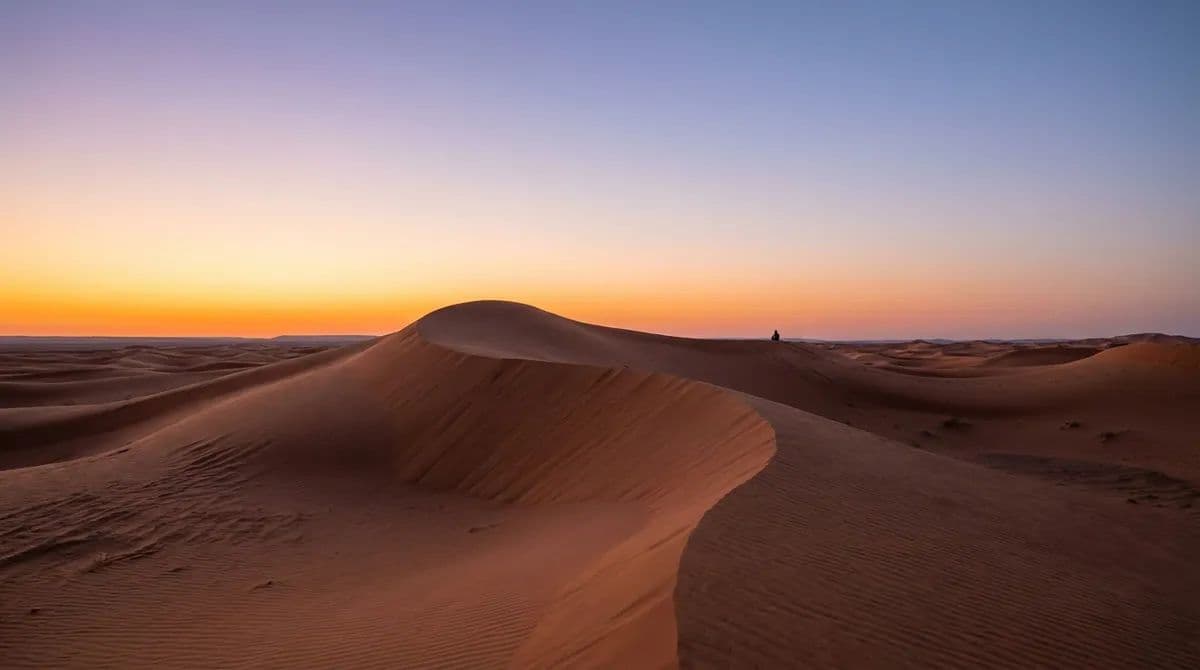
The first thing the desert teaches you is that silence is not the absence of sound. It is the presence of everything sound normally conceals. In a quiet travel destination like the Erg Chebbi dunes of southeastern Morocco, where the nearest paved road is fifteen kilometers away and the nearest city is a full day's drive, you discover sounds you did not know you had been making: the rush of blood in your ears, the mechanical click of your eyelids blinking, the faint high-pitched whine that your nervous system produces when there is nothing else to hear. The desert does not give you silence. It gives you yourself, stripped of the acoustic camouflage that civilization provides.
I spent three nights in the Erg Chebbi, sleeping on the sand in a camp that had no electricity, no running water, and no sound source louder than the occasional snort of a camel tethered to a stake twenty meters away. The first night was almost unbearable. Not because of discomfort -- the sand was surprisingly accommodating, and the temperature, though it dropped steeply after sunset, was manageable with a good sleeping bag -- but because the silence was so total that my brain, deprived of its usual input, began to hallucinate sound. I heard music. I heard voices. I heard the phantom ringing of a phone I had switched off and left in Merzouga. My auditory cortex, accustomed to constant stimulation, was manufacturing stimuli from nothing, the way a starving person might hallucinate food.
By the second night, the hallucinations had faded, and in their place was something I had never experienced: a quiet so profound that perception itself seemed to change register. I could hear a beetle crossing the sand fifty meters away -- a sound so faint it existed more as a vibration than a noise, a tremor at the bottom of hearing. The stars, absurdly dense in the absence of light pollution, seemed to produce a visual hum, a brightness that was almost audible. The boundary between senses blurred. I understood, for the first time, why desert cultures produced the world's richest traditions of oral storytelling: when the ambient soundscape is reduced to nearly nothing, a human voice becomes the most extraordinary sound on earth.
The Acoustics of Emptiness
Sound engineers measure ambient noise in decibels, and the scale is instructive. A typical city street registers between 70 and 85 decibels. A quiet suburban bedroom at night measures around 30 to 40. A professional recording studio, designed for maximum silence, achieves 15 to 20. The deep Sahara, on a windless night, can drop below 10 decibels -- a level of quiet so extreme that it is technically classified as approaching the threshold of human hearing.
At these levels, the nature soundscapes travel experience becomes something entirely different from what most people understand by "nature sounds." There are no birds -- not in the deep erg, where the sand fields extend to the horizon in every direction and there is nothing for a bird to eat. There are no insects, or almost none. There is no water moving, no leaves rustling, no branches creaking. There is the sand itself, which makes a faint susurration when the wind moves across its surface -- a sound so delicate and continuous that you stop hearing it after a few minutes, the way you stop hearing your own heartbeat. And there is the wind, when it comes, which in the Sahara can arrive with startling suddenness and a sound like tearing fabric, turning the silence inside out.
The Atacama Desert in northern Chile achieves even more extreme acoustic conditions, partly because of its altitude -- much of the Atacama lies above 2,000 meters -- and partly because of its absolute aridity. Parts of the Atacama have received no measurable rainfall in recorded history, which means there is no vegetation whatsoever: no grass, no lichen, no microbes in the soil. The landscape is so sterile and so quiet that NASA uses it as a terrestrial analogue for Mars.
I spent an afternoon in the Valle de la Luna near San Pedro de Atacama, and the silence there had a different quality from the Saharan silence. The Sahara's quiet is soft -- the sand absorbs and muffles, creating a hush that feels padded, almost gentle. The Atacama's quiet is hard. The bare rock and compacted salt flats reflect sound rather than absorbing it, which means that the few sounds that exist -- your footsteps, your breathing, the click of a camera shutter -- seem amplified, thrown back at you by the landscape with startling clarity. It is a silence that makes you self-conscious, aware of every noise your body produces, aware that you are the loudest thing for miles.
Why Desert Cultures Listen Differently
The relationship between desert silence and oral tradition is not coincidental. It is causal. In environments where ambient sound is minimal, the human voice acquires an almost supernatural presence, and the cultures that developed in these environments built their entire knowledge systems around the spoken word.
The Tuareg of the central Sahara maintained their history, genealogies, legal codes, and poetry entirely through oral transmission for centuries. Their language, Tamasheq, is rich in onomatopoeia and tonal nuance -- qualities that are only perceptible in environments quiet enough to hear them. A Tuareg poem recited in the desert at night, with no competing sound source, is a fundamentally different aesthetic experience from the same poem read from a page in a university library. The desert provides the acoustic space that the language was designed for.
Similarly, the Bedouin traditions of the Arabian Peninsula -- the qasida poetry, the genealogical recitations that could extend for hours, the elaborate formal speech of the majlis -- developed in response to the acoustic conditions of the desert. When the environment is silent, a human voice can carry extraordinary distances and convey extraordinary subtlety. The micro-inflections of tone, breath, and rhythm that distinguish a master storyteller from a competent one are audible in the desert in ways they never could be in a city or even a village.
This is also why the desert has been, across multiple religious traditions, the landscape of revelation. Moses received the law in the Sinai. Jesus was tempted in the Judean desert. Muhammad received the Quran in a cave on Mount Hira, overlooking the desert surrounding Mecca. The mystics of every tradition have sought the desert, not for its beauty -- which is severe and can be terrifying -- but for its acoustic properties. In a landscape stripped of distraction, the voice you hear might be your own conscience, or it might be something else entirely. The desert does not distinguish.
The Empty Quarter: Sound at the Edge of Nothing
The Rub' al Khali -- the Empty Quarter -- is the largest contiguous sand desert on Earth, covering an area roughly the size of France across Saudi Arabia, Oman, the UAE, and Yemen. It is also, by most accounts, the quietest place on the planet that a civilian traveler can reasonably visit.
The explorer Wilfred Thesiger, who crossed the Empty Quarter twice in the late 1940s with Bedouin companions, wrote about the silence with a reverence that borders on the mystical. "In the desert," he wrote, "I found a freedom unattainable in civilization, a life unhampered by possessions since everything that was not a necessity was an encumbrance. I found, too, a companionship inherent in the circumstances, and the contentment which comes from knowing that there is nothing better to be done."
What Thesiger did not write about, because the technology to measure it did not yet exist, was the acoustic phenomenon that modern visitors to the Rub' al Khali report: the singing sands. Under certain conditions of temperature and humidity, the sand dunes of the Empty Quarter produce a deep, resonant hum when wind or footsteps disturb their surface -- a sound variously described as a cello's lowest note, the drone of an airplane, or the vibration of a tuning fork pressed against the earth.
The phenomenon is physical, not mystical -- it is caused by the synchronized vibration of millions of sand grains of similar size sliding against each other -- but its effect in the context of absolute desert silence is genuinely unsettling. You are standing in the quietest place you have ever been, and the ground is singing. The desert, which you thought was teaching you patience, is also teaching you that the earth has a voice.
Meaningful Travel in the Margin of Silence
The meaningful travel experiences that deserts provide are not comfortable. The heat during the day can be brutal. The cold at night can be dangerous. The logistics of getting to genuinely remote desert locations are expensive and complicated. And the silence itself, as I discovered on my first night in the Erg Chebbi, is initially more distressing than peaceful, because it confronts you with the constant inner monologue that urban noise ordinarily drowns out.
But this discomfort is precisely the point. The desert is the original quiet travel destination, and what it offers is not relaxation but recalibration. After three days in the Sahara, I returned to Marrakech and the sensory assault of the medina -- the calls to prayer, the motorbike horns, the thousand competing conversations in the souks -- felt not overwhelming but richly, almost painfully beautiful. The silence had reset my baseline. Sounds that I would normally have filtered as noise now registered as music, each one distinct and full of information.
This is the desert's deepest teaching, and it requires patience to receive: that silence is not an escape from sound but a preparation for it. The Tuareg and the Bedouin, who live in silence, are not escaping the auditory world. They are training their ears for the moments when sound arrives -- a voice, a wind, a camel's bell -- and must be heard with full attention because survival depends on it.
Modern life has reversed this relationship. We live immersed in sound and seek silence as a respite, a spa treatment, a luxury good. The desert corrects this inversion. It reminds you that silence is the natural condition and sound is the event, that listening is not a passive activity but a skill, and that the skill atrophies when it is never exercised.
The Desert at Night
If daytime in the desert is a lesson in patience, nighttime is a lesson in scale. Without light pollution, the sky over the Sahara or the Atacama reveals itself as the three-dimensional depth that it actually is rather than the flat dome that city skies suggest. The Milky Way is not a smudge but a river, and the stars nearest to the horizon are visibly dimmer and redder than those overhead, revealing the atmosphere as a lens that bends and filters starlight in real time.
In the Atacama, where several of the world's most powerful telescopes are located precisely because of the extreme clarity of the air, the night sky is so dense with stars that it takes your eyes twenty to thirty minutes to fully adapt -- and when they do, you can see not just stars but the dark lanes of interstellar dust that divide the Milky Way into streams, and the faint glow of the Magellanic Clouds, satellite galaxies of our own, visible only from the Southern Hemisphere.
Lying on my back on the Atacama salt flat, staring upward into this improbable depth, I understood something about the desert that all the daytime walking and listening had not conveyed: the desert is not empty. It is the only landscape that allows you to see how full the universe actually is. Every other environment -- forest, city, ocean -- puts a ceiling between you and the cosmos. The desert removes that ceiling and leaves you face to face with the infinite. The patience it teaches is not just the patience to wait, or to listen, but the patience to look at something overwhelmingly vast without flinching.