The Color of Rain: Monsoon Travel and the Beauty of Getting Soaked

Carmen Ruiz
Writer
The rain arrived in Kerala at 4:17 on a Tuesday afternoon in June, and it arrived with the conviction of something that had been planning this for months. One moment the air was still, heavy, pregnant with a humidity so dense it felt like wearing a wet towel. The next moment the sky split along a seam I could not see and the water fell with a force that I felt in my sternum, a vertical river that turned the world to noise and motion and the particular green -- a green so saturated it seemed to vibrate -- that only tropical rain can unlock.
I was standing on the veranda of a homestay in Alleppey, and I did not go inside. This was deliberate. I had come to Kerala in the monsoon precisely to experience what the shoulder season travel wisdom says to avoid, and I intended to experience it fully. The rain hammered the palm fronds into a percussion section. The backwaters rose visibly, the brown water creeping up the stone steps of the ghats like an animal exploring its boundaries. A heron stood motionless on a half-submerged post, as indifferent to the deluge as if it were sunshine. Within twenty minutes, the world had changed color, temperature, sound, and smell, and I understood, viscerally and for the first time, that monsoon is not weather. It is a season, a transformation, a complete overwriting of the sensory environment that reveals a landscape no dry-season tourist ever sees.
Western travel advice about monsoon destinations is almost universally wrong. "Avoid the rainy season" is the standard guidance, issued with the same confidence that once informed travelers to avoid street food and only drink bottled water. It is advice born of a fundamental misunderstanding: the assumption that rain is an obstacle to travel rather than a reason for it. In Kerala, in Bali, in Kyoto, in Luang Prabang, the rainy season is not a diminished version of the dry season. It is a different country, with different colors, different sounds, different temperatures, different food, different rituals, and different moods. To visit only in dry weather is to visit only half the place.
Kerala: Where the Rain Is the Festival
The Kerala monsoon is not merely tolerated by the local population. It is celebrated. After months of building heat -- April in Kerala can reach 38 degrees with humidity above 90 percent, conditions that make outdoor activity a form of mild torture -- the arrival of the southwest monsoon in early June is greeted with something close to ecstasy. The slow travel destinations of the Malabar coast come alive in ways that the dry season, with its postcard perfection, cannot match.
The Ayurvedic medical tradition considers the monsoon the ideal season for treatment, because the rain cools the body and opens the pores, making the skin more receptive to the oils and herbs that form the foundation of Ayurvedic therapy. Monsoon packages at Ayurvedic retreats in Kerala are actually more expensive than dry-season packages -- a market signal that directly contradicts the Western advice to avoid visiting.
The food changes too. Monsoon is kanji season -- the time for rice porridge, for fish curries that are thinner and spicier than their dry-season counterparts, for kappa (tapioca) cooked with coconut and chili, dishes designed to warm the body and cut through the damp. The markets in Fort Kochi are quieter than in December or January, the tourists having been scared away by weather forecasts, but the produce is at its best: mangoes, jackfruit, snake gourd, and the small, intensely flavored bananas that ripen faster in the monsoon humidity.
And the landscape. The Kerala backwaters during monsoon are a world of uninterrupted green. The rice paddies, transplanted just before the rains, are luminous. The coconut palms, washed daily, gleam as if polished. The water hyacinth blooms purple across every still surface. The quality of light -- diffused through layers of cloud, reflected off wet surfaces, intensified by the extreme humidity -- is softer and richer than any dry-season light, and photographers who know this come specifically for the monsoon, understanding that the rain brings a palette that sunshine cannot.
Bali's Wet Season Temples
Bali's wet season, roughly November to March, empties the beaches and fills the temples. This is not a coincidence. The Balinese Hindu calendar is agricultural, keyed to the rice cycle, and the wet season is the season of planting, of temple ceremonies related to fertility and water, of rituals that take place in the rain because the rain is the whole point.
Visiting Bali's temples during the wet season is a fundamentally different experience from visiting during the dry months that the tourism industry promotes. Tirta Empul, the holy water temple near Ubud, is a slow travel destination of extraordinary power during the rains. The sacred springs that feed the purification pools flow at maximum volume, the water cascading through carved stone spouts with a force that makes the purification ritual genuinely physical -- not a gentle symbolic splash but a full-body encounter with water that has traveled through volcanic rock for decades before emerging, cold and mineral-rich, at the temple's heart.
The rice terraces of Jatiluwih and Tegallalang, Bali's most photographed landscapes, are at their most beautiful during the planting season that coincides with the wet months. The terraces are flooded, creating a staircase of mirrors that reflects the sky and the surrounding palms with a clarity that would make a Renaissance painter weep. The famous Instagram shots of these terraces are almost all taken in dry season, when the rice is tall and golden. But the wet season view -- flooded paddies, green shoots emerging from silvered water, clouds reflected in a thousand narrow pools -- is, to my eye, incomparably more beautiful.
The rain itself, in Bali, is usually concentrated in intense afternoon bursts rather than all-day drizzle. A typical wet-season day begins with sunshine, builds through humid warmth to an afternoon downpour of spectacular intensity, and then clears to a sunset of unusual color and drama, the rain having cleaned the atmosphere and left the air charged with the negative ions that create that distinctive post-storm clarity. You get wet for two hours. You get extraordinary light for the other ten.
Tokyo's Tsuyu: The Season of Hydrangeas
Japan has a word for the rainy season -- tsuyu, literally "plum rain," because it coincides with the ripening of the plum trees -- and the existence of a specific, poetic term tells you everything about the Japanese relationship with rain. Tsuyu is not a nuisance to be avoided. It is a season to be observed, appreciated, and aesthetically engaged with, as deliberately as cherry blossom season or autumn leaves.
Tsuyu runs from approximately early June to mid-July, and it brings a particular kind of rain: soft, persistent, warm, and often accompanied by mist that transforms Japanese gardens and temple grounds into ink wash paintings. The hydrangeas, which bloom in profusion during tsuyu, are the season's signature flower -- their enormous blue, pink, and purple clusters visible in every garden, every park, every temple precinct, their colors intensified by the rain to a saturation that seems almost artificial.
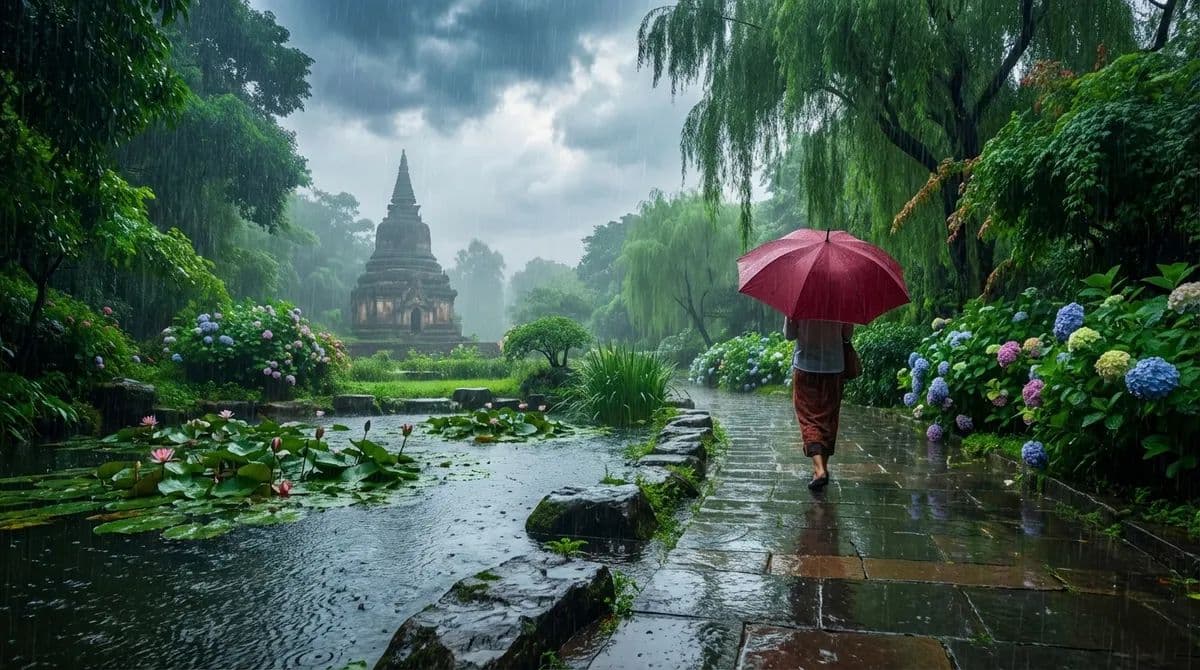
Meigetsuin Temple in Kamakura, known as the "Hydrangea Temple," is the most famous tsuyu destination, but dozens of temples and shrines across Japan celebrate the season with hydrangea festivals. Hasedera, also in Kamakura, lines its hillside paths with thousands of hydrangea plants that bloom in a sequence timed to the progression of the rains. Walking these paths in light rain, under an umbrella, with the flowers glowing against the grey sky and the grey stone of the temple precincts, is a rain travel experience of rare and particular beauty.
The Japanese aesthetic concept of wabi-sabi -- the beauty of impermanence, imperfection, and incompleteness -- finds its most natural expression during tsuyu. The wet moss on temple stones, the drops gathering on a bamboo fence, the particular way that rain alters the color of hinoki wood from blonde to amber -- these are all manifestations of the transient, the ephemeral, the never-quite-the-same-twice that Japanese aesthetics has always valued more highly than the permanent and the perfect. Tsuyu is not cherry blossom season's lesser cousin. It is its complement: where cherry blossoms celebrate the beauty of what passes, tsuyu celebrates the beauty of what falls.
Luang Prabang and the Generosity of Rain
The ancient Lao capital of Luang Prabang, at the confluence of the Mekong and Nam Khan rivers, is a UNESCO World Heritage Site of extraordinary grace. Its saffron-robed monks, gilded temples, and colonial-era shuttered houses are among the most photographed subjects in Southeast Asia. But the photographs almost always show dry-season Luang Prabang -- the version with blue skies, golden light, and tourists occupying every available seat at the night market.
Wet-season Luang Prabang, from May to September, is a different place. The rivers rise dramatically, the Mekong turning from brown to red as it carries sediment from the uplands. The waterfalls in the surrounding hills -- Kuang Si, Tad Sae -- swell from picturesque cascades into thundering torrents of white water that you hear before you see. The forests on the hillsides achieve a green of almost violent intensity, and the air smells of wet earth and frangipani and the wood smoke from the baguette ovens that are a legacy of the French colonial period.
The rain in Luang Prabang follows the same afternoon-burst pattern as Bali, and the mornings are often clear and cool, ideal for the daily alms-giving ceremony that remains the town's most sacred ritual. The monks walk in single file through the quiet streets at dawn, collecting sticky rice from kneeling residents, and the absence of tourist crowds during the wet season makes the ceremony feel less like a spectacle and more like what it is: a daily act of mutual generosity between the monastic community and the lay population, practiced without interruption for centuries.
The Physiology of Getting Wet
There is a reason that rain feels good on skin, and it is not purely psychological. Rainwater is slightly acidic, with a pH around 5.6, and this mild acidity has a gentle exfoliating effect on the skin's surface. The impact of rain droplets on skin produces micro-stimulation of tactile receptors, creating a mild sensory arousal that the nervous system registers as pleasant. And the negative ions generated by falling water -- the same ions produced by waterfalls and ocean surf -- have been associated in multiple studies with reduced serotonin levels and improved mood.
But beyond the physiology, there is something psychologically liberating about getting wet. Modern Western life is organized around the avoidance of rain -- umbrellas, covered walkways, weather apps that warn you to stay inside, an entire infrastructure dedicated to keeping water off your body. To walk deliberately into the rain, to let it soak your clothes and plaster your hair to your forehead and run in rivulets down your neck, is a small act of rebellion against the culture of comfort. You are choosing discomfort, and the choice makes you feel alive in a way that comfort rarely does.
Every monsoon culture understands this intuitively. Children in Kerala play in the first rains of the season with a joy that is not ignorance of discomfort but celebration of it. Farmers in Bali stand in their flooded paddies with expressions of satisfaction that are not stoic endurance but genuine pleasure. The rain is not something that happens to them. It is something that happens for them, the annual renewal that their livelihoods and their rituals depend on, and the soaking is part of the gift.