The Case for Staying Still: What You See in a Week That You Miss in a Day

Anna Lindqvist
Writer
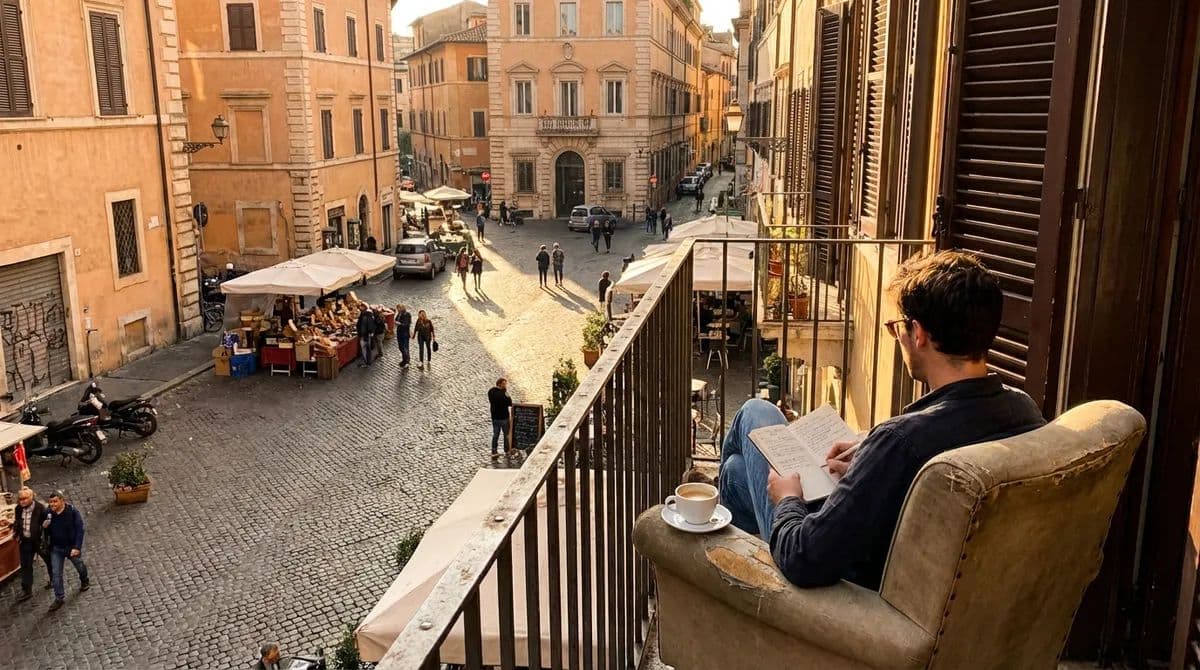
On the fourth morning in Trastevere, the woman at the bakery stopped asking what I wanted and simply handed me a cornetto and a caffe. She had noticed, over three consecutive mornings of the same order at the same time, that I was not a tourist passing through but a temporary fixture, and she adjusted her behavior accordingly. This tiny shift -- from the transaction of commerce to the recognition of routine -- was, I realized, the entire point of slow travel experiences. It was also, by any standard itinerary, an absurdly inefficient use of time. In the four days it took to earn that wordless cornetto, I could have "done" Rome. The Colosseum, the Vatican, the Pantheon, Trastevere, Testaccio, the Borghese Gallery -- all ticked, all photographed, all converted into the currency of having-been-there that modern travel prizes above all else.
Instead, I had done nothing. Or rather, I had done the kind of nothing that traveling with intention requires: I had walked the same streets at different times of day, noticing how the light changed on the ochre facades, how the produce at the market stalls shifted as the week progressed, how the evening passeggiata filled the piazzas with a social choreography so precise and so ancient that it felt almost biological. I had eaten at the same trattoria three nights running and been rewarded, on the third night, with a dish that was not on the menu -- the chef's interpretation of what a regular customer might like. I had sat in the same bench in Piazza di Santa Maria in Trastevere and watched the fountain's light display at sunset, which changed slightly every evening depending on the clouds, and I had begun to understand that the fountain was not a single thing to be seen but a daily event to be attended.
This is the deep travel experience that staying still makes possible: not the accumulation of sights but the development of a relationship with a place. And like all relationships, it requires time -- specifically, it requires the time that most travel itineraries are designed to eliminate.
The Problem with Efficiency
Modern travel is organized around the principle of maximum coverage in minimum time. Guidebooks rank attractions by must-see priority. Trip-planning apps optimize routes. Social media rewards the traveler who has been everywhere and photographs of a different landmark at each stop. The implicit assumption is that seeing more is better, that travel is a form of consumption, and that the correct metric for a successful trip is the number of experiences it contains.
This assumption is, when you examine it, genuinely strange. We do not apply the same logic to any other domain of human experience. No one would argue that the best way to appreciate a novel is to read it at maximum speed, skipping paragraphs to maximize plot coverage. No one would claim that the best way to know a person is to spend fifteen minutes with them and then move on to the next person. And yet we routinely argue that the best way to know a city -- an entity far more complex than any novel or any person -- is to visit it for two days and then fly to the next destination.
The slow travel movement, which has been gathering momentum for more than a decade and reached a tipping point during the pandemic years when restricted movement forced people to discover depth instead of breadth, is a direct response to this absurdity. Its central claim is simple: that the quality of travel is inversely proportional to the speed at which it is conducted. The less you move, the more you see. The longer you stay, the deeper you go. The fewer places you visit, the more of each place you take home.
Shimokitazawa: The Neighborhood That Rewards Patience
If Trastevere taught me about the relationship between routine and recognition, Shimokitazawa in Tokyo taught me about the relationship between slowness and surprise. Shimokitazawa -- "Shimokita" to locals -- is a neighborhood in western Tokyo that most guidebooks describe in a paragraph: vintage clothing shops, small theaters, indie coffee shops. It is, in the efficiency model of travel, a half-day destination at most.
I spent nine days there, and it was not enough.
The first two days were predictable. I walked the main streets, browsed the vintage shops, drank excellent coffee, and felt I had a reasonable understanding of the neighborhood's character. On the third day, I began to notice the alleys -- narrow passages between buildings that led to second-floor bars, basement record shops, and courtyards where elderly residents tended bonsai collections of startling beauty. On the fourth day, I found the Shimokitazawa Garage, a live music venue the size of a living room, where a band I had never heard of played a two-hour set to an audience of thirty. On the fifth day, I had a conversation with a bookshop owner who drew me a map of his personal Shimokitazawa: the ramen shop that only opens when the chef feels like it, the temple where the neighborhood cats congregate at exactly four o'clock, the rooftop garden that is technically private but that the owner opens to anyone who asks politely.
None of this appeared in any guidebook. None of it was Instagrammed or TripAdvisored or algorithmically surfaced. It existed in the neighborhood the way a secret exists in a person -- not hidden exactly, but available only to those who have earned enough trust to receive it. And that trust is earned not by asking the right questions but by spending enough time that the questions become unnecessary. Shimokitazawa did not reveal itself because I was clever or resourceful. It revealed itself because I was still.
The Alfama's Vertical Secrets
Lisbon's Alfama district is a labyrinth. This is not a metaphor -- the neighborhood is a tangle of staircases, alleyways, dead ends, and passages so narrow that you can touch both walls simultaneously, laid out according to a medieval logic that predates the grid-obsessed urban planning of modernity. Getting lost in the Alfama is not a risk but a certainty, and for the day-tripper it is a frustrating certainty, because every wrong turn consumes precious minutes that could be spent at the next item on the itinerary.
For the slow traveler, getting lost in the Alfama is the itinerary.
Over the course of a week, I mapped the neighborhood with my feet, learning its vertical logic -- the Alfama is built on a steep hillside, and movement is as much up and down as it is forward and back. I discovered that the neighborhood has at least three distinct temporal zones: the early morning, when the fishmongers set up their stalls near the river and the light is peach-colored and tentative; the midday, when the heat drives everyone indoors and the only sounds are the creak of laundry drying on lines strung between balconies; and the evening, when the fado houses open and the neighborhood fills with a music so melancholy and so beautiful that the buildings themselves seem to be grieving.
I learned where the best miradouros were -- not the famous viewpoints marked on tourist maps, but the private ones, the doorways and rooftops and dead-end alleys that opened unexpectedly onto views of the Tagus estuary and the red roofs of the Alfama cascading down to the water. I learned which tascas -- the tiny, family-run restaurants that serve lunch to the neighborhood -- would seat a stranger and which preferred to keep their tables for regulars. I learned that the woman who sold ginjinha from a window on Rua de Sao Miguel knew the history of every building on the street and would share it with anyone who stopped to listen.
This accumulated knowledge -- this dense, layered understanding of a single neighborhood -- is what slow travel experiences produce and what rapid travel cannot. It is not better than seeing the Belem Tower and the Jeronimos Monastery. It is a different kind of knowing, the kind that comes from inhabiting a place rather than visiting it.
The Neuroscience of Familiarity
There is a neurological basis for the claim that staying still produces deeper travel. Research on place learning shows that the hippocampus -- the brain region responsible for spatial memory and navigation -- does not merely store a map of an environment. It builds a model that becomes richer and more detailed with repeated exposure, incorporating temporal patterns (what happens where and when), emotional associations (how a place makes you feel at different times of day), and predictive expectations (what you anticipate finding around the next corner).
This hippocampal model is what gives a well-known place its feeling of depth. When you walk a street for the first time, you see it in two dimensions: buildings, shops, people. When you walk the same street for the tenth time, you see it in something closer to four dimensions: the buildings as you know them now and as you remember them from previous walks, the shops with their routines and rhythms, the people as individuals whose habits you have begun to recognize. The street has not changed. Your brain's model of it has become richer, and that richness is experienced as meaning.
This is why a week in a single neighborhood produces memories that outlast a month of rapid travel. The hippocampal model built by repeated, slow exposure is more detailed, more interconnected, and more emotionally tagged than the thin, isolated snapshots produced by a single brief visit. The slow traveler does not merely remember more. They remember differently -- in a way that feels less like recalling a photograph and more like recalling a relationship.
The Economics of Slowness
Slow travel is also, counterintuitively, cheaper. Not in all cases and not in all destinations, but the structural economics of staying put tend to favor the budget-conscious traveler.
Accommodation costs drop dramatically with weekly rates. Apartment rentals, which become practical only with stays of a week or more, are almost always cheaper per night than hotels. Eating at neighborhood restaurants rather than tourist-facing establishments saves money and improves quality in roughly equal measure. Transportation costs approach zero when your radius of exploration is walkable. And the impulse purchases that rapid travel encourages -- the souvenir bought because you will never return, the expensive meal booked because it is your only night in the city -- lose their urgency when you have time. You can always go back tomorrow. You can always try the other restaurant next week.
The deeper economic insight, though, is about value rather than cost. The slow traveler spends less money on more experience, because the experiences that slow travel produces -- the conversations, the routines, the gradual deepening of understanding -- are not purchasable. They are earned through the investment of time, which is the one resource that modern travel ideology treats as scarce and that slow travel ideology treats as the point.
How to Stay Still
The practice of slow travel is simple in principle and difficult in execution, because it requires resisting the most powerful force in modern tourism: the fear of missing out. Every day you spend in Trastevere is a day you are not spending at the Vatican. Every afternoon in Shimokitazawa is an afternoon you are not spending in Akihabara. The itinerary you did not follow haunts you like a ghost, whispering that you are wasting your trip, that you should be seeing more, doing more, moving more.
The antidote to this fear is a deliberate narrowing of scope. Choose a neighborhood, not a city. Define your territory -- a few square blocks, a particular set of streets -- and commit to exploring it thoroughly before venturing beyond. Walk the same route at different times of day. Eat at the same restaurant more than once. Let the barista learn your name. Accept that you will miss the major attractions, and observe that what you gain in exchange -- intimacy, recognition, belonging -- is not available at any attraction, however major.
Traveling with intention also means traveling without a plan. The itinerary is the enemy of slow travel, not because planning is bad but because the itinerary creates obligations, and obligations create pace, and pace is the opposite of presence. The slow traveler's plan is to have no plan, or rather, to have a plan so minimal that it leaves room for the unplanned -- the chance encounter, the unexpected invitation, the discovery that arises only when you have nothing else to do and nowhere else to be.