The Beautiful Dead

Ingrid Olsen
Writer
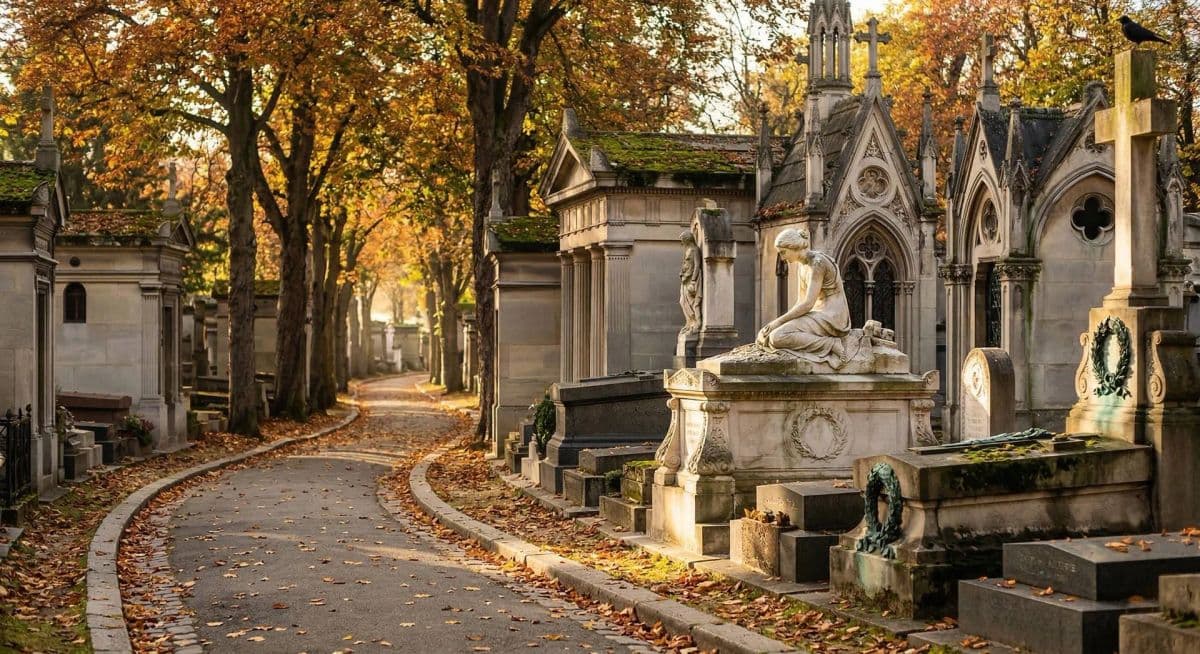
In autumn, when the chestnuts drop and the light in Paris takes on that quality — golden, angled, slightly melancholy — that makes the city feel like a painting of itself, Pere Lachaise becomes something more than a cemetery. The paths wind uphill through a canopy of turning leaves. The graves, stacked and layered like a city in miniature, catch the low sun on their stone surfaces and glow. The air smells of damp earth and fallen leaves and the faintly mineral scent of old stone. A blackbird sits on a moss-covered cross and sings with an unselfconsciousness that feels, in this setting, almost irreverent. This is the cemetery as art gallery — perhaps the world's greatest open-air collection of sculpture, architecture, and typographic design — and it charges no admission, keeps no hours, and requires nothing of the visitor but the willingness to walk slowly and look.
Pere Lachaise was designed to be beautiful. When it opened in 1804, on the eastern heights of Paris, it was conceived as a new kind of burial ground — not the cramped, unsanitary churchyard of the medieval tradition but a landscaped garden, a place where the dead would rest among trees and winding paths and carefully composed views. The model was the English landscape garden, with its calculated informality, its artful arrangement of natural and built elements. Napoleon's prefect, Nicolas Frochot, understood that Parisians would not abandon the familiar churchyard unless the alternative was irresistibly attractive. He made it so. The first burials included the relocated remains of Moliere and La Fontaine — celebrities enlisted to give the new cemetery cultural authority — and the Parisians came.
They have not stopped coming. Pere Lachaise receives more than three million visitors a year, making it the most visited cemetery in the world and one of the most visited sites in Paris. Some come for the famous graves — Jim Morrison's perpetually flower-strewn plot, Oscar Wilde's lipstick-kissed tomb by Jacob Epstein, Chopin's white marble monument with its weeping muse. But many come for the cemetery itself — for the extraordinary accumulation of funerary art that two centuries of Parisian death have produced, and for the atmosphere, which is unlike anything else in the city: quiet, contemplative, saturated with the particular beauty that arises when human vanity meets human mortality and decides to make something lasting.
Cemeteries as Art Galleries
The case for beautiful cemeteries as travel destinations is not difficult to make, but it is strangely underrepresented in mainstream travel literature. Guidebooks mention Pere Lachaise, Highgate, and Recoleta — the famous three — but rarely treat them as what they manifestly are: open-air museums containing some of the finest sculpture, architectural design, and decorative art of their respective periods. The cemetery as art gallery is a concept that most cultures intuitively understand but that tourism, with its relentless preference for the living over the dead, consistently undervalues.
Consider the Staglieno Cemetery in Genoa, which contains what is arguably the most important collection of nineteenth-century realistic sculpture in Italy. The cemetery's marble figures — life-sized, exquisitely detailed, carved by the leading sculptors of the Italian Risorgimento — depict grief with a specificity and emotional intensity that few museum collections can match. A widow kneels beside a tomb, her face turned away, her hand resting on the stone as if it were still warm. A child reaches upward, as if trying to follow a departing parent into the sky. A soldier slumps forward, still gripping his rifle, his body caught in the instant between life and death. The sculpture is not idealized. It is painfully, almost uncomfortably real — the folds of fabric rendered with such precision that you can identify the weave, the expressions carved with a psychological acuity that suggests the sculptor had studied the face of every mourner who ever lived.
Mark Twain visited Staglieno in 1867 and wrote, in "The Innocents Abroad," that it was "a world of art, a gallery of beauty." He was not wrong. The cemetery contains thousands of sculptures, many by artists whose work hangs in major museums, displayed in an outdoor setting where the light changes hourly and the stone ages with a grace that marble in a climate-controlled gallery never achieves. The green patina of oxidation, the black tracery of lichen, the way rain pools in a carved eye socket and reflects the sky — these are accidental effects that no curator could produce and that transform the sculptures into something richer and stranger than their makers intended.
The Architecture of Death
Cemetery art tourism is also, inevitably, cemetery architecture tourism. The great cemeteries of the world are exercises in architectural ambition, their chapels and mausoleums representing every style from neoclassical to art nouveau to brutalist. In the Recoleta Cemetery in Buenos Aires, the mausoleums are like a city block compressed — hundreds of them packed into a relatively small space, each one competing for attention, each one announcing the wealth, taste, and social aspirations of the family interred within.
The styles range across two centuries. Greek temples stand next to Gothic chapels stand next to art deco towers. Some are austere, all clean lines and polished granite. Others are extravagant, encrusted with marble angels, bronze wreaths, and stained glass. The effect is overwhelming — a visual noise that, paradoxically, resolves into a kind of harmony when you slow down and take the mausoleums one at a time. Each one is a miniature architectural statement, a building designed for a single purpose — to house the dead with dignity — and the range of solutions that Buenos Aires's architects and their clients arrived at is a catalogue of how a culture thinks about death.
Evita's tomb is here, of course — the grave of Eva Peron, which draws a constant stream of visitors who leave flowers and photographs. The tomb itself is modest by Recoleta standards: a simple black marble facade bearing the family name, Duarte. The modesty is either deliberate or ironic, given that the woman interred within was one of the most extravagant figures in Argentine history. Either way, the contrast between the tomb's restraint and the excess of the surrounding mausoleums makes it one of the most memorable graves in the cemetery — not because of what it shows but because of what it refuses to show.
The Democratic Dead
Not all beautiful cemeteries are monuments to wealth and status. Some of the most moving burial grounds in the world are those that treat the dead equally — military cemeteries where identical headstones stretch to the horizon, or public cemeteries where the simplicity of the markers creates a beauty that is entirely democratic.
The American military cemetery at Colleville-sur-Mer, above Omaha Beach in Normandy, contains 9,387 white marble crosses and Stars of David, arranged in precise rows across a green lawn that falls away toward the English Channel. The design is deliberately uniform — each marker identical in size and shape, each grave given exactly the same space — and the effect is cumulative. One cross is a cross. Ten thousand crosses, arrayed across a clifftop overlooking the beach where their occupants died, is something else entirely — a geometric expression of collective sacrifice that moves even the most skeptical visitor.
In Koyasan, the sacred mountain in central Japan, the Okunoin cemetery winds through a cedar forest that is over a thousand years old. More than two hundred thousand graves line the mossy path, ranging from the elaborate mausoleums of feudal lords to simple stone markers for ordinary citizens. The forest creates a cathedral effect — the massive trunks rising like columns, the canopy filtering the light into the same dappled pattern the Japanese call komorebi — and the graves, covered in moss and lichen and fallen needles, seem to be slowly returning to the earth from which the stones were cut. The sound is extraordinary: wind in the cedars, water flowing over stone, the occasional deep note of a temple bell from somewhere deeper in the forest. It is one of the most peaceful places I have ever visited, and it is a cemetery.
Reading Stones
The art of the gravestone is the art of compression — of saying, in the smallest possible space, something true about a human life. The best gravestones achieve this with a brevity that poetry envies. "She did what she could" — on a headstone in a rural English churchyard. "Free at last" — on Martin Luther King Jr.'s tomb in Atlanta. "I told you I was ill" — Spike Milligan's epitaph in Winchelsea, Sussex, written in Irish Gaelic because the local diocese refused to allow it in English.
The most artistic cemeteries in the world are those where the art of the gravestone has been practiced with the greatest care and the greatest range. In the old Jewish cemetery of Prague, where twelve thousand headstones are crammed into a space designed for far fewer — burials were layered up to twelve deep over three centuries, and the stones were pushed upward as new graves were dug below — the cumulative effect is of a stone forest, the markers tilted and crowded and overlapping like a crowd of people trying to be heard. The Hebrew inscriptions, carved with a calligraphic precision that reflects the importance Judaism places on the written word, give each stone the quality of a page from a sacred text.
In New Orleans, the above-ground tombs of St. Louis Cemetery No. 1 — necessitated by the city's high water table, which turned conventional burial into an exercise in inadvertent exhumation — create a miniature city of whitewashed vaults that the locals call, with characteristic New Orleans directness, the "Cities of the Dead." The tombs are stacked, shared, and reused — a practical response to limited space that has produced an aesthetic unlike any other cemetery in America. The plaster peels. The names fade. The vaults crack open and are sealed again. The effect is of a place where death is not hidden or sanitized but acknowledged as a constant, physical presence in the life of the city.
The Cemetery as Time Machine
Every cemetery is a history lesson, a record of the community that created it. The headstones tell you who lived here, when they lived, how old they were when they died, and what the living thought worth remembering about them. Read enough headstones and patterns emerge: the clusters of infant graves that mark a plague year, the military section where an entire generation of young men died within a few years of each other, the shift from religious inscriptions to secular ones that tracks a culture's changing relationship with faith.
In the Assistens Cemetery in Copenhagen, where Hans Christian Andersen and Soren Kierkegaard both lie, the graves span four centuries and include a cross-section of Danish society that no other single site can match. Poets, scientists, politicians, and ordinary citizens share the same ground, and the changing styles of their memorials — from the restrained classicism of the eighteenth century through the elaborate sentimentality of the Victorian era to the minimalist severity of the modern period — compose a visual history of Denmark's evolving attitudes toward death, art, and self-presentation.
The Cimitero Monumentale in Milan, one of the most architecturally ambitious cemeteries in Europe, doubles as a gallery of Italian industrial design. The tombs of Milan's great commercial families — the Camparis, the Brancas, the Falcks — are miniature architectural masterpieces that reflect the aesthetic of the era in which they were built. An art nouveau mausoleum from 1910 sits beside a rationalist cube from the 1930s, which sits beside a postmodern construction from the 1980s. The cemetery reads like a textbook of Italian design, each tomb a statement about the relationship between death, beauty, and the money required to reconcile the two.
Why We Visit the Dead
The deeper question behind cemetery tourism is not "why are cemeteries beautiful?" — the answer to that is obvious: because the living have always wanted to make beautiful things for the dead, and the dead, being unable to object, have been the recipients of some of humanity's most extravagant artistic impulses. The deeper question is why we visit at all. Why walk among the graves of strangers? What do we gain from an afternoon spent reading the names and dates of people we never knew?
Part of it is the simple pleasure of beauty encountered in an unexpected context. We expect art in galleries. We expect architecture in cities. We do not expect either in a cemetery, and the surprise amplifies the pleasure. But there is something else — something that has less to do with aesthetics and more to do with the fundamental human need to be reminded of mortality. The cemetery is the one place in the modern city where death is not hidden, not euphemized, not sanitized behind hospital curtains and funeral-home decorum. It is simply present, inscribed in stone, surrounded by trees, and open to anyone who cares to visit.
This is valuable. In a culture that has become expert at avoiding the subject of death — that has outsourced dying to institutions and mourning to professionals — the cemetery offers a corrective. It says: people lived, and they died, and here is the evidence. Some were famous. Most were not. All are equally dead. The democracy of the graveyard is absolute, and in that democracy there is a strange comfort — the reminder that mortality is the one experience that every human being shares, and that the art we make to mark it is, at its best, a celebration of the life that preceded it.