The Bathhouse at the Edge of Winter

Priya Sharma
Writer
The first thing you notice is not the heat. It is the sound. In the Gellért Baths in Budapest, at six-thirty on a Tuesday morning in December, the sound is a low, continuous murmur — part echo, part drip, part the amplified breathing of a dozen bodies settling into water that is just on the comfortable side of scalding. The thermal spring that feeds the Gellért has been rising from the Buda hills for millennia, its water travelling through limestone for thousands of years before emerging at a steady thirty-eight degrees Celsius into a vaulted hall of Zsolnay tiles, green and turquoise and gold, that would not be out of place in an Art Nouveau cathedral. The steam softens the mosaic ceiling into a watercolor blur. The light, filtering through stained glass windows, arrives in the pool already diffused, already gentle, already part of the warmth. You lower yourself in, and the city — its traffic, its cold, its urgency — ceases to exist. Bathhouse culture travel is, at its heart, the practice of disappearing into warmth and re-emerging changed.
This is what a bathhouse does. It removes you. Not just from the cold, though that removal is literal and immediate, but from the tempo and priorities of the world outside the door. A bathhouse operates on a different clock. There is no agenda. There is no destination. There is only heat, water, stone, and the slow negotiation between your body and the temperature. The Romans understood this. The Ottomans understood this. The Japanese understood this. And in the handful of places around the world where bathhouse traditions have survived the twentieth century's preference for private showers and efficient hygiene, you can still experience what they understood: that the act of bathing, done communally and done slowly, is not merely about cleanliness. It is about something closer to restoration.
Thermal Bath Traditions: Budapest and the Art of Ruin
Budapest is built on thermal springs. More than a hundred and twenty springs feed the city's baths, and the bathing tradition here stretches back two thousand years — first the Romans, who built the original thermal complexes at what is now Aquincum on the Buda side, then the Ottoman Turks, who during their hundred and fifty years of occupation built the hammams that still operate today, then the Austro-Hungarian empire, which turned bathing into a grand civic ritual and built the monumental bath palaces that define Budapest's thermal identity.
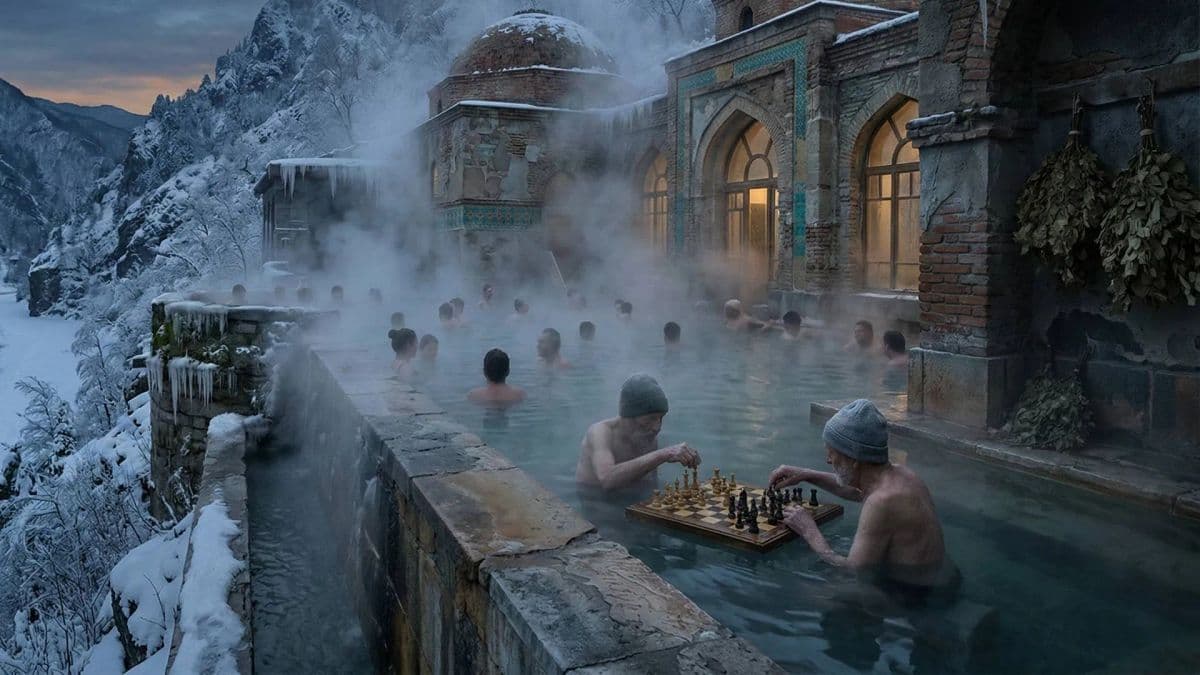
The Széchenyi Baths in the City Park are the largest medicinal bath complex in Europe — a neo-baroque palace of yellow stone containing eighteen pools, including three vast outdoor pools where, on winter mornings, bathers float in clouds of steam so thick that the surrounding buildings disappear entirely. The regulars — retired men who come every morning, year-round — play chess on floating boards, their fingers wrinkled, their concentration unbroken, the steam rising around them like a slow-motion explosion. They have been doing this for decades. Their fathers did it before them. The chess sets are waterlogged and ancient, and the games are serious.
But it is the Rudas Baths, built by the Ottomans in the sixteenth century, that best preserve the original spirit of Budapest's thermal culture. The main pool sits beneath an original Ottoman dome, its octagonal symmetry pierced by star-shaped openings through which light falls in discrete shafts onto the dark water below. The pool is small — perhaps ten meters across — and the water is hot, genuinely hot, heated by the springs that rise directly beneath the building. The stone walls are original, worn smooth by five centuries of hands and backs and shoulders. The light is dim. The sound is minimal. And the effect is of having stepped into a space that belongs to no particular century — a space where the only relevant facts are the temperature of the water and the architecture of the dome above it.
The Hammam: Water as Devotion in Istanbul
In Istanbul, the hammam is not a luxury. It is, or was, a necessity — the original public utility, older than piped water, older than private bathrooms, older than the concept of the bathroom as a room in a house. The hammam tradition in the Islamic world is inseparable from the requirements of ritual purification: the Quran prescribes ablution before prayer, and the hammam provided the means. But the hammam also became something more — a social institution as central to Ottoman life as the coffeehouse or the mosque.
The Cemberlitas Hamami, designed by the great architect Mimar Sinan in 1584, sits on a busy street between the Grand Bazaar and Sultanahmet, its dome rising above the surrounding shops with an authority that four centuries of urban development have not diminished. Inside, the sequence is precise and unchanged since the sixteenth century. You enter the camekan, the reception hall — a high, domed room lined with wooden changing cubicles. You wrap yourself in a pestemal, the traditional cotton wrap. You enter the warm room, the iliklik, where the temperature begins to rise. And then you enter the hot room, the hararet, and the hammam reveals itself.
The hararet of the Cemberlitas is a masterpiece of thermal architecture. The central platform — the gobek tasi, the navel stone — is a slab of heated marble, warmed from below by the furnace, large enough for a dozen people to lie on simultaneously. The marble is hot but not burning — a temperature that has been calibrated by centuries of practice to be exactly at the threshold where heat becomes therapeutic. You lie on it, and the heat enters your body through your back, through your shoulders, through the backs of your legs, in a slow, penetrating wave that loosens muscles you did not know were tight. The dome above is pierced by dozens of small glass openings — elephant eyes, they are called — through which daylight enters in thin columns, illuminating the steam in a way that makes the air itself visible.
Then the tellak, the bath attendant, arrives. The ritual that follows — the scrubbing with the kese mitt, which removes a quantity of dead skin that is both impressive and faintly mortifying, followed by the soap massage with a cloud of foam generated from a cotton pouch — is not gentle. It is thorough. It is systematic. It operates on the principle that cleanliness is not a state you achieve passively but something that must be worked for, extracted, demanded from the body. By the end, when you are rinsed with bowls of warm water poured from a height that sends sheets of water cascading over stone, you feel not merely clean but somehow lighter, as though mass itself has been removed along with the grime.
The Onsen: Silence and Surrender in Japan
If the hammam is vigorous and communal, the Japanese onsen is its contemplative counterpart. The onsen tradition — bathing in natural hot springs — is so central to Japanese culture that the country has catalogued over twenty-seven thousand hot spring sources, and onsen resorts, called ryokan, occupy an entire category of the hospitality industry. But to understand the onsen is to understand that it is not about the water, or not only about the water. It is about the ritual that surrounds the water — a ritual of purification, silence, and surrender that transforms a physical act into something that functions very much like meditation.
The etiquette is precise. You wash before you enter the pool — thoroughly, seated on a low stool at a tap station, soaping and rinsing your entire body until you are, by any reasonable standard, already clean. Only then do you enter the water. This is the critical distinction: the onsen is not for getting clean. It is for what comes after clean. You enter the water already purified, and what the water offers is not hygiene but something else — a dissolution of the boundary between your body and the heat, a softening of the edges, a permission to stop. In a culture that values effort, discipline, and the suppression of individual comfort for the sake of collective harmony, the onsen is the sanctioned space for letting go.
In the mountain onsen of Kurokawa, in Kyushu, the rotenburo — the outdoor bath — is set into a hillside above a river gorge. Cedar trees rise on three sides. The water is milky, opaque, heated by volcanic activity far below the surface. You sit in the pool with the water at shoulder level and the cold mountain air on your face, and the contrast between the two temperatures — the searing heat of the water, the sharp cold of the winter air — produces a state of alertness that is simultaneously relaxation. The steam rises. The river sounds below. A woodpecker strikes a dead tree somewhere in the cedars. And the ritual asks only one thing of you: that you be present in your body, in this water, in this moment. The thermal bath traditions of Japan are, in this way, a practice of radical attention.
The Banya: Birch and Breath in Russia
The Russian banya is not gentle. It does not pretend to be gentle. It is a practice of extremes — extreme heat, extreme cold, extreme sensation — and its adherents regard it with the same mixture of devotion and masochism that distance runners bring to their marathons. The banya is not a bath. It is an ordeal, and the ordeal is the point.
The traditional banya is a wooden building, often birch or pine, containing a stove heaped with stones — the kamenka — that are heated to temperatures that would be dangerous in any other context. Water is thrown on the stones to produce bursts of steam — the phar — that drive the temperature in the steam room to levels that make breathing an act of conscious will. Your skin prickles. Your ears burn. The air feels solid, almost liquid, as though the room has been filled with an invisible substance that presses against every surface of your body simultaneously.
And then the venik — the bundle of dried birch branches, soaked in hot water until they are supple and fragrant — and the practice of being beaten with it, which sounds barbaric and feels, inexplicably, sublime. The birch leaves release their essential oils — camphor, betulin, a sharp green fragrance that cuts through the steam — and the rhythmic striking opens the pores, stimulates circulation, and produces a sensation that is part sting, part caress, part percussion. Veterans of the banya speak of a state that arrives after the third or fourth cycle of steam room and cold plunge — a euphoria, a clarity, a feeling of having been dismantled and reassembled in a slightly improved configuration.
In Moscow, the Sanduny Baths — built in 1808 and renovated in a style of such extravagant opulence that the changing rooms resemble the foyer of a minor palace — preserve the banya tradition in its most elaborate form. The pool rooms have gilded columns. The steam rooms have hand-carved wooden benches. The cold plunge pools are fed by artesian wells. But the essential experience is the same one available in a wooden shack in the Siberian forest: the cycle of heat and cold, repeated until the body surrenders its tensions and the mind, for a few precious minutes, goes quiet.
The Jjimjilbang: Korea's Living Room of Steam
In South Korea, the jjimjilbang — the large, multi-room bathhouse that functions as equal parts spa, social club, and overnight accommodation — represents perhaps the most evolved form of the public bathing tradition. A jjimjilbang like Seoul's Dragon Hill Spa is not merely a bathhouse. It is a small city of warmth, containing hot and cold pools, saunas of varying temperatures and materials (jade, charcoal, salt, clay), sleeping rooms heated by ondol floors, a food court, a cinema, and a rooftop garden. Families come for the weekend. Students come to study. Businessmen come to sleep off long nights. The jjimjilbang is Korea's communal living room, and it operates twenty-four hours a day, every day of the year.
The bathing sequence is similar to the Japanese onsen — thorough washing before entering the communal pools — but the social atmosphere is entirely different. Where the onsen is silent, the jjimjilbang is sociable. Conversations happen. Friendships are maintained. Business is discussed. The hot room — the bulgama, heated to temperatures that make the Russian banya seem temperate — is a place of shared endurance, where strangers bond over their mutual proximity to heat-related collapse. The cold room — a chamber maintained at sub-zero temperatures — is a place of shared relief, where the same strangers laugh together in the shock of the cold.
The Sulphur Baths of Tbilisi
The Abanotubani district of Tbilisi — the bathhouse district — gives its name to the city itself. Tbilisi derives from the Georgian word "tbili," meaning warm, and the sulphur springs that rise in this quarter of the old town have been the city's defining feature since, according to legend, King Vakhtang Gorgasali's falcon dropped a freshly caught pheasant into a hot spring in the fifth century and the king, impressed by nature's gift, founded the city on the spot.
The bathhouses are built into the hillside, their domed brick roofs rising from the ground like the humps of buried creatures. Inside, the water is hot, strongly sulphurous, and an unearthly shade of blue-green. The smell — the rotten-egg tang of hydrogen sulphide — is powerful on first encounter and invisible within minutes, as the nose adapts and the body surrenders to the water's mineral embrace. The experience is ancient, elemental, and deeply specific to this place: the combination of the sulphur water, the brick domes, the scrubbing administered by a muscular attendant with a kisi mitt, and the glass of cold Georgian beer offered afterward in the dressing room constitutes a sequence of pleasures that has remained unchanged, in its essentials, for centuries.
The Blue Lagoon and Beyond: Geothermal Bathing in Iceland
Iceland's relationship with hot water is geological and fundamental. The island sits on the Mid-Atlantic Ridge, directly above the boundary between the North American and Eurasian tectonic plates, and the geothermal energy that this position provides heats the country's homes, its greenhouses, and its swimming pools. Every town in Iceland has a public hot pot — a small, heated outdoor pool — and the social life of the nation revolves around these pools in the way that social life in other countries revolves around pubs or piazzas.
The Blue Lagoon, near Keflavik airport, is the most famous of Iceland's geothermal bathing sites, but it is also the least representative. The lagoon is artificial — its water is the waste effluent from a nearby geothermal power plant — and its milky blue colour comes from the silica suspended in the water rather than from any natural spring. More authentic, and more powerful, are the wild hot springs that dot the Icelandic landscape: the Reykjadalur valley near Hveragerdi, where a hot river runs through a grassy canyon and bathers soak in water heated by the earth itself; the Myvatn Nature Baths in the north, where you float in geothermal water while looking out over a volcanic landscape of pseudocraters and lava fields; the remote Westfjords hot springs, where the only company is the wind and the occasional Arctic fox.