The Art of Getting Gloriously Lost

Carmen Ruiz
Writer
I was looking for the Basilica of San Clemente. This much I remember. I had left the Colosseum heading east — or what I believed to be east — along a street that should have delivered me, within ten minutes, to a twelfth-century church built atop a fourth-century church built atop a first-century Roman house built atop a Mithraic temple. Four layers of civilization stacked like geological strata, accessible by a single staircase. It was the reason I had come to this neighborhood, and I had studied the route on my phone before leaving the hotel.
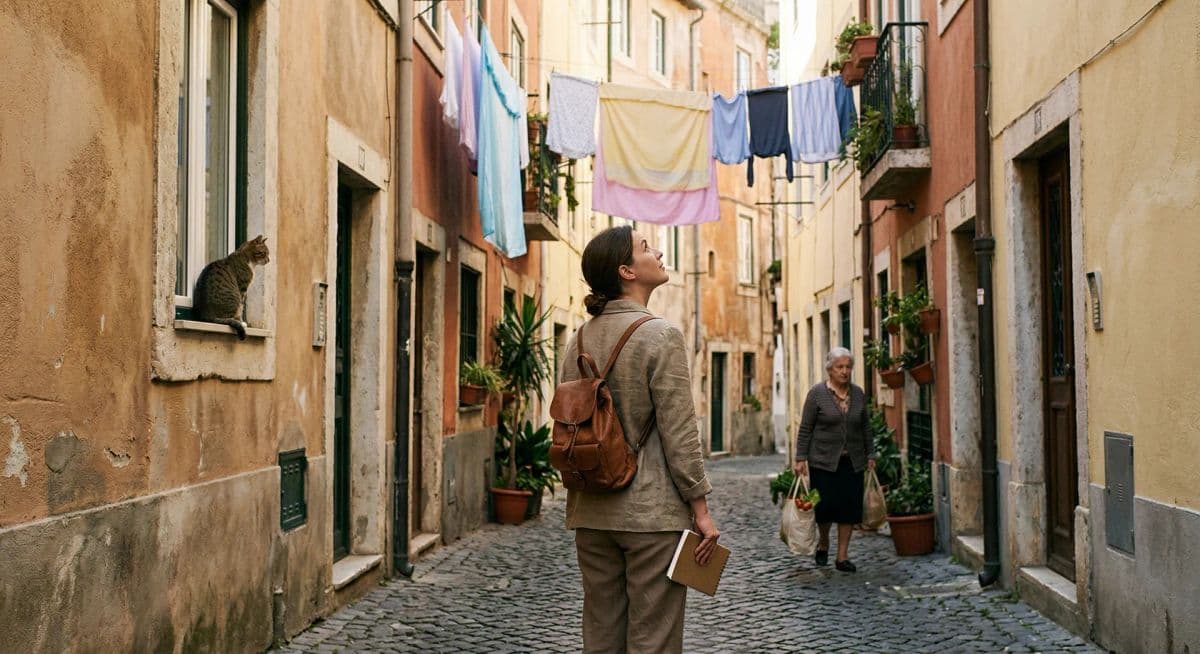
But somewhere between the Colosseum and the basilica, I turned left instead of right — or right instead of left — and entered a residential street that appeared on no tourist itinerary. The buildings were the color of weak tea. Laundry hung between windows on lines that sagged under the weight of sheets and work shirts. A cat watched me from a first-floor windowsill with the particular contempt that Roman cats reserve for tourists who have wandered off the authorized path. An elderly woman emerged from a doorway carrying a net bag of lemons and gave me a look that was not hostile but curious — the look of someone who knows that strangers do not come here, and who is mildly interested in how this one arrived.
I was lost. Not dangerously lost — Rome is not a wilderness, and I had a phone in my pocket that could, at any moment, resolve my confusion with a blue dot and a set of turn-by-turn instructions. But I did not reach for it. Something in the quality of the street — its quietness, its ordinariness, its absolute indifference to my presence — made me want to stay lost for a while longer. To follow the street wherever it led. To see what Rome looked like when Rome was not performing for an audience.
Rebecca Solnit, in her luminous book A Field Guide to Getting Lost, writes: "Lost is not a place but a state of mind, and wandering is not a failure but a form of attention." The sentence is one of those rare formulations that, once read, changes the way you experience the world. It reframes disorientation as presence. It suggests that the planned route — the Google Maps trajectory, the guidebook itinerary, the carefully optimized schedule — is not the highest form of travel but a kind of insulation against it. The GPS guarantees that you will arrive. It cannot guarantee that you will notice anything along the way.
The Psychogeography of Wandering
The deliberate practice of getting lost has a name, and it has a history. The Situationist International, the French avant-garde movement of the 1950s and 60s, coined the term dérive — literally "drift" — for the act of walking through a city without destination, allowing the terrain and one's emotional responses to it to determine the route. Guy Debord, the movement's chief theorist, described the dérive as a technique for revealing the "psychogeography" of a place — the emotional and behavioral effects that a city's geography exerts on its inhabitants.
The Situationists were Marxists, and their dérives were intended as political acts — disruptions of the capitalist city's logic of efficiency and consumption. But stripped of their ideological apparatus, the principles of the dérive are simply the principles of attentive walking. Move slowly. Follow impulse rather than plan. Notice what the planned route would have you ignore. Turn down the street that looks interesting rather than the street that leads to the next attraction. Allow yourself to be drawn by the texture of a wall, the sound of music from an upper window, the smell of bread from a bakery you did not know existed.
The psychogeographer does not reject maps. She reads the city as a map — a text inscribed in stone and asphalt and vegetation, legible to anyone willing to slow down enough to decipher it. The width of a street tells you about the era in which it was built. The height of a curb tells you about the traffic that once used it. The species of tree planted along a boulevard tells you about the aesthetic preferences of the administration that planted them. The presence or absence of graffiti tells you about the neighborhood's relationship with authority. Every surface is a document. Every intersection is a choice.
What the Phone Takes Away
The smartphone has done more to change the experience of being in an unfamiliar place than any technology since the automobile. This is not a controversial claim. Anyone who traveled before the smartphone era and travels now will confirm it: the experience is fundamentally different. Not worse — in many ways, demonstrably better. Navigation is easier. Translation is instant. Restaurant recommendations are abundant. The anxiety of not knowing where you are or how to get where you are going — an anxiety that could, in the pre-digital age, consume entire afternoons — has been effectively eliminated.
But something has been lost in the elimination of that anxiety. The smartphone resolves uncertainty before it can become curiosity. It answers the question "Where am I?" before the question has time to transform into the more interesting questions: "What is this place? Why does it look like this? Who lives here? What would happen if I kept walking?" Getting lost travel without GPS means allowing those questions to emerge — to feel the discomfort of not knowing and to discover that the discomfort, if you sit with it long enough, transmutes into something else. Attention. Alertness. The heightened perception that comes from being slightly off-balance.
The neuroscience supports this. Studies of spatial navigation have shown that the hippocampus — the brain region responsible for spatial memory and orientation — is more active when a person is navigating by internal cues (landmarks, memory, dead reckoning) than when following GPS instructions. London taxi drivers, who are required to memorize the city's twenty-five thousand streets for the Knowledge exam, have been shown to have significantly larger hippocampi than the general population. The act of figuring out where you are — the effortful, sometimes frustrating process of constructing a mental map from sensory input — strengthens the very cognitive faculties that passive navigation allows to atrophy.
This does not mean you should throw your phone away. It means you might, occasionally, choose not to use it. Choose to navigate by sun and shadow, by the slope of the ground, by the sound of traffic or water or birdsong. Choose to ask a stranger for directions — an act that, in the smartphone age, has become almost quaint, like writing a letter by hand. The stranger's directions will be imprecise, may be wrong, and will certainly be more interesting than a blue line on a screen. They will include opinions, warnings, digressions, and local knowledge that no algorithm can replicate. They will be, in other words, human.
The Productive Error
The history of exploration is largely a history of productive errors. Columbus was looking for India. The Portuguese who first reached Japan were blown off course by a storm. The most important archaeological discoveries — Pompeii, the Terracotta Army, the Lascaux cave paintings — were stumbled upon by people who were looking for something else entirely. The accident, the wrong turn, the unplanned deviation — these are not failures of navigation but opportunities for discovery.
The same principle applies at the scale of a single afternoon in an unfamiliar city. The restaurant you find because you took a wrong turn may be better than the one you were looking for. The church you enter because you need to rest your feet may contain a fresco that changes your understanding of the Renaissance. The conversation you have with the shopkeeper who gives you directions may tell you more about the city than any guidebook. The planned route is optimized for the known. Getting lost opens you to the unknown.
I think of a morning in Lisbon, when I set out to find the Feira da Ladra flea market and instead found myself in a neighborhood called Graca that I had not planned to visit. The streets were steep and empty. The tiles on the buildings — azulejos, the blue-and-white ceramic panels that are Lisbon's signature decorative element — were cracked and fading, beautiful in their disrepair. I found a miradouro, a viewpoint, that was not in any guidebook, where an old man was sitting on a bench feeding pigeons, and the view of the Tagus estuary was so expansive and so uncrowded that it felt like a private revelation. I stayed for an hour. I never made it to the flea market. It was the best morning of the trip.
Structured Lostness
There is a middle way between the rigidly planned itinerary and the total dérive. Call it structured lostness — the practice of setting a general direction or a loose objective and then allowing the specific route to emerge from the walk itself. You might decide to walk from your hotel to a neighborhood on the other side of the city without looking at a map. You might choose to follow a river or a tram line or a particular type of architecture, letting the path reveal itself. You might set a time limit rather than a destination: walk for two hours in any direction, then navigate back.
The key is intentionality. Getting lost is not the same as being careless. It is a deliberate choice to trade efficiency for openness, to accept the possibility of frustration in exchange for the possibility of surprise. It requires a certain tolerance for ambiguity — the willingness to not know where you are for long enough that the not-knowing becomes interesting. This tolerance is a skill, and like any skill, it improves with practice. The first time you put your phone away in an unfamiliar city, you will feel anxious. The fifth time, you will feel free.
The Flaneur's Descendants
The tradition of purposeful urban wandering runs deep in Western literature. Baudelaire's flaneur — the idle observer who strolls through Paris, watching and being watched, collecting impressions like a botanist collects specimens — is the literary ancestor of every travel writer who has found material in an aimless walk. Walter Benjamin expanded the concept, describing the flaneur as a reader of the city, someone who deciphers the urban environment the way a scholar deciphers a text. Will Self and Iain Sinclair have continued the tradition in London, producing books-length accounts of walks that are simultaneously physical journeys and intellectual excavations.
But the flaneur tradition is not exclusively Western or literary. The Japanese concept of arukimachi — walking the town — describes a similar practice of purposeful, attentive urban exploration. The Hindu tradition of parikrama — circumambulating a sacred site on foot — combines spiritual practice with geographical knowledge, creating a form of walking that is simultaneously devotional and navigational. The Aboriginal Australian tradition of the walkabout, much misunderstood in Western culture, is a form of deep geographical engagement that reads the landscape as narrative, following songlines that encode directions, landmarks, and spiritual knowledge in musical form.
What all these traditions share is the recognition that walking without a predetermined route is not aimless but a different kind of aim — one directed not at arrival but at encounter. The person who sets out without a destination is not going nowhere. She is going everywhere. Every street is a possibility. Every corner is a decision point. Every step is a choice that forecloses some options and opens others, and the accumulation of these choices produces a path that is, in retrospect, as specific and unrepeatable as a fingerprint.
The View from Nowhere
There is a particular moment, when you are genuinely lost in an unfamiliar city, when the anxiety peaks and then breaks — like a wave that has been building and finally crashes. You do not know where you are. You do not know how to get where you were going. The landmarks are unfamiliar, the street signs are in a script you cannot read, the sun is behind clouds and you have lost your sense of direction. For a few seconds, the disorientation is acute, almost physical. And then something shifts. The need to be somewhere specific dissolves. The present moment expands to fill the space that the future destination was occupying. You are here. Wherever here is. And here, it turns out, is interesting.
This is the moment that Solnit is describing when she writes about the value of being lost. It is the moment when the traveler stops being a person moving between points on a map and becomes a person inhabiting a place. The difference is enormous. The person in transit sees the street as a means to an end — a route between the hotel and the museum, between the restaurant and the train station. The person who is lost sees the street as itself — its architecture, its inhabitants, its sounds, its light, its life. The first sees a route. The second sees a place.