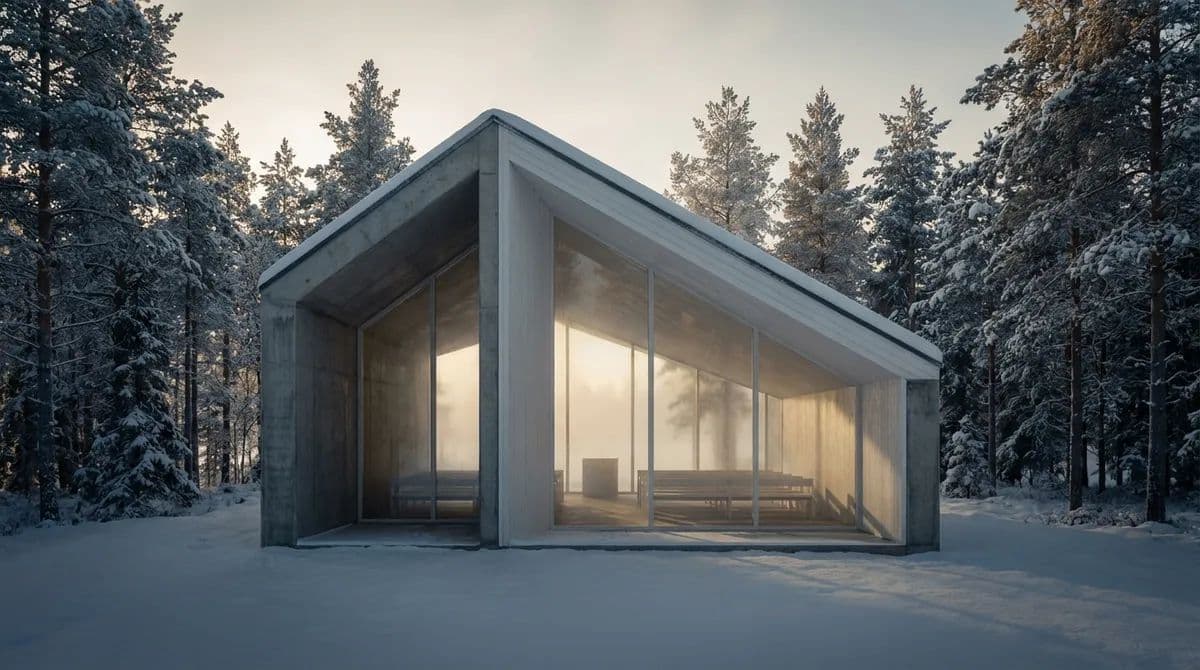
The Architecture of Silence: Minimalist Cathedrals of Northern Europe

Priya Sharma
Writer
There is a moment, stepping into certain buildings, when the noise inside your skull simply stops. Not because you have willed it, not because you are trying to meditate or be present or any of the other exhausting imperatives of modern wellness culture, but because the space itself has made silence unavoidable. The walls have conspired with the light. The ceiling has entered into an agreement with the floor. And you, the visitor, the tourist clutching a guidebook and nursing a mild headache from too much coffee, find yourself suddenly, involuntarily still.
This is what sacred spaces architecture does at its most potent: it doesn't ask you to be quiet. It makes quiet the only possible response.
I first encountered this phenomenon not in a famous cathedral or a revered temple, but in a small wooden chapel on the outskirts of Turku, Finland, on a February afternoon when the sun set at half past three and the birch trees outside were sketched in charcoal against a sky the color of pewter. The chapel was unlocked, unattended, and entirely empty. There was nothing to see, really -- pale wood, a simple altar, a window that framed the snow-covered cemetery beyond. And yet I stayed for nearly an hour, doing nothing, thinking almost nothing, held in place by something I still struggle to name. The building had composed a silence so complete that leaving felt like an act of disruption.
That afternoon began a preoccupation that has shaped the way I travel ever since: a search for buildings that practice architecture appreciation travel in reverse -- structures that strip away rather than accumulate, that use emptiness as their primary material, that understand how much can be said by saying almost nothing at all.
The Finnish Tradition: Where Less Becomes Everything
Finland's relationship with architectural silence runs deeper than aesthetics. It is rooted in something cultural, perhaps even geological -- the vast forests, the lakes that freeze into planes of pure geometry, the long winters that teach you how to be alone with your thoughts without panicking. Finnish architects have always understood that a building's most important material is the space it encloses, not the walls that enclose it.
The Kamppi Chapel of Silence in Helsinki is perhaps the most visited expression of this philosophy, though "visited" feels like the wrong word for what happens there. Designed by K2S Architects and opened in 2012, it sits in the middle of Narinkka Square, surrounded by the cheerful commercial chaos of shopping centers and tram stops. From outside, it resembles a wooden vessel, a curved form clad in spruce planks that have weathered to a silvery grey. There is no cross, no bell tower, no obvious signifier that this is a place of worship -- or, more accurately, a place of non-worship, since the Kamppi Chapel is explicitly ecumenical, open to anyone of any faith or none.
Inside, the effect is immediate and almost physical. The curved walls rise to a height of eleven meters, tapering toward a skylight that admits a column of diffuse Nordic light. The only furnishings are a few simple benches and a small shelf of electric candles. The wood absorbs sound so effectively that the traffic and conversation outside might as well be in another country. People enter, sit down, and fall silent -- not because they are instructed to, but because the architecture makes noise feel like a violation of some unspoken contract.
What strikes me about Kamppi, and about Finnish sacred architecture more generally, is the refusal to manipulate. There are no tricks of scale designed to make you feel small and God feel large. No gold leaf, no dramatic lighting, no acoustic engineering to amplify a whisper into something portentous. The building simply offers you emptiness and trusts you to fill it -- or not -- with whatever you need.
Further north, in Muurame, Alvar Aalto's church from 1929 demonstrates that this tradition has deep roots. Aalto, who would go on to become Finland's most celebrated architect, designed the Muurame Church when he was just thirty-one, and already his instinct for restraint was fully formed. The white interior, the careful placement of windows to catch the low Arctic light, the way the space seems to breathe -- it all anticipates the minimalist sacred spaces that Scandinavian architects would spend the next century refining.
Tadao Ando and the Church of Light
If Finnish architects arrived at architectural silence through cultural inheritance and climate, Tadao Ando arrived at it through concrete. The self-taught Japanese architect -- a former boxer who never attended architecture school -- has spent his career exploring how the most industrial of materials can produce the most transcendent of spaces.
His Church of the Light in Ibaraki, Osaka, completed in 1989, is arguably the most famous minimalist sacred space in the world, and it earns that reputation honestly. The building is essentially a concrete box, bisected by a wall set at a fifteen-degree angle to the main volume. Behind the altar, a cruciform slit in the concrete wall admits a cross of pure light that shifts and changes throughout the day. There is no glass in the slit -- Ando wanted the congregation to feel the weather, to hear the rain, to experience the cross not as a symbol but as a physical phenomenon.
The pews are made from recycled scaffolding planks. The floor is bare concrete. In winter, the unheated space is bitterly cold. These are not oversights or budget compromises; they are theological decisions rendered in architecture. Ando has spoken about wanting to create spaces where people confront the elemental -- light, shadow, wind, temperature -- without the mediation of comfort. His buildings are contemplative travel destinations not because they are pleasant but because they are truthful.
What Ando shares with his Finnish counterparts is an understanding that sacred architecture does not require grandeur. His Water Temple on Awaji Island invites visitors to descend through a lotus pond into an underground hall washed in vermillion light. His Meditation Space at the UNESCO headquarters in Paris is a cylinder of concrete and granite barely large enough to hold a dozen people. Each space achieves its power not through addition but through subtraction -- by removing everything that is not essential until only the essential remains.
The Scandinavian Chapel Trail
Between Finland's wooden silence and Japan's concrete austerity, there exists a constellation of Nordic chapels and churches that constitute one of Europe's most rewarding -- and least promoted -- architectural pilgrimages.
In the forests outside Gothenburg, Erik Gunnar Asplund's Woodland Chapel at the Skogskyrkogarden cemetery is a masterwork of architecture that disappears into its surroundings. Built in 1920, the small domed chapel sits beneath a canopy of pine trees, its shingled roof deliberately mimicking the forest floor. Inside, the dome is painted to suggest a night sky, but the overall effect is less of entering a building than of entering a clearing -- a space carved from nature rather than imposed upon it.
Sverre Fehn's Hedmark Museum in Hamar, Norway, while not a religious building, demonstrates the same Nordic genius for making architecture and silence synonymous. Fehn threaded concrete walkways through the ruins of a medieval bishop's fortress, creating a space where past and present coexist in a conversation conducted entirely in whispers. The museum is a masterclass in how restraint can generate more emotional power than spectacle.
And then there is the Arctic Cathedral in Tromso, which complicates the narrative beautifully. Jan Inge Hovig's 1965 design is anything but minimal -- its soaring triangular form and enormous stained-glass window are dramatic, even theatrical. And yet the interior achieves a silence that rivals any of the spare chapels discussed above. The secret is in the geometry: the converging planes of the walls and ceiling create a sense of compression that quiets the mind even as the scale impresses the eye. It is a reminder that architectural silence is not always about simplicity. Sometimes it is about finding the single gesture that makes all other gestures unnecessary.
The Theology of Emptiness
Why do these spaces affect us so deeply? Part of the answer is neurological -- studies have shown that minimalist environments reduce cognitive load, allowing the brain's default mode network to activate, the same network associated with daydreaming, introspection, and creative thinking. But science only takes us so far. There is something happening in these buildings that transcends the measurable.
The Japanese concept of "ma" -- the pregnant void, the meaningful pause between events -- comes closer to capturing it. In Japanese arts, from flower arrangement to music to architecture, what is not there is as important as what is. A pause in a conversation can say more than the words that surround it. An empty wall can be more eloquent than one covered in frescoes.
Finnish architects seem to have arrived at a similar understanding independently, perhaps because the landscape itself is a teacher of ma. When you live in a country where the sky is your ceiling for months on end, where forests extend to the horizon in every direction, where winter strips the world down to black and white, you learn that emptiness is not absence. It is presence waiting to be noticed.
This is what makes these minimalist cathedrals so different from the tourist-trail churches of Rome or Barcelona or Seville, magnificent as those are. The great baroque and gothic churches overwhelm you with the glory of God and the ingenuity of humans. They fill every surface with narrative, every corner with craftsmanship. They are buildings that talk, ceaselessly and brilliantly. The churches of Northern Europe and Japan, by contrast, are buildings that listen.
Beyond Religion: Secular Silence
The hunger for architectural silence extends well beyond the religious. Peter Zumthor's Therme Vals in Switzerland, while technically a spa, functions as a secular cathedral of stone and water and steam. The space is designed around the experience of moving between hot and cold, light and dark, sound and silence -- a choreography of the senses that leaves visitors in a state closer to meditation than relaxation.
Similarly, the Chichu Art Museum on Naoshima Island, another Tadao Ando creation, buries its galleries underground so that art is encountered in conditions of near-total silence. James Turrell's installations within the museum -- which manipulate light and perception -- achieve their full impact only because the architecture has first stripped away every distraction. You cannot see what Turrell is showing you until Ando has silenced everything else.
These secular temples of quiet suggest that our need for architectural silence is not fundamentally religious. It is human. In an age of constant notification, perpetual connectivity, and the ambient roar of commerce, the building that offers genuine silence has become as radical as any avant-garde manifesto. Perhaps more so: manifestos add to the noise. Silence subverts it.