The Acoustic Wonders You've Never Heard Of

Carmen Ruiz
Writer
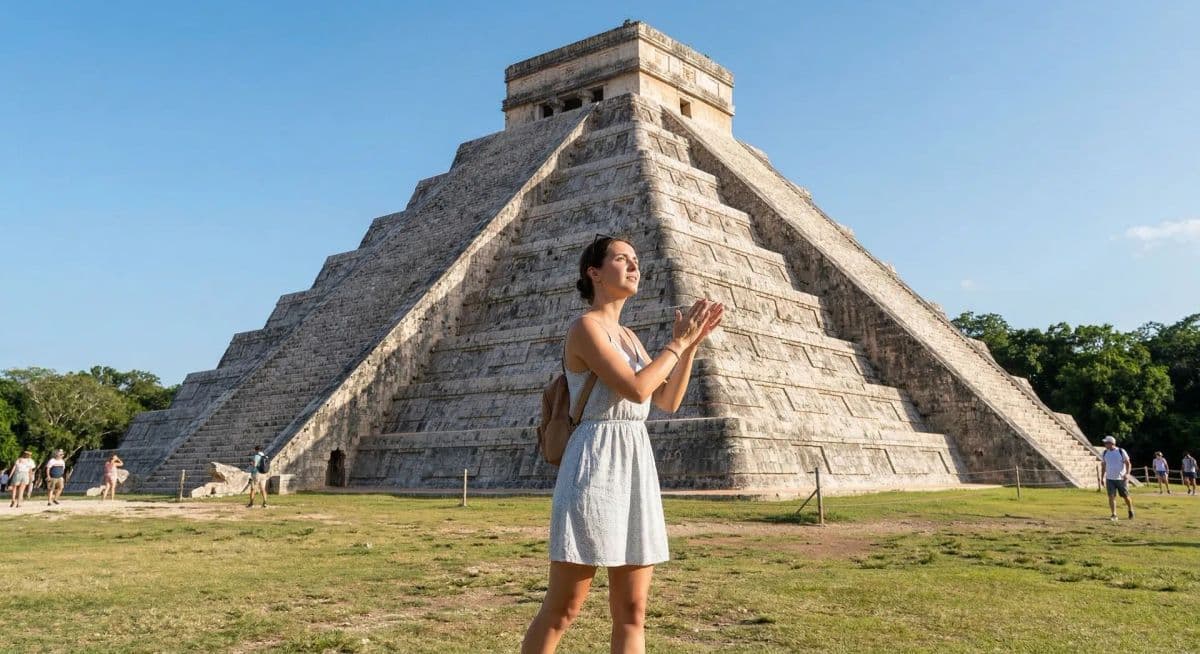
There is a staircase in the Mayan ruins of Chichen Itza that does something no guidebook adequately prepares you for. Stand at the base of El Castillo — the great stepped pyramid that dominates the site — and clap your hands once, sharply. What returns is not an echo. It is a chirp. A high, descending note that sounds uncannily like the call of the quetzal, the sacred bird of Mesoamerican mythology. The sound drops in pitch as it decays, mimicking the bird's distinctive cry with a fidelity that seems impossible for stone and air to produce. Archaeoacoustic researchers have confirmed what the Maya likely knew eight centuries ago: the dimensions of the pyramid's steps create a frequency-dependent diffraction effect that transforms a percussive impulse into a tonal response. The building is, in a literal sense, a musical instrument. And it is only one of the acoustic wonders of the world that most travelers walk past without ever hearing.
We have mapped the world's visual wonders exhaustively. Every guidebook ranks them, every traveler collects them, every social media feed displays them. But the world's acoustic wonders — places where architecture, geology, or atmospheric conditions create sounds that defy everyday experience — remain largely unknown, unvisited, and undocumented by anyone other than a small community of archaeoacousticians and sound artists. This is an extraordinary oversight. To experience places through sound at these sites is to encounter something that photographs cannot capture and words can only approximate: the uncanny sensation of a place that speaks back.
Whispering Galleries: Architecture as Telephone
The most famous acoustic wonder in the Western world sits 259 steps above the floor of St. Paul's Cathedral in London. The Whispering Gallery, a circular walkway running around the interior of the dome, demonstrates a phenomenon that has fascinated scientists since Lord Rayleigh first explained it in 1878: sound waves traveling along a concave surface lose very little energy, allowing a whisper pressed against the wall on one side of the dome to be heard clearly by someone on the opposite side, 34 meters away. The whisper does not cross the open space — it creeps along the wall, hugging the curved surface in what physicists call a "gallery wave."
St. Paul's is the most visited, but it is far from the only whispering gallery in the world. The dome of the Capitol Building in Washington, D.C., produces a similar effect, as does the circular reading room of the British Museum. The Gol Gumbaz mausoleum in Bijapur, India — which houses the second-largest pre-modern dome ever built — takes the phenomenon to an extreme: a single clap is repeated up to seven times by the dome's acoustics, and a whisper at any point along the circular gallery can be heard at every other point simultaneously. The effect is disorienting, almost hallucinatory — standing inside the Gol Gumbaz is like being inside the ear itself.
But perhaps the most haunting whispering gallery is the least known. The Echo Wall at the Temple of Heaven in Beijing, a circular stone wall surrounding the Imperial Vault of Heaven, allows two people standing at any two points along the wall's 193-meter circumference to carry on a conversation at normal speaking volume. The wall, built in 1530, predates Rayleigh's physics by 348 years, and its acoustic properties were clearly intentional — the Temple of Heaven was designed as a conduit between the emperor and heaven, and sound was understood as the medium of that communication. To speak along the Echo Wall is to participate in a five-hundred-year-old acoustic ritual that has outlived the empire that created it.
The Chirping Pyramids of Mesoamerica
The quetzal echo at Chichen Itza is the most famous example of what researchers call "acoustic artifacts" in pre-Columbian architecture, but it is far from the only one. The staircase of the Moon Pyramid at Teotihuacan, outside Mexico City, produces a different acoustic effect: a flutter echo that transforms a single handclap into a rapid series of reflections, creating a sound that some researchers compare to the patter of rain on water. Given that Tlaloc, the rain god, was the pyramid's primary deity, the acoustic design may have been deliberately devotional.
At the Mayan site of Palenque, the palace complex contains a series of corridors that act as natural amplifiers. A speaker standing at one end of the main gallery can be heard clearly by hundreds of listeners in the courtyard — a feature that suggests the architecture was designed for public address in an era before any form of electronic amplification. The acoustics of these spaces are so effective that modern sound engineers, invited to study them, have expressed admiration for their sophistication.
The question of intentionality is the great debate of archaeoacoustics. Did the Maya design El Castillo to produce the quetzal chirp, or is it a coincidence of geometry? The evidence tilts toward deliberateness. The quetzal was the most sacred creature in Mayan cosmology, associated with the feathered serpent god Kukulkan, to whom the pyramid is dedicated. The stepped dimensions that produce the chirp effect are not structurally necessary — the pyramid could have been built with different proportions and remained just as stable. And the Maya were sophisticated acousticians in other contexts, designing ball courts with parabolic walls that allowed referees to be heard by thousands. To dismiss the chirp as accident requires ignoring a pattern of acoustic intelligence that runs through the entire civilization.
Singing Sands and Booming Dunes
Not all acoustic wonders are human-made. In the deserts of the Gobi, the Sahara, the Arabian Peninsula, and parts of California, certain sand dunes produce sounds so loud and so sustained that they have been described in literature for over a thousand years. Marco Polo wrote of "spirits of the desert" producing "all kinds of musical instruments, and also of drums and the clash of arms." Charles Darwin, encountering singing sands in Chile, called the sound "remarkable."
The phenomenon occurs when dry, uniformly sized sand grains avalanche down a steep dune face. The friction between the moving grains creates a vibration that the dune amplifies, producing a low-frequency hum that can exceed 100 decibels — louder than a jackhammer. The pitch depends on the grain size and the dune's dimensions: the Kelso Dunes in California produce a note around 90 hertz, a deep bass that you feel more than hear. The singing dunes of the Badain Jaran desert in Inner Mongolia produce a higher tone, around 150 hertz. And the great star dunes of the Saharan erg near Timimoun in Algeria have been reported to produce sustained tones lasting up to fifteen minutes.
What makes booming dunes genuinely strange is that the phenomenon is still not fully understood. Multiple competing theories exist — some emphasizing the grain-to-grain friction, others the resonance of the dune body itself, others the role of a thin, hard subsurface layer that acts as a vibrating membrane. What is agreed is that the conditions are surprisingly specific: the sand must be dry, the grains must be within a narrow size range (typically 150-300 micrometers), and the dune must be of a certain minimum size. Wet the sand, and the effect vanishes. Disturb the grain sorting, and it vanishes. The singing dune is a fragile instrument that only plays under precise conditions.
Neolithic Sound Chambers
In the Hal Saflieni Hypogeum on Malta — a subterranean temple complex carved from limestone approximately five thousand years ago — there is a small chamber known as the Oracle Room. Stand in this chamber and speak in a low baritone, somewhere around 110 hertz, and the room comes alive. The walls vibrate. The sound swells and sustains, filling the space with a resonance that is felt in the bones as much as heard in the ears. Researchers using modern acoustic measurement equipment have confirmed that the Oracle Room is tuned to amplify frequencies in the 110-hertz range with extraordinary precision — the same frequency range that neuroscience research has since associated with shifts in brain activity toward meditative and trance-like states.
Similar acoustic tuning has been found in Neolithic passage tombs across Ireland, Scotland, and Orkney. Newgrange, the famous Irish passage tomb that predates Stonehenge by a thousand years, has a chamber that resonates strongly at frequencies between 95 and 120 hertz — a baritone voice, or the note of a low drum. The Camster Round cairn in Caithness resonates at 4 hertz — below the threshold of human hearing, but within the range that produces physiological effects including disorientation and a sense of awe. These are not accidents of construction. The builders of these tombs understood something about the relationship between sound, stone, and human consciousness that we are only now beginning to measure.
The implications are profound. If Neolithic cultures were deliberately tuning their sacred spaces to frequencies that alter brain states, then the history of acoustic architecture does not begin with the Greeks, as conventionally taught, but five thousand years earlier, in the stone chambers of Malta and the passage tombs of Ireland. The acoustic wonders of the ancient world may be far more numerous — and far more intentional — than anyone suspected.
Musical Roads and Accidental Instruments
The modern world has produced its own acoustic curiosities, some deliberate and some accidental. Musical roads — highways with precisely spaced grooves cut into the asphalt that play a melody when a car drives over them at the correct speed — exist in Japan, South Korea, Denmark, and the United States. The most famous, in Lancaster, California, plays a somewhat approximate rendition of the "William Tell Overture" for drivers traveling at 55 miles per hour. Japan's Melody Roads, scattered across Hokkaido and other regions, play folk songs with considerably more accuracy.
Then there are the accidental instruments. The Clifton Suspension Bridge in Bristol produces a deep, resonant hum in certain wind conditions — a sound that Brunel never intended but that has become part of the bridge's identity. The jet engine test cells at Heathrow Airport create infrasonic waves that can be felt, though not heard, in nearby neighborhoods. And the Golden Gate Bridge, after a railing renovation in 2020, began producing an eerie, whistling drone in high winds — a sound so unexpected and so persistent that it alarmed San Francisco residents and generated international news coverage. The new aluminum railings, with their aerodynamic slat design, had created the world's largest accidental aeolian harp.