Star-Bathing: Traveling to the Last Dark Skies

Carmen Ruiz
Writer
The first thing that happens when you see a truly dark sky is that you lose your balance. Not metaphorically — literally. Your vestibular system, accustomed to the stable visual horizon provided by ambient light, suddenly has no reference point. The ground is dark. The sky is dark. And between them, where you expected the reassuring glow of civilization, there is instead an abyss of stars so dense and so deep that your inner ear cannot reconcile the visual information with the gravitational information, and for a vertiginous moment you feel as though you might fall upward. This is the experience that stargazing travel destinations promise and that, in the best of them, they deliver: not merely a view of the night sky but a recalibration of your sense of scale, a physical encounter with the universe's indifference to your existence that is, paradoxically, one of the most moving experiences available to a human body standing on the surface of the earth.
Ninety-nine percent of the population of Europe and the United States lives under light-polluted skies. For most people alive today, the Milky Way is not a visible feature of the night but an abstraction, something known from photographs and planetarium projections but never directly perceived. The last generation to routinely see the full night sky — the thirty-five hundred stars visible to the naked eye on a clear, dark night, plus the luminous band of our own galaxy arcing overhead like a bridge made of light — was born before the widespread electrification of rural areas in the mid-twentieth century. Since then, the night sky has been progressively erased, and with it a sensory experience that shaped human consciousness for two hundred thousand years: the nightly confrontation with infinity.
The Atacama: Where Astronomy Lives
Chile's Atacama Desert is the driest non-polar desert on earth, and its altitude, aridity, and remoteness from urban light sources make it one of the finest stargazing locations on the planet. This is not a subjective assessment. It is the reason that the world's most powerful ground-based telescopes — the European Southern Observatory's Very Large Telescope, the Atacama Large Millimeter Array, the forthcoming Extremely Large Telescope — are clustered on the mountaintops above the desert floor. The astronomers chose this place because the sky here is, by measurable standards, the clearest and darkest available.
But you do not need a telescope to experience the Atacama sky. You need only to walk outside after sunset, away from the handful of small towns that dot the desert, and look up. The adjustment takes about twenty minutes — that is how long the human eye needs to fully dark-adapt, for the rod cells in the retina to reach their maximum sensitivity — and during those twenty minutes, the sky unfolds. First the brightest stars appear, the familiar constellations assembling themselves like old friends arriving at a party. Then the fainter stars fill in, thousands of them, until the spaces between the constellations are no longer dark but granular, textured, alive with points of light too faint to resolve individually but collectively bright enough to cast a dim shadow on the desert floor. And then the Milky Way emerges, not as a faint smudge but as a structural feature of the sky — a river of light with dark lanes and bright nebulae visible to the naked eye, so vivid and so present that it seems to have weight, as though it might drape itself across the mountain ridges like a luminous fog.
The Atacama teaches you something about the relationship between dryness and clarity. Water vapor in the atmosphere scatters and absorbs light, which is why humid places produce hazy skies. The Atacama's air is so dry that some weather stations have recorded years without measurable rainfall, and this aridity produces a transparency that makes the sky feel closer, more immediate, as though the atmosphere itself has thinned to the point of near-absence. You are not looking through the air at the stars. You are looking at the stars with almost nothing in between.
NamibRand: The African Dark
Namibia's NamibRand Nature Reserve, on the edge of the Namib Desert, was designated an International Dark Sky Reserve in 2012 — one of the first in Africa and one of the largest in the world. The reserve covers more than two hundred thousand hectares of desert and mountain terrain, and its management plan includes strict controls on artificial lighting: no exterior lights that shine above the horizontal plane, no unshielded bulbs, no illumination of the sky for any purpose. The result is a darkness so complete that on moonless nights, the only light source visible from the reserve's interior is the Milky Way itself.
The dark sky parks travel experience in NamibRand is distinctive because the landscape participates in the darkness. The Namib Desert's sand dunes — some of the tallest in the world, reaching heights of three hundred meters — create a horizon line that rolls and undulates like a frozen sea, and at night these dunes become silhouettes against the star field, their shapes defined not by light falling on them but by the light they block. The effect is theatrical in the most literal sense: the dunes are the stage flats, the stars are the backdrop, and you are the sole audience member in an amphitheater that stretches to every horizon.
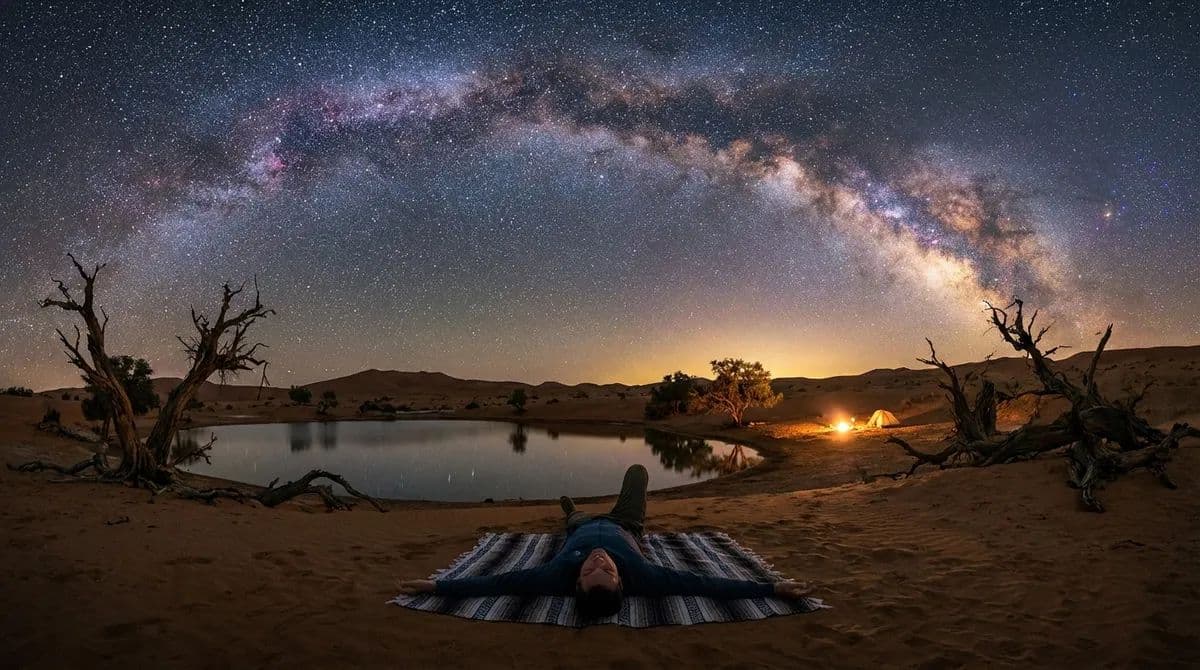
The wildlife of the desert is nocturnal in ways that complement the stargazing. Aardwolves and bat-eared foxes emerge from their burrows after sunset. Brown hyenas patrol the gravel plains. Barking geckos produce their strange, repetitive calls — a sound like a tiny dog trapped in a matchbox — creating a sonic texture that accompanies the visual spectacle of the sky. The experience of lying on the desert sand, looking up at the Milky Way while listening to the sounds of animals you cannot see, is a reminder that darkness is not emptiness. It is fullness experienced through senses other than sight.
Coll: The Scottish Outpost
The Scottish island of Coll, in the Inner Hebrides, became one of the world's first island dark sky communities in 2013. With a permanent population of fewer than two hundred people and no street lighting, Coll achieves a natural darkness that most communities lost decades ago. The island's latitude — fifty-six degrees north — means that the winter nights are extraordinarily long, with only six hours of daylight around the solstice, providing extended windows for observation.
But Coll's darkness is different from the Atacama's or NamibRand's. It is a wet darkness, a maritime darkness, a darkness in which the weather is as much a part of the experience as the stars. Clear nights on Coll are spectacular — the Milky Way arches over the island with a brilliance amplified by the surrounding sea, which absorbs light rather than reflecting it, deepening the darkness at the horizons — but clear nights are not guaranteed. The North Atlantic weather produces cloud systems that can obscure the sky for days, and part of the Coll experience is the waiting, the checking of forecasts, the stepping outside every hour to assess the cloud cover, the particular elation of a break in the weather at two in the morning when the clouds part and the sky opens like a curtain and the stars appear with the suddenness and intensity of a surprise.
This unpredictability is, strangely, part of the value. In the Atacama, where clear skies are virtually guaranteed, stargazing can feel almost too easy — the sky is always there, always available, and the surplus of certainty can produce a paradoxical complacency. On Coll, every clear sky is a gift, and gifts are appreciated in proportion to their uncertainty. The islanders know this. They have a tradition of telephoning each other when the aurora borealis appears — the island is far enough north to see the northern lights during periods of high solar activity — and these calls have the excited, conspiratorial tone of people sharing a secret that the sky has decided, for reasons of its own, to reveal.
Aoraki Mackenzie: The Southern Cross
New Zealand's Aoraki Mackenzie International Dark Sky Reserve, established in 2012 around the slopes of Aoraki/Mount Cook and the shores of Lake Tekapo, is the largest dark sky reserve in the world and the only one in the Southern Hemisphere to hold the highest "gold tier" status. The reserve's significance lies not only in its darkness but in its position: from this latitude, forty-four degrees south, the sky contains features invisible from the Northern Hemisphere, including the Magellanic Clouds — two satellite galaxies of the Milky Way that appear as luminous smudges in the southern sky, each one a separate galaxy containing billions of stars.
The Southern Cross, the constellation that appears on the flags of New Zealand, Australia, Brazil, and several other southern nations, is visible here with a clarity that makes its cultural significance immediately comprehensible. In the Northern Hemisphere, the Southern Cross is an exotic abstraction. From Aoraki Mackenzie, it is a practical navigational tool, its long axis pointing toward the south celestial pole with the reliability of a compass. The Maori name for the constellation is Te Punga — the anchor — and standing on the shore of Lake Tekapo, watching it rise over the mountains, you understand the name intuitively. It anchors the sky. It tells you which way is south and which way is home.
The lake itself adds a dimension to the stargazing that open desert does not provide. On calm nights, the surface of Lake Tekapo becomes a mirror for the sky, and the stars appear both above and below, creating the illusion of standing in a sphere of light with no ground and no ceiling. The Milky Way, reflected in the lake's glacial-blue water, seems to pass beneath your feet. The experience dissolves the boundary between up and down, sky and earth, observer and observed, producing a sensation that is less like looking at stars and more like floating among them.
The Biology of Starlight
The human eye is a remarkable instrument for stargazing, though most people never discover this because they never give it the chance. Full dark adaptation takes twenty to thirty minutes, during which the chemistry of the retina shifts from cone-dominated (color-sensitive, low-sensitivity) to rod-dominated (colorblind, high-sensitivity). Once adapted, the eye can detect single photons — individual packets of light that left a star hundreds of years ago and have been traveling through space ever since, crossing unimaginable distances to arrive, at this exact moment, at the surface of your retina. The act of seeing a faint star is, in a real physical sense, an act of receiving a message from the deep past, delivered at the speed of light across the vacuum of space, and your eye is the instrument that decodes it.
This biological capacity is ancient. It evolved under dark skies, in a world without artificial light, where the ability to see in low light had immediate survival value — for navigation, for predator detection, for the social life of primates who gathered around fires and read each other's faces by firelight and starlight. The modern eye is the same eye, carrying the same sensitivity, but it has been rendered functionally blind by the pervasive glow of electric light. Traveling to a dark sky reserve is, in this sense, a kind of sensory rehabilitation — a restoration of a capacity that was always there but had been overwhelmed by the noise of a too-bright world.
The Loss and the Seeking
Light pollution is increasing globally at a rate of approximately ten percent per year. Satellite measurements show that the artificially illuminated surface of the earth is growing in both extent and intensity, and the number of places where a truly dark sky can be experienced is shrinking correspondingly. The International Dark-Sky Association has certified only about two hundred dark sky places worldwide, and many of these are under pressure from nearby development, light encroachment from growing cities, and the proliferation of LED lighting, which is more energy-efficient but also more disruptive to natural darkness because of its blue-spectrum emission.
This loss is driving the noctourism movement. The dark sky reserves and parks that have emerged around the world are not tourist attractions in the conventional sense. They are refuges — places where a fundamental human experience is still available, where the sky is still the sky that our ancestors knew, where the night is still dark enough to reveal what darkness has always revealed: the scale of the universe, the insignificance of human concerns, and the strange, deep comfort that comes from confronting both of these truths simultaneously.