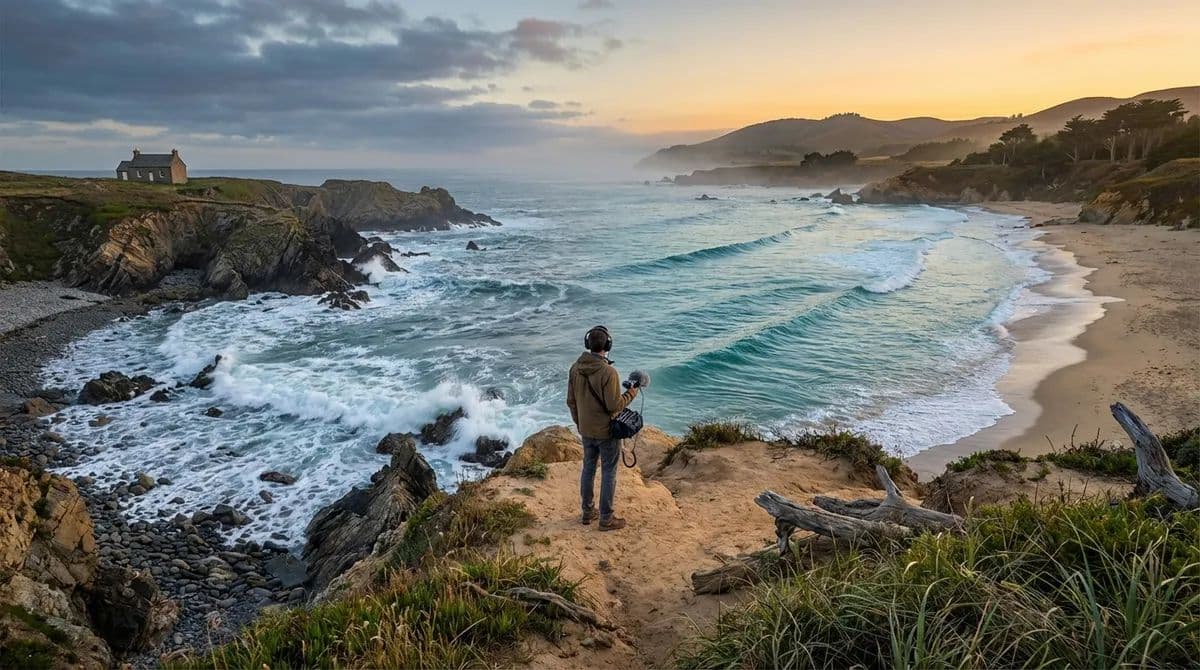
Soundscapes of the Coast: Why the Ocean Sounds Different Everywhere

Carmen Ruiz
Writer
Stand on the Cliffs of Moher in February and close your eyes. The Atlantic does not whisper here — it detonates. Three hundred feet below, waves that have traveled unbroken from Newfoundland slam into limestone and shale with a percussive force that vibrates through your boots, through your ribs, into the hollow of your chest. The wind carries salt spray upward in veils, and with it a sound that is less a roar than a sustained, complex chord: the bass of deep water meeting rock, the mid-range hiss of white water retreating across gravel, the high keening of air forced through crevices in the cliff face. This is the soundscape travel experience of Ireland's west coast — violent, magnificent, unmistakable. And it sounds nothing like the ocean anywhere else on earth.
We speak of "the sound of the sea" as though it were one thing, a single sonic category filed alongside birdsong and rainfall in the library of nature sounds. But this is a profound flattening. The ocean produces radically different sounds depending on wave energy, seafloor bathymetry, shoreline geology, wind exposure, biological activity, and human presence. The gentle lap of the Adriatic against a Venetian fondamenta is a different instrument entirely from the explosive shore break of Nazare, which is different again from the long, sighing withdrawals of the Pacific along Big Sur's granite coast. To travel coastlines with open ears is to discover that the ocean has accents — and that those accents encode geology, climate, and deep time in every wave.
The Physics of a Breaking Wave
To understand why coastal walks and nature sounds vary so dramatically from place to place, it helps to understand what a breaking wave actually is. A wave in open ocean is energy, not water — the water molecules themselves move in circular orbits, rising and falling but traveling almost nowhere. It is the energy that moves, sometimes across thousands of miles of open sea. When that energy reaches shallow water, the circular motion is compressed by the rising seafloor. The wave slows at the bottom but continues at speed on top, creating the familiar curl. When the ratio of wave height to water depth reaches approximately three to four, the wave becomes unstable and breaks.
How it breaks — and therefore how it sounds — depends on the gradient of the approach. A gently sloping sandy beach produces spilling breakers, waves that crumble at the crest and tumble forward in a prolonged, continuous hiss. This is the sound of Waikiki, of the Algarve, of the long sandy stretches of the Outer Banks: a soft, sustained exhalation that generations of sleep-aid apps have tried to replicate. A steeper beach produces plunging breakers — the classic curling tube that surfers chase — which collapse with a sudden, percussive thud followed by a rush of turbulent white water. The sound is more rhythmic, more dramatic, with distinct silences between impacts. And a near-vertical shore produces surging breakers, waves that rush up the face of rock or seawall without truly breaking at all, creating a heavy, slurping sound followed by a long, gravelly withdrawal.
Each of these wave types sounds different not just in volume but in timbre, rhythm, and spatial quality. The spilling breaker is diffuse and enveloping. The plunging breaker is directional and percussive. The surging breaker is intimate and tactile. A traveler who knows this — who can identify a breaking type by ear — possesses a kind of coastal literacy that transforms a walk along any shoreline from scenery into conversation.
Shoreline Geology as Instrument
The material that waves strike is as important as the waves themselves. Basalt, the volcanic rock that forms Iceland's Reynisfjara beach and the Giant's Causeway in Northern Ireland, is dense and resonant. Waves hitting basalt columns produce a deep, almost metallic ring — a sound you feel in your teeth. Chalk, the soft white limestone of the Dover cliffs and Normandy's Etretat, absorbs more energy and produces a muffled, almost padded impact. Granite, as found along the coasts of Brittany, Cornwall, and Maine, falls somewhere between — hard enough to reflect sound, rough enough to scatter it.
Then there is the matter of what lies between the rocks. A pebble beach is one of the ocean's most extraordinary instruments. As each wave retreats, it drags millions of stones across one another, producing a layered, cascading percussion that sounds different on every beach because the stones themselves differ. The flint pebbles of Chesil Beach in Dorset — famously graded by the sea from pea-sized at the east end to fist-sized at the west — produce a descending scale of clatter as you walk along the strand. The smooth basalt pebbles of Santorini's Kamari beach produce a deeper, more resonant rattle. The coral rubble beaches of the Maldives produce a high, almost glassy tinkling.
Sand, too, has its acoustic properties. The quartz sands of the Outer Banks sing — literally. Certain beaches, when conditions are right, produce a squeaking or booming sound underfoot, caused by friction between uniformly sized, highly polished grains. The "singing sands" of Eigg in Scotland, the "barking sands" of Kauai in Hawaii, and several beaches along the coast of Oman all exhibit this phenomenon. The sound is startling, almost comical — a deep, resonant hum rising from beneath your feet as you walk, as though the beach itself were protesting the disturbance.
Ocean Sounds on Different Beaches
The differences between coasts are not merely academic. They are felt. The traveler who has stood on a beach in the Seychelles, where the Indian Ocean arrives in long, slow rollers that break with a soft, almost pneumatic thud on granite boulders the size of houses, knows a fundamentally different ocean than the one who has watched the North Sea chew at the Yorkshire coast in short, angry chops that sound like applause.
Consider the contrast between two iconic Pacific coastlines. Big Sur's coast faces southwest into the world's largest ocean, receiving swells that originate in storms near Antarctica and travel unimpeded for eight thousand miles. By the time they reach the California coast, these swells are long-period — the time between crests can exceed twenty seconds — and they break with an almost geological slowness, a deep, building roar followed by a sustained exhalation as the white water spreads across the rocks. The sound is epic, cathedral-like, befitting the scale of the landscape.
Now consider the coast of Okinawa, where the Pacific meets a fringing coral reef that dissipates wave energy hundreds of meters from shore. By the time the water reaches the beach, it arrives in small, gentle pulses — a soft, rhythmic lapping barely louder than a conversation. The dominant sound is not the waves at all but the biological reef system: the crackling of snapping shrimp, the grinding of parrotfish teeth on coral, the occasional splash of a fish breaching. It is an entirely different ocean — quieter, more intimate, more alive — though it carries the same name on every map.
The Biological Chorus
The ocean is not silent between waves. Marine biologists have only recently begun to catalog the extraordinary acoustic richness of coastal ecosystems, and what they have found challenges the old assumption that the underwater world is a "silent deep." Coral reefs are among the noisiest environments on earth, producing a constant crackling, popping, and clicking that can be heard above water on calm days. Kelp forests create a distinctive rustling sound as their fronds sway in the current. Rocky shores at low tide are alive with the popping of sea anemones, the scraping of limpets, and the bubbling of trapped air escaping from crevices.
These biological sounds vary dramatically by geography and season. The spring mating chorus of toadfish in the Chesapeake Bay is loud enough to disturb houseboats. The synchronized clicking of pistol shrimp on tropical reefs can exceed 200 decibels underwater. The song of humpback whales, audible above water in calm conditions in Hawaii, Tonga, and the Silver Bank off the Dominican Republic, adds a haunting, otherworldly layer to the coastal soundscape that no recording can fully capture.
For the traveler willing to sit quietly at the water's edge, these biological sounds offer a dimension of coastal experience that most visitors miss entirely. The trick, as with all mindful listening, is simply to wait. The first five minutes on a beach, your ears are saturated by the dominant sound of waves. But as you settle in, as the ear adjusts, the secondary and tertiary layers emerge — the birds, the insects, the living reef, the wind through coastal grasses. The soundscape deepens, and with it your sense of being inside the ecosystem rather than merely looking at it.
Cultural Soundmarks of the Shore
Human communities have been shaping coastal soundscapes for millennia, and the acoustic culture of a coastline is as distinctive as its geology. The fog horns of the Pacific Northwest — deep, mournful, spaced at precise intervals — are among the most recognizable coastal soundmarks in the world, and their gradual decommissioning as GPS replaces auditory navigation represents a genuine cultural loss. The wooden-hulled fishing boats of Kerala, launched through the surf each morning by teams of men chanting in unison, create an acoustic event that has likely remained unchanged for centuries. The muezzin's call drifting across the harbor of Zanzibar's Stone Town at sunset, mixing with the creak of dhow rigging and the slap of wavelets against coral stone quays, produces a soundscape of such layered beauty that it functions almost as civic music.
Even the absence of certain sounds tells a story. The coasts of Japan, before 2011, had a distinctive sonic character shaped by the rhythmic activity of fishing communities — the thrum of engines, the rattle of nets, the early-morning fish auctions conducted in a rapid, stylized chant. The tsunami silenced entire stretches of coast, and though communities have rebuilt, the acoustic texture has changed. Some harbors are quieter now. Some species of bird have moved in where fishing boats no longer run. The soundscape carries the memory of the disaster in ways that the rebuilt seawalls do not.