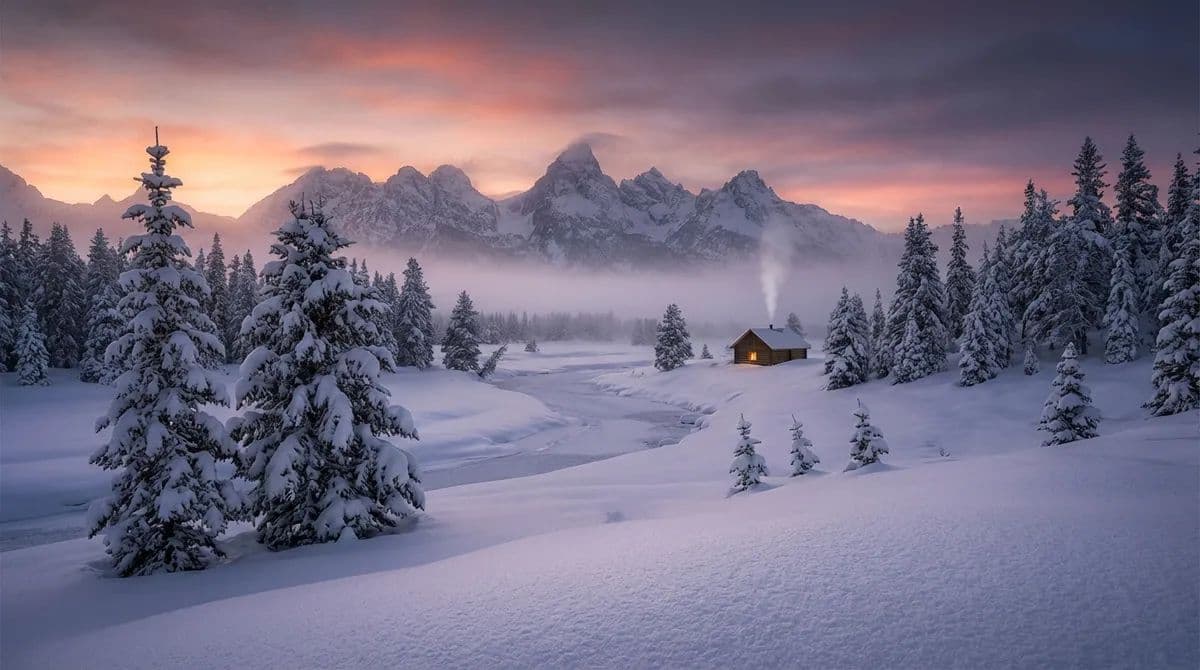
Snow as Silence: Winter Destinations Where Sound Disappears

Marcus Webb
Writer
The silence arrives before you understand what has happened. You stepped out of the cabin in Finnish Lapland ten minutes ago, into a landscape so white that the horizon has dissolved — the snow-covered ground and the overcast sky are the same shade of pale, and the birch trees between them are thin black lines drawn on an almost-blank page. You stood still to look. And then, gradually, you noticed that you were not hearing anything. Not quiet. Not low-level background noise. Nothing. The wind had stopped. No birds were calling. No distant engine hummed. The snow, which had been falling all night and lay fresh and undisturbed in every direction, had absorbed the world's sound the way a sponge absorbs water, and what remained was a silence so complete that you could hear your own blood moving through your ears — a faint, rhythmic whoosh that is normally masked by the ambient noise of civilization but that here, in the winter quiet of a landscape purpose-built for stillness, became the loudest thing in the world. These are the winter travel destinations where sound disappears, and they offer something that no other environment on earth can provide: the experience of hearing nothing.
Fresh snow absorbs up to sixty percent of ambient sound. This is not a poetic claim. It is an acoustic measurement, documented in studies of nature soundscapes and environmental noise. The mechanism is straightforward: fresh snow is porous, full of tiny air pockets between ice crystals, and these air pockets trap sound waves the way acoustic foam traps sound in a recording studio. The softer and newer the snow, the more effective the absorption. Packed snow, ice, and crusted surfaces lose this quality — they become reflective, bouncing sound rather than absorbing it. But fresh powder, the kind that falls overnight and lies undisturbed in the morning light, is one of the most effective natural sound-dampening materials on the planet.
Lapland: The White Room
Finnish Lapland in winter is an exercise in sensory reduction. The color palette is reduced to white, gray, black, and the occasional deep green of a spruce tree. The temperature — routinely minus twenty-five to minus thirty-five degrees Celsius — reduces the range of smells to almost nothing; cold air carries fewer volatile molecules, and the frozen landscape produces no biological odors. The daylight is reduced to a few hours of twilight around midday, the sun never properly rising but instead producing a prolonged blue dusk that gives everything the quality of an underexposed photograph.
And the sound is reduced to silence. Not the relative silence of a quiet countryside, where you can still hear a distant highway or the drone of an airplane or the bark of a dog on a neighboring farm, but an absolute silence, a zero-level acoustic environment that feels, the first time you encounter it, like a physical presence. The silence has weight. It presses against your eardrums. It makes the small sounds you do produce — the crunch of your boots on the snow, the rustle of your jacket, the sound of your own breathing — seem startlingly loud, almost obscene, as though you were shouting in a library.
The Sami people, the indigenous inhabitants of Lapland, have a relationship with winter silence that is both practical and spiritual. The reindeer herders who still practice semi-nomadic pastoralism across the Arctic tundra read the silence for information: the quality of the quiet tells them about snow conditions, wind direction, the proximity of a herd. A silence that is too complete — too dead, too uniform — suggests that the wind has stopped entirely, which in Arctic conditions can mean that extremely cold air is settling into the valleys, a dangerous development. A silence with a faint, distant rumble may indicate a reindeer herd on the move. The silence is not empty. It is a signal, and the Sami have been reading it for thousands of years.
For the mindful travel experiences seeker, Lapland's winter silence offers something that meditation retreats attempt to manufacture and rarely achieve: a natural environment that eliminates external stimulation and forces the mind to confront its own noise. In a silent landscape, the internal monologue becomes audible in a way it never is in cities, and the experience of hearing your own thoughts without the usual background of sensory input is, for many people, simultaneously restful and unsettling. The silence does not relax you. It empties you. What happens after that — whether the emptiness fills with peace or with anxiety — depends on what you brought with you.
Hokkaido: Powder and Stillness
Japan's northernmost island receives some of the heaviest snowfall on earth. The combination of cold Siberian air masses passing over the relatively warm Sea of Japan produces a phenomenon called lake-effect snow — or, more accurately, sea-effect snow — that dumps meters of powder on the mountains and valleys of central Hokkaido between December and March. The town of Niseko has become famous among skiers for this snow, which is so dry and light that it has earned the nickname "Japow" — Japanese powder — and is considered among the finest ski snow in the world.
But the acoustic qualities of Hokkaido's snow are as remarkable as its skiing qualities. The extreme dryness of the snow — its low moisture content, its high ratio of air to ice — makes it an exceptionally effective sound absorber. Walking through the birch forests above Niseko after a fresh snowfall is an experience of almost hallucinatory quiet. The trees, heavy with snow, form a white corridor that deadens sound from every direction. Your footsteps make a soft, dry squeak — the sound of individual ice crystals deforming under pressure — that carries no further than a few meters before the snow absorbs it. The silence between your steps is so deep that you can hear the snow itself: a faint, intermittent ticking as individual snowflakes land on the surface of the existing pack, a sound so quiet that it exists at the very threshold of human hearing.
The Japanese have a word for this quality: *shizukesa*, which translates imperfectly as "quietness" or "tranquility" but carries a connotation of something more active — not the absence of noise but the presence of silence, silence as a positive quality rather than a privation. The concept appears throughout Japanese aesthetics — in the silent pauses of Noh theater, in the empty space of an ink painting, in the rock gardens of Zen temples — and Hokkaido's winter landscape is its most expansive natural expression. The snow does not merely create quiet. It creates *shizukesa* — the active, intentional, beautiful silence that is one of Japan's most distinctive cultural exports.
The Engadin: Alpine Acoustics
Switzerland's Engadin Valley, in the southeastern corner of the country, has been a winter destination since the nineteenth century, when the resort town of St. Moritz essentially invented the concept of winter tourism by convincing a group of British guests that the Alps in January were not merely tolerable but desirable. The gamble succeeded — the guests returned the following winter, bringing friends — and St. Moritz became the template for every ski resort that followed.
But the Engadin's acoustic qualities predate its tourism industry by millennia. The valley is a deep, U-shaped glacial trough, its floor at an altitude of eighteen hundred meters, its walls rising steeply to peaks above four thousand meters. This topography creates a natural amphitheater, and in winter, when the snow covers every surface, the amphitheater becomes an anechoic chamber — a space in which sound has nowhere to reflect and nothing to reflect off, because every surface absorbs rather than bounces the acoustic energy.
The result is a silence that has a spatial quality unique to mountain environments. In flat terrain — Lapland, for instance — silence is omnidirectional, surrounding you evenly. In the Engadin, silence has architecture. The mountains define the edges of the quiet, and within those edges, the silence has depth and dimension. A sound produced at one end of the valley — a church bell in Sils Maria, say — travels across the snowfield with a clarity that is almost startling, arriving at the other end undistorted and unreflected, because there are no surfaces to scatter it. The philosopher Friedrich Nietzsche, who spent several winters in Sils Maria and wrote some of his most important work there, was fascinated by the valley's acoustic qualities. His concept of "the great silence" — the silence that precedes the most important thoughts — may owe something to the literal silence of the Engadin in January, where the snow and the mountains conspire to produce a quiet so complete that thinking becomes, for once, the loudest activity available.
Patagonia: Wind and Its Absence
Patagonia seems an unlikely entry on a list of silent winter destinations. The region is famous for its wind — the westerlies that blow across the Southern Ocean and hit the Andes with a force that can knock a grown person off their feet. In summer, the wind is relentless, a physical presence that shapes every outdoor experience and makes the landscape feel hostile and exhilarating in equal measure.
But in winter — the austral winter, June through August — the wind patterns shift, and there are days, sometimes weeks, of perfect calm. When the calm coincides with fresh snowfall, the Patagonian steppe undergoes a transformation that is as dramatic as any on earth. The endless grasslands, normally tawny and wind-whipped, become a white plain stretching to every horizon, and the silence that descends is the silence of vast, flat space — not the enclosed, intimate silence of a forest or a valley but the exposed, almost frightening silence of a landscape with nothing in it. No trees. No buildings. No topographic features to break the acoustic monotony. Just snow and sky and the occasional guanaco standing perfectly still in the distance, a brown shape against the white, watching you with the wary attention of a wild animal that has never seen a human in winter.
The Torres del Paine massif, the granite towers that are Patagonia's most iconic landmark, takes on a different character in winter snow. The trails are empty — the park receives a fraction of its summer visitors — and the silence around the towers is broken only by the occasional crack of ice calving from a glacier, a sound like distant thunder that rolls across the snowfield and then subsides into a silence that feels even deeper for having been interrupted. The contrast between the crack and the silence that follows is one of the most powerful acoustic experiences in nature — a reminder that silence is not static but dynamic, that it can deepen, intensify, and become more itself in the aftermath of sound.
The Neuroscience of Snow Silence
The human nervous system was not designed for silence. It evolved in an environment of continuous low-level sound — wind, water, insects, birds, the vocalizations of social primates — and it treats silence not as rest but as an anomaly, a signal that something unusual is happening. This is why true silence can feel unsettling. The brain, deprived of its expected acoustic input, begins generating its own sounds — tinnitus, the perception of ringing or buzzing in the ears, is more noticeable in very quiet environments because the brain, lacking external input, amplifies its own internal noise.
But sustained exposure to natural silence — the kind available in snow-covered landscapes — produces measurable physiological effects that go beyond the subjective experience of "feeling calm." Studies have shown that prolonged quiet reduces cortisol levels, lowers blood pressure, and shifts brain activity from the stress-associated beta waves toward the more relaxed alpha and theta patterns associated with meditation and creative thought. The snow silence of Lapland or Hokkaido or the Engadin is not merely pleasant. It is, in a measurable biochemical sense, therapeutic. The nervous system, exposed to the deep quiet that snow produces, begins to reset toward a baseline that chronic noise has shifted away from.
This is the deeper value of winter travel to quiet places: not escape from noise, but recovery from it. The modern urban environment produces average noise levels of sixty to seventy decibels — roughly equivalent to continuous conversation — and the cumulative effect of this exposure is a chronic low-grade stress that most people have normalized to the point of invisibility. The snow silence does not eliminate this stress. It reveals it, the way cleaning a window reveals how dirty the glass had become. You did not know how loud your life was until you heard what its absence sounded like.