Port Cities and the Art of Arrival

Priya Sharma
Writer
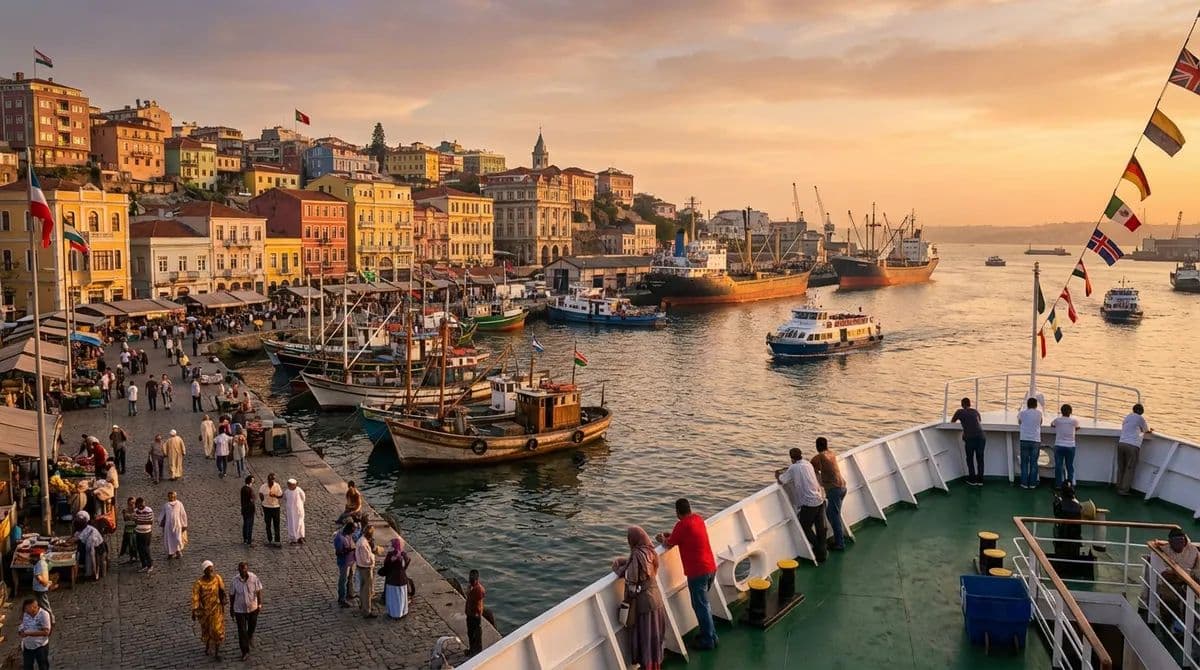
There is a quality that port cities share and that landlocked cities cannot replicate, no matter how cosmopolitan they become. It is the quality of arrival -- the permanent, structural openness to what comes from elsewhere. A port city is, by definition, a city that faces outward, a city whose raison d'etre is the exchange between here and there, between the known and the unknown, between the cargo in the hold and the market on the quay. The hidden stories of cities are most densely layered in ports, because ports are where stories arrive.
I noticed this quality for the first time in Valparaiso, Chile, standing on one of the cerros -- the steep hills that rise from the harbor like an amphitheater of painted houses -- looking down at the container ships in the bay and the funicular railways that climb the hillsides like slow, mechanical insects. Valparaiso is not a beautiful city in the conventional sense. It is weathered, steep, structurally precarious, and perpetually on the verge of sliding into the Pacific. But it has something that beautiful cities often lack: a density of cultural landscape exploration that is directly proportional to its history as a port.
Every wave of maritime arrival has left a deposit. The Spanish colonists left the grid of the lower town. The British merchants left the Victorian banks and warehouses of the Barrio Puerto. The German immigrants left beer gardens and a tradition of Christmas stollen that is still baked in Valparaiso's German bakeries. The Italians left pasta shops and a theatrical tradition. The Chinese left the earliest Chinatown in South America. And the sailors who passed through from everywhere left everything else: the slang that mixes Spanish, English, German, and maritime pidgin; the street art that covers every available surface with images drawn from a hundred traditions; the cuisine that combines local seafood with techniques from half the globe.
This layering -- this geological accumulation of cultural deposits -- is the defining characteristic of port city culture, and it is what makes port cities the most interesting off the beaten path cities for travelers who care about complexity over beauty, depth over polish.
Marseille: The Oldest Port in France
Marseille was founded by Greek sailors from Phocaea in approximately 600 BCE, making it the oldest city in France and one of the oldest continuously inhabited ports in the world. In the twenty-six centuries since, it has been Phoenician, Roman, medieval, colonial, industrial, and postcolonial, and each era has left its mark on the city's cultural DNA in ways that are visible on every street and audible in every conversation.
The cultural landscape exploration of Marseille begins at the Vieux-Port, the old harbor around which the city has organized itself for millennia. The port is no longer commercially active -- the container ships dock at the Joliette, further west -- but it remains the city's psychological center, the place where Marseillais come to sit, eat bouillabaisse, argue about football, and watch the fishing boats return with the day's catch.
The hidden stories of cities are rarely more dramatically visible than in Marseille's neighborhoods. Walk north from the Vieux-Port into the Panier, Marseille's oldest quarter, and you walk through a Mediterranean kasbah: narrow streets, stairs instead of sidewalks, laundry strung between buildings, the smell of spices from North African shops, the sound of Arabic and French and Comorian French and a dozen other languages competing for acoustic space. Walk east into the Cours Julien, and you enter a bohemian quarter of street art, vintage shops, and cafes that would not be out of place in Kreuzberg or Williamsburg. Walk south along the Corniche, and you pass the grand villas of the industrial bourgeoisie who made their fortunes importing colonial goods.
Marseille's identity is not French in the way that Paris or Lyon are French. It is Mediterranean, which means it belongs to the sea more than to the nation-state. Its closest cultural relatives are not the cities of the French interior but the other ports of the Mediterranean basin -- Naples, Barcelona, Istanbul, Alexandria -- cities that share Marseille's layered identity, its polyglot energy, and its fundamental orientation toward the water.
Zanzibar Stone Town: The Crossroads of the Indian Ocean
Stone Town, the historic center of Zanzibar City, is a UNESCO World Heritage Site and one of the most extraordinary port city environments on earth. The architecture alone -- a palimpsest of Swahili, Arab, Indian, and European influences, with elaborately carved wooden doors, coral stone walls, and covered balconies that project over streets barely wide enough for a single car -- tells a story of cultural encounter that spans two millennia.
Zanzibar was, for most of its history, the commercial hub of the Indian Ocean trade network: the point where African ivory, gold, and slaves were exchanged for Indian textiles, Chinese porcelain, and Arabian incense. The port attracted settlers from every corner of the Indian Ocean world, and their descendants still inhabit Stone Town, maintaining distinct cultural traditions -- Omani, Indian Gujarati, Indian Bohra, Swahili, Comorian -- within a shared urban space of extraordinary intimacy.
The cultural landscape exploration of Stone Town is best conducted on foot and without a map, because the town's narrow alleys defy cartographic representation and reward the kind of aimless wandering that reveals hidden mosques, Hindu temples, Zoroastrian fire temples, Anglican cathedrals, and the palace of the Omani sultan -- all within a ten-minute walk of each other. The juxtaposition is not accidental. It is the spatial expression of a port city's essential nature: the willingness to accommodate difference, to make room for the stranger, to allow multiple traditions to coexist in close quarters.
The food of Stone Town reflects this coexistence with particular eloquence. The night market at Forodhani Gardens -- a waterfront gathering of food stalls that sets up each evening as the sun sets over the Indian Ocean -- offers a cuisine that is neither African nor Indian nor Arab but all three simultaneously: Zanzibar pizza (a thin crepe filled with meat, vegetables, and egg), urojo (a turmeric-yellow soup of Indian origin adapted to East African ingredients), and mishkaki (grilled meat skewers seasoned with a spice blend that reflects centuries of Indian Ocean trade).
Yokohama: The Gateway and Its Ghosts
Yokohama's relationship with arrival is more recent and more ambivalent than Marseille's or Zanzibar's. Before 1859, the village that would become Japan's second-largest city was a sleepy fishing settlement on the shore of Tokyo Bay. Then Commodore Perry's Black Ships arrived, and the Tokugawa shogunate, under duress, opened Yokohama as one of the first treaty ports -- a designated zone where foreigners could live, trade, and introduce the outside world to a nation that had been closed for over two centuries.
The off the beaten path cities experience that Yokohama offers is shaped by this sudden, involuntary opening. The city's historic districts -- the Bluff, where foreign merchants built Victorian and Colonial-style houses on the hillside above the harbor; Chinatown, which is the largest in Japan and one of the largest in the world; and the Motomachi shopping street, where Japanese merchants sold Western goods to the foreign residents -- are all products of the treaty port era, and they retain a quality of cultural mixing that feels different from the organic cosmopolitanism of older port cities.
The difference is that Yokohama's cosmopolitanism was imposed rather than evolved. The foreign merchants who settled in the Bluff brought their architecture, their food, and their customs as a package, transplanting them wholesale rather than adapting them to local conditions. The result is a city where Victorian England, Republican China, and Meiji Japan coexist in an arrangement that is visually striking but emotionally complex -- a reminder that not all cultural exchange is voluntary, and that the art of arrival sometimes looks, from the port city's perspective, like the fact of invasion.
Modern Yokohama has metabolized this complexity into something rich and distinctive. The Red Brick Warehouse, a Meiji-era customs building, now houses galleries and event spaces. The waterfront Minato Mirai district is a showcase of contemporary Japanese architecture. And Chinatown remains a living, working community -- not a tourist attraction that happens to be Chinese but a Chinese community that happens to attract tourists -- with dim sum restaurants, herbalists, and temples that serve the neighborhood's daily needs alongside its commercial ones.
The Grammar of Port City Culture
What do Valparaiso, Marseille, Zanzibar Stone Town, and Yokohama have in common? They are all cities whose identities are defined not by a single culture but by the interaction between multiple cultures, an interaction that is ongoing, unfinished, and permanently in flux.
This is the grammar of port city culture, and it has several distinctive features. The first is linguistic diversity. Port cities are polyglot by nature. The waterfront workers of Marseille speak a French inflected with Arabic, Italian, and Provencal. The market vendors of Stone Town switch between Swahili, Arabic, Hindi, and English with a fluency that reflects centuries of multilingual commerce. The signage in Yokohama's Chinatown is trilingual -- Japanese, Chinese, English -- and the restaurants add Korean and Vietnamese to the linguistic mix.
The second is culinary fusion. Port city cuisines are the original fusion cuisines, not as a marketing concept but as a historical fact. The bouillabaisse of Marseille is a Mediterranean fish stew adapted from Greek cooking by Provencal fishermen using North African spices. The curries of Stone Town are Indian recipes transformed by East African ingredients. The ramen of Yokohama -- which is where ramen, one of Japan's most iconic dishes, was first introduced to the country by Chinese immigrants -- is a Chinese noodle soup adapted to Japanese tastes. In each case, the dish is the product of arrival: ingredients, techniques, and palates meeting in a port and producing something that belongs to neither the origin nor the destination but to the crossing itself.
The third is architectural layering. Port city architecture is never pure. It is always a collage of styles that reflect successive waves of arrival and influence. The carved doors of Stone Town combine Swahili design with Indian craftsmanship and Arab calligraphy. Valparaiso's Victorian warehouses sit beside Art Nouveau mansions and modernist apartment blocks. Marseille's Le Corbusier Unite d'Habitation rises above a cityscape of ancient Greek foundations and medieval churches. The built environment of a port city is its autobiography, written in stone and wood and concrete by the successive communities that have called it home.
The Port City as Model
In an era of increasing nationalism, border anxiety, and cultural defensiveness, the port city offers an alternative model: a way of organizing human community around openness rather than closure, around arrival rather than exclusion, around the productive friction of difference rather than the comfortable sameness of homogeneity.
This is not to romanticize port cities. They have always been places of exploitation as well as exchange, of violence as well as creativity. The slave trade operated through ports. Colonial power was projected from ports. The wealth that built the grand houses of Marseille and the warehouses of Yokohama was extracted from elsewhere and shipped through these harbors. The hidden stories of port cities include stories of suffering alongside stories of cultural richness, and any honest cultural landscape exploration must reckon with both.
But the port city's fundamental orientation -- its face-toward-the-sea, its openness to what arrives, its capacity to absorb and be transformed by the stranger -- remains, I believe, the most generative model of human community we have. The port city does not ask the stranger where she is from or why she has come. It makes room. It makes a market. It makes a meal from whatever ingredients the ship has brought. And in doing so, it produces a culture of extraordinary richness, complexity, and resilience -- a culture that is always arriving, always in transit, always unfinished.