Neighborhood as Novel: Spending a Full Day in One Square Mile

Elena Mori
Writer
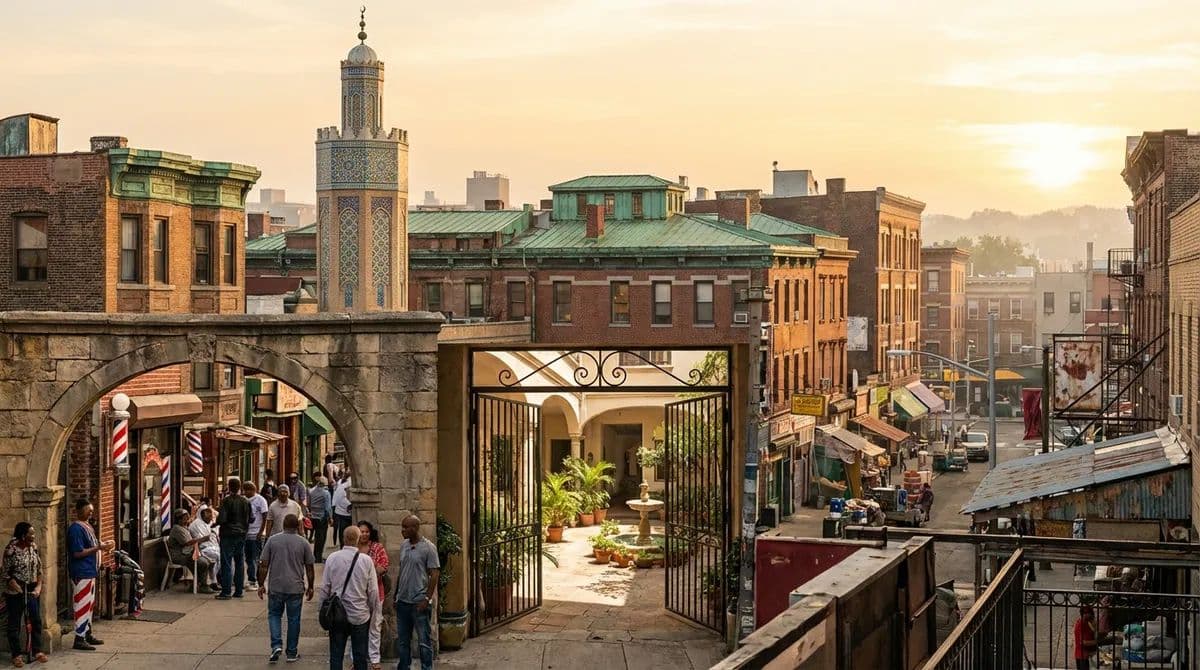
The gate was open. That is how it begins — not with a plan, not with a map, not with a recommendation from a guidebook or an algorithm, but with a gate that happens to be open on a Tuesday afternoon in Cihangir, Istanbul, revealing a courtyard that you did not know existed. The courtyard is small, perhaps ten meters square, paved with worn stone, shaded by a mulberry tree whose branches have been trained along a wire trellis to form a green ceiling. There is a fountain, dry. There are geraniums in tin cans on the windowsills. A cat sleeps on a cushion that has been placed, with evident deliberation, on the sunniest step. The courtyard is not on any map. It is not reviewed on any platform. It exists in the space between the public life of the street and the private life of the apartments that surround it, and the only way to find it is to explore a city at your own pace, slowly enough that an open gate registers not as a detail to be passed but as an invitation to be accepted.
This is vertical travel — the practice of going deep rather than wide, of choosing a single neighborhood, a single square mile, and reading it with the attention you would give a novel. Not skimming for plot points. Not racing to the conclusion. But moving slowly through the text, noticing the sentences, the word choices, the spaces between paragraphs, the way one chapter connects to the next through images and echoes that only become visible when you give them time. The neighborhood walking tour that vertical travel proposes is not a tour at all, in the conventional sense. It has no route, no stops, no schedule. It is an act of reading — and the text is the city itself.
The concept is simple. Choose one square mile. Spend an entire day in it. Do not leave. Do not consult a guidebook. Walk every street, enter every shop that is open, sit in every park, drink coffee in every cafe, and pay attention to everything — the architecture, the people, the sounds, the smells, the quality of light at different hours, the way the neighborhood changes between morning and afternoon, between the work hours and the evening. By the end of the day, you will know more about that square mile than most residents know about their own neighborhood. And you will have had a deep travel experience that no highlight-hopping itinerary can replicate.
Cihangir: The Novel in Miniature
Cihangir occupies a steep hillside above the Bosphorus in the Beyoglu district of Istanbul. It is small — perhaps fifteen blocks in each direction — and its character is distinct from the neighborhoods that surround it. Where Istiklal Caddesi, the main commercial street of Beyoglu, is loud, crowded, and relentlessly commercial, Cihangir is quiet, residential, and self-contained: a village within a city, populated by artists, writers, academics, and the particular breed of stray cat that Istanbul elevates to the status of civic mascot.
The morning chapter of Cihangir reads like domestic fiction. The neighborhood wakes slowly. The first sounds are the clink of tea glasses from the kahvehane on the corner, where elderly men gather at 7 a.m. for cay and backgammon. The bakeries open: simit, pogaca, borek, the warm, doughy vocabulary of Turkish breakfast arranged in shop windows like punctuation. The fruit seller sets up his stall on the steep street that drops toward the mosque, arranging pomegranates and figs with an aesthetic care that suggests he is aware of being watched. The cats emerge from wherever cats go at night and assume their positions on walls, cars, and the particular sunny ledge outside the veterinary clinic that has become, by feline consensus, the neighborhood's social center.
By midday, the novel shifts register. The cafes fill with the freelance workers and writers who give Cihangir its reputation as Istanbul's creative quarter. The conversations are in Turkish, English, Kurdish, and Arabic — the multilingual texture of a neighborhood that attracts outsiders and, over time, absorbs them. The antique shops on Cihangir Caddesi open their doors, and the interior chapter begins: rooms full of Ottoman calligraphy, Soviet-era cameras, Art Deco lamps, and the accumulated material culture of a city that has been collecting things for 8,500 years.
The evening chapter is the best. As the sun drops toward the Golden Horn, Cihangir's western-facing streets fill with golden light, and the neighborhood's small park — a triangular wedge of grass and benches overlooking the Bosphorus — becomes the communal living room. Families, couples, solitary readers, dog walkers, and the inevitable cats converge on the park's benches and the surrounding cafes. The view is one of the finest in Istanbul: the Bosphorus, the Asian shore, the minarets of Sultanahmet catching the last light. But the view is not the point. The point is the gathering itself — the nightly ritual of a neighborhood coming together in its public space to watch the day end. This is the chapter you would miss if you were across the city, checking the Blue Mosque off your list.
The Marais: Reading the Layers
Paris's Marais district — the ancient marsh turned aristocratic quarter turned Jewish neighborhood turned gay neighborhood turned fashion district — is a square mile that contains more layers of Parisian history than any other. A day spent reading it is a day spent reading France.
The morning chapter begins at the Place des Vosges, the oldest planned square in Paris, completed in 1612. At 8 a.m., the square belongs to the joggers and the dog walkers, and the rose-brick facades of the pavilions — identical, symmetrical, a monarch's vision of urban order — glow in the morning light with a warmth that makes the square feel more like a drawing room than a public space. Victor Hugo lived at No. 6. His apartment is now a museum, and standing in his study, looking down at the square he described in Les Miserables, is one of those moments where the physical city and the literary city converge — where the novel you are reading is, literally, the novel he wrote.
Walk north into the Jewish quarter — the Pletzl, as it was known in Yiddish — and the Marais's middle chapter reveals itself. The rue des Rosiers, with its falafel shops and Hebrew bookstores, is the remnant of a community that once dominated this part of Paris and that was nearly destroyed during the Holocaust. The memorial plaques on the school buildings — "A la memoire des eleves de cette ecole deportes de 1942 a 1944" — are the Marais's most devastating text, and they are embedded in the fabric of the neighborhood at child's-eye height, unavoidable if you are paying attention.
The afternoon chapter is commercial and sensory. The Marais's transformation into Paris's most fashionable shopping district has layered a new text over the historical ones: concept stores in seventeenth-century hotels particuliers, galleries in former workshops, cocktail bars in medieval cellars. The juxtaposition is not always comfortable, but it is always interesting — the tension between the neighborhood's past and its present is the engine of its vitality, and a day spent walking through it teaches you more about how cities metabolize their own history than any lecture.
Colaba: The Density of Stories
Colaba, at the southern tip of Mumbai, is one square mile of such extraordinary density that a day within it feels like a week. The neighborhood contains the Gateway of India, the Taj Mahal Palace Hotel, the Afghan Memorial Church, the Colaba Causeway market, and approximately a quarter of a million people living, working, eating, praying, and negotiating the intricate social choreography of Indian urban life in conditions of proximity that would test the sanity of any European city planner.
The morning chapter of Colaba is maritime. The fishing boats of the Sassoon Dock return at dawn, and the dock — one of the oldest in Mumbai — becomes a theater of organized chaos: fish sorted by species into plastic tubs, ice crushed and distributed, prices negotiated in rapid Marathi, the whole operation conducted with an efficiency that belies its apparent disorder. The smell is powerful and specific — salt, diesel, fish, the ammoniac tang of melting ice — and it is the smell of Colaba's oldest industry, older than the British, older than the Mughals, older than history.
By midday, the novel shifts to the Colaba Causeway, the main commercial street, where the density of commerce achieves a kind of sublime excess: stalls selling everything from antique maps to fake designer sunglasses to handmade leather sandals to mobile phone cases, packed so tightly that the merchandise of adjacent stalls overlaps and the boundary between shops dissolves into a continuous field of objects. The Causeway is not a place you navigate. It is a place you submit to, letting the crowd carry you, letting your attention snag on whatever snagging is available.
The evening chapter is architectural. As the heat breaks and the light softens, Colaba's Victorian Gothic buildings — the university, the high court, the railway terminus — take on a theatrical grandeur that the harsh midday light suppresses. The stone glows. The arches deepen. The buildings, which during the day are simply the backdrop to the street's frenetic activity, assert themselves as the neighborhood's oldest and most permanent residents. They have been here since the 1870s. They will be here when the mobile phone stalls are gone. A day in Colaba teaches you, among many other things, the difference between what is temporary and what endures.
Palermo Soho: The Open Book
Buenos Aires's Palermo Soho — the grid of tree-lined streets between Avenida Santa Fe and the railway tracks — is the most readable of neighborhoods, a square mile that seems to have been designed for the practice of vertical travel. The streets are wide enough to walk slowly. The buildings are low enough to see the sky. The cafes are numerous enough that you never need to walk more than a block to find a seat. And the neighborhood's character — bohemian, creative, unpretentious — invites the kind of aimless observation that vertical travel requires.
The morning chapter is the quietest. Palermo Soho wakes late by Buenos Aires standards — the neighborhood's nightlife keeps it up, and the mornings belong to the dog walkers and the yoga studios and the specialty coffee shops that have colonized every second corner. The graffiti and street art that cover many of Palermo Soho's walls are best read in the morning, when the light is even and the streets are empty enough to stand back and look. The murals range from the political to the whimsical, and their constant turnover — new works appearing over old ones every few weeks — makes the walls a kind of public diary, a continuously updated record of the neighborhood's preoccupations.
The afternoon brings the design shops, the vintage boutiques, the independent bookstores with their displays of Argentine literature spilling onto the sidewalk. Palermo Soho's commercial life is artisanal rather than corporate, and the shopping is less about acquisition than about browsing — entering a space, examining its aesthetic choices, absorbing its atmosphere, and moving on. The cafes fill. The conversations multiply. The neighborhood achieves the particular density of social energy that makes it, by late afternoon, one of the most pleasant places on earth to sit with a cortado and a book and do absolutely nothing.
How to Read a Neighborhood
The technique requires no expertise, only commitment. Choose your square mile the night before. Study a map long enough to understand its boundaries, then put the map away. Arrive early — 7 a.m. if possible, when the neighborhood is still in its domestic register. Walk every street, systematically at first, then randomly as patterns and interests emerge. Enter shops. Sit in parks. Drink coffee slowly. Eat lunch where the locals eat, which you will identify by the absence of English menus. Return to places that interested you in the morning and see how they have changed by afternoon. Stay until dark.
The goal is not comprehensive knowledge. The goal is the quality of attention that comprehensive intention produces. By committing to one square mile, you eliminate the distraction of choice — the persistent, attention-fragmenting question of "should I be somewhere else?" — and replace it with the simpler, deeper question: "What is here?" The answer, in any neighborhood of any city on earth, is more than a day can exhaust.