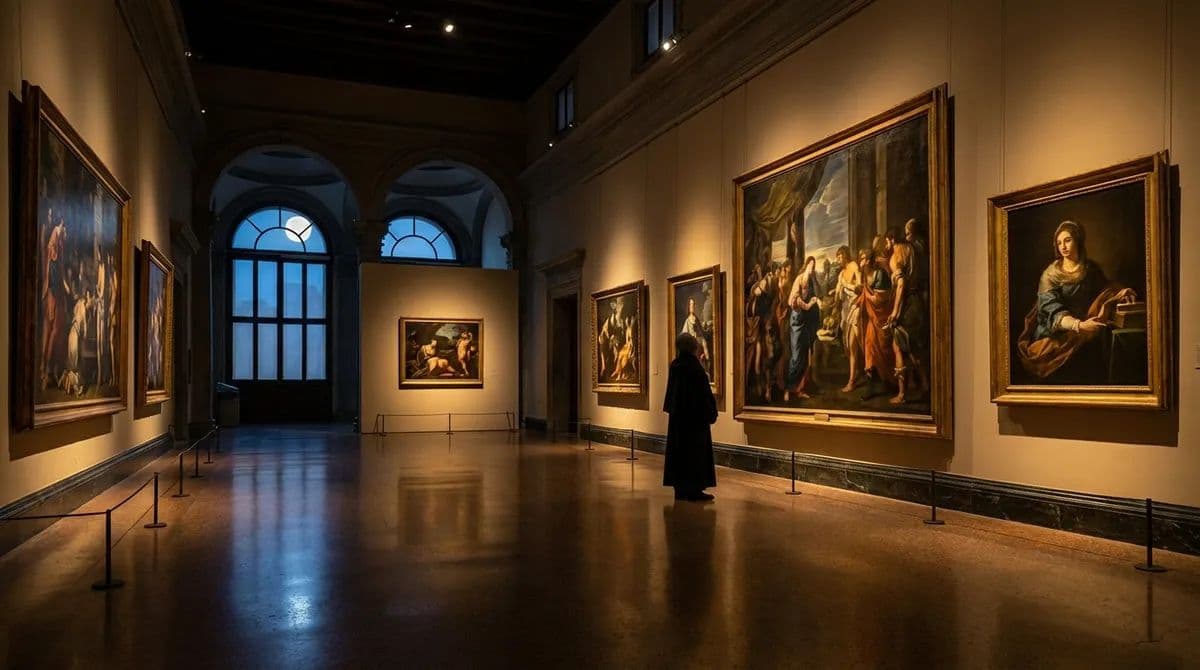
Midnight Museums: Art, Solitude, and the Privilege of Emptiness

Elena Mori
Writer
The last tour group left the Louvre's Denon Wing forty minutes ago. Their guide's amplified voice — tinny, cheerful, relentlessly informative — has faded down the Galerie d'Apollon like a radio station losing signal. Now there is only the sound of your own footsteps on the parquet, and the particular silence of a very large room that has recently been full of people and is adjusting to their absence. The *Winged Victory of Samothrace* stands at the top of the Daru staircase, her stone drapery frozen mid-billow, and for the first time today she is not surrounded by a semicircle of raised phones. She is alone. You are alone. And the quality of the encounter — the sheer spatial generosity of standing before a masterpiece with no one between you and the marble — is so different from the daytime experience that it feels like a different art form entirely. After-hours museum experiences do not merely reduce the crowd. They change the nature of seeing.
This is the secret that curators have always known and that the noctourism movement is now making available to a wider public: art was not made for crowds. A painting is a conversation between one consciousness and another, conducted across centuries, and conversations require a certain quiet. The Mona Lisa behind her bulletproof glass, besieged by three hundred visitors at any given moment during operating hours, is not having a conversation with anyone. She is being surveilled. But the Mona Lisa at ten o'clock at night, when the museum has emptied and the guards have settled into their chairs and the light has been dimmed to a conservation-friendly amber — that is a different Lisa entirely. She is looking at you. She has time. And you, for the first time, have time to look back.
The Uffizi After Hours
Florence's Uffizi Gallery began offering limited after-hours visits several years ago, and the program has become one of the most coveted tickets in European museum-going. The appeal is not mysterious. The Uffizi during the day is one of the most overwhelming museum experiences on earth — the corridors are narrow, the masterpieces are dense, and the visitor volume during peak season can reach ten thousand per day, creating a slow-moving human current that carries you past Botticelli's *Primavera* at approximately the same pace you would move through an airport security line.
At night, the Uffizi becomes a different building. The Vasari Corridor, that elevated passageway connecting the gallery to the Palazzo Pitti across the Arno, takes on a conspiratorial quality in low light — you are walking a secret passage that the Medici built specifically to move between their palace and their government without encountering the public, and at night that original purpose feels restored. The self-portraits lining the corridor — Rembrandt, Velazquez, Chagall — watch you pass with an attention that the daytime crowds make impossible to reciprocate.
In the Botticelli rooms, the difference is most profound. *The Birth of Venus* is a painting that asks for distance — it was designed to be viewed from across a room, the way you would view a stage set, the figures emerging from a golden atmosphere that requires space to breathe. During the day, that distance is impossible. At night, you can stand at the far wall and let the painting come to you, crossing the empty room on its own terms, at its own pace. The foam at Venus's feet seems to move. The roses blown by the wind god Zephyr seem to drift. The painting, released from the pressure of competing gazes, begins to perform again.
The Prado's Extended Nights
Madrid's Prado Museum offers extended hours on certain evenings, and the experience is shaped by the particular character of the collection. The Prado is heavy with Goya, Velazquez, and El Greco — painters whose work deals in shadow, darkness, and the difficult territories of human psychology. Seeing these paintings at night is not merely a logistical improvement. It is a tonal alignment. You are seeing dark paintings in darkness, and the resonance between the art and the ambient light creates an immersive quality that daylight disrupts.
Goya's *Black Paintings*, transferred from the walls of his rural house the Quinta del Sordo, are perhaps the most powerful after-hours experience in any museum in the world. These are paintings made by a deaf, aging man in a house on the outskirts of Madrid, painted directly onto the plaster walls for no audience but himself. *Saturn Devouring His Son* — that horrifying, magnificent image of the titan consuming his own child, the eyes wild with a madness that is also a kind of grief — was never meant to be seen by the public. It was a private hallucination, a conversation between Goya and his own terror, and encountering it in a nearly empty room, at night, with the ambient sounds of the museum reduced to the hum of climate control, is to feel something of the original intimacy of the work. You are not a tourist looking at a famous painting. You are an intruder in someone's nightmare, and the painting knows it.
Velazquez's *Las Meninas*, by contrast, becomes more playful at night. The painting's famous game of gazes — the Infanta looking at you, Velazquez looking at you, the mirror in the back reflecting the king and queen who are supposedly standing where you are standing — works best when there is only one viewer to triangulate with. During the day, with fifty people jostling for position, the spatial illusion collapses. At night, alone before the canvas, the illusion reconstitutes. You step to the left; the Infanta's gaze follows. You step to the right; Velazquez adjusts. The painting is a machine for producing the sensation of being watched, and it requires solitude to function.
Why Darkness Changes Art
The relationship between art and light is not incidental. It is foundational. Before electric lighting, paintings were viewed by candlelight or the variable illumination of windows, and painters composed with this in mind. Caravaggio's chiaroscuro — the dramatic contrast between deep shadow and intense light — was designed for rooms lit by candles, where the painted light and the actual light would merge into a single system. Viewing a Caravaggio under the flat, even illumination of modern gallery lighting is like hearing a symphony through a phone speaker: technically accurate, aesthetically impoverished.
Many museums have begun to recognize this, and the better after-hours programs adjust their lighting accordingly. The Rijksmuseum in Amsterdam, during its occasional night openings, dims the overhead lights in the Rembrandt galleries and allows the paintings' internal light sources — the candles, the windows, the mysterious radiances that Rembrandt conjured from oil and pigment — to do more of the visual work. The effect is transformative. Rembrandt's *Night Watch*, already a painting about the interplay of light and shadow, seems to deepen, its figures stepping forward from the canvas with a three-dimensionality that daylight flattens.
The neuroscience of this experience is straightforward. In dim light, the pupils dilate, increasing the eye's sensitivity to contrast and reducing the sharpness of peripheral vision. This creates a natural spotlight effect: your gaze narrows, focuses, and the painting fills more of your visual field. You see less of the room and more of the art. The experience becomes more intimate, more enclosed, more like the private act of reading than the public act of museum-going. You are not scanning a wall of paintings. You are inside one painting, and the darkness around you is the frame.
The Quiet Revolution of Noctourism
The growth of noctourism experiences — a term that encompasses everything from midnight museum visits to stargazing expeditions to after-dark walking tours — reflects a broader shift in what travelers are seeking. The daytime experience of major cultural sites has become, for many visitors, an exercise in crowd management rather than aesthetic engagement. The Sistine Chapel receives twenty-five thousand visitors per day. The British Museum's Egyptian galleries are so densely packed on summer afternoons that the Rosetta Stone is visible only as a dark rectangle behind a wall of shoulders. The experience of actually looking at art — sustained, contemplative looking — has been engineered out of the daytime visit by the sheer volume of bodies.
Night visits restore what the day has taken away: silence, space, and the temporal luxury of standing still. They also introduce something the day never had, which is the particular emotional register of being in a large, semi-dark space filled with objects made by people who are no longer alive. Museums during the day feel institutional — educational, civic, slightly medicinal. Museums at night feel sacred. The shift is not just atmospheric. It is categorical. The building stops being a repository and starts being a temple, and the art stops being content and starts being presence.
Private Hours and the Democracy of Access
There is an uncomfortable tension in the after-hours museum experience, and it is worth naming. These events are often expensive. The Louvre's private night tours, the Vatican's after-hours programs, the Met's exclusive evening events — they are priced to exclude, and the solitude they offer is, in part, a function of economic gatekeeping. The privilege of emptiness is literally a privilege, available to those who can pay for the absence of others.
Some institutions are working to address this. The British Museum offers free late-night openings on Fridays. The Tate Modern in London keeps its galleries open until ten on weekends at no additional cost. Berlin's Lange Nacht der Museen — Long Night of Museums — opens dozens of institutions for a single affordable ticket, turning the city into a nocturnal cultural circuit that democratizes the after-hours experience. These programs suggest that the appetite for nighttime museum-going is not limited to the wealthy; it is a genuine, broadly felt desire for a different relationship with art.
The most radical version of this idea may be the small museums that never close. In some European cities, tiny galleries and artist-run spaces operate on honor systems, their doors unlocked, their lights on timers. You walk in, you look, you leave. There is no guard, no audio guide, no gift shop. There is only the art and the silence and the strange thrill of being alone with something beautiful at an hour when you should, by all reasonable standards, be asleep.