Listening for the Last Words

Ingrid Olsen
Writer
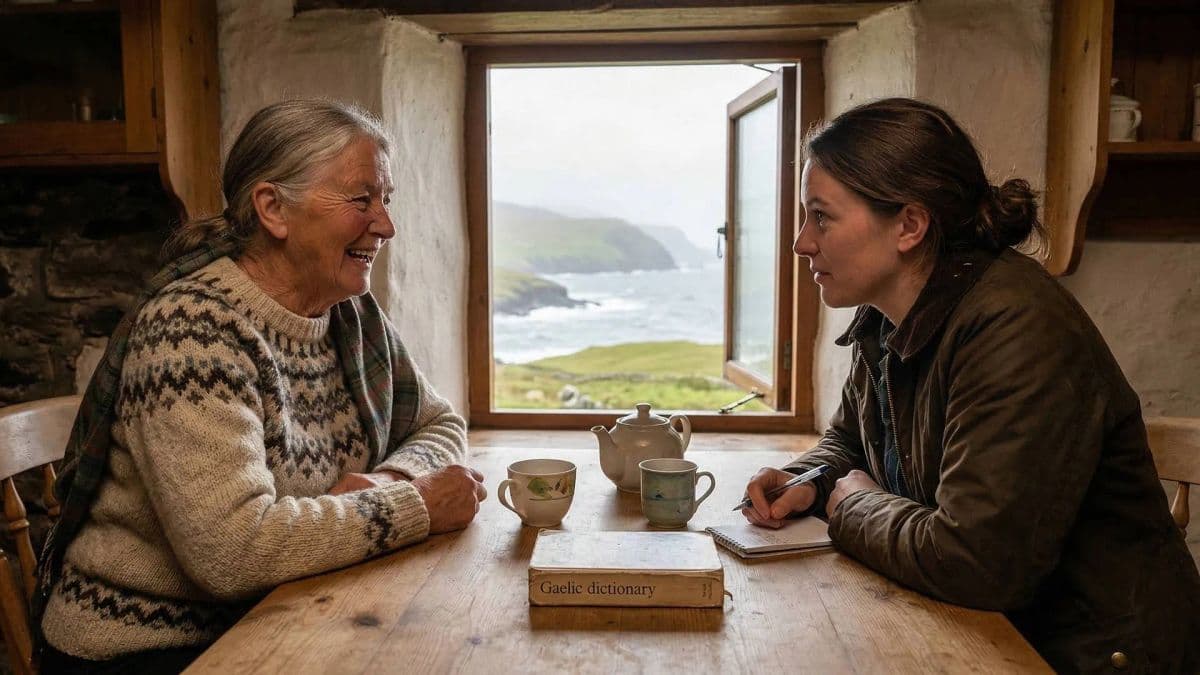
Somewhere in the Scottish Highlands, on an island where the wind never quite stops and the sea is audible from every room, a woman in her seventies tells a joke. It is in Gaelic — not the standardized Gaelic of university courses or government signage, but the specific, salt-flavored dialect of her parish, a variant that perhaps two hundred people still speak with full fluency. The joke involves a seal, a minister, and a fishing boat. It relies on a pun that exists only in this language, in this dialect, on this island. Translated into English, it becomes a mildly amusing anecdote. In Gaelic, it is apparently devastating — the kind of joke that makes her friend across the kitchen table put down her tea and laugh until she has to remove her glasses to wipe her eyes.
I do not understand the joke. I do not speak Gaelic. But I understand something about the laughter — its particular quality, the way it carries decades of shared reference, the way it sounds like an entire world compressed into a few sentences. And I understand, watching these two women, that when the last speakers of this dialect are gone, this joke will die with them. Not just the words, but the specific cognitive architecture that makes the pun possible, the cultural context that makes it funny, the emotional frequency it vibrates on. An entire way of being humorous in the world will simply cease to exist.
This is what it means to travel to hear endangered languages. It is not linguistic tourism in any academic sense. It is something closer to pilgrimage — a journey to stand in the presence of voices that are, with each passing year, growing quieter. There are approximately seven thousand languages spoken on Earth today. By the most conservative estimates, half of them will fall silent by the end of this century. That is one language dying, on average, every two weeks. Each death takes with it not just vocabulary and grammar but an irreplaceable way of perceiving and organizing reality. Each silence is a library burning.
The Geography of Disappearance
The map of endangered languages is also a map of the world's most extraordinary places to travel. This is not a coincidence. Languages survive longest in regions of geographic isolation — mountains, islands, deep forests, arctic coastlines — places where the homogenizing forces of urbanization, mass media, and economic integration arrive last. To seek out endangered languages travel destinations is, almost inevitably, to find yourself in landscapes of staggering beauty and cultural depth.
In Papua New Guinea, the most linguistically diverse place on Earth, more than eight hundred languages are spoken across an area roughly the size of Sweden. The island's extreme topography — razor-backed mountain ranges, impenetrable river valleys, swamps that stretch to the horizon — created natural barriers that allowed tiny communities to develop languages as distinct from their neighbors as English is from Mandarin. In a single day's walk, you can pass through three or four language zones, each with its own mythology, its own kinship terminology, its own way of counting, its own words for the particular green of the moss that grows on the particular trees of that particular valley.
Many of these languages are spoken by fewer than a hundred people. Some by fewer than a dozen. In the village of Kaki Ae, on the southern coast, the language known by the same name was, at last count, spoken by perhaps forty individuals, most of them elderly. The younger generation has shifted to Tok Pisin, the English-based creole that serves as Papua New Guinea's lingua franca. They can understand their grandparents but cannot reply in kind. The language is receding like a tide, and no one has yet found a way to reverse it.
The Scottish Highlands tell a similar story in a different key. Gaelic was once the dominant language of Scotland, spoken from the Borders to the Northern Isles. By the eighteenth century, a combination of political suppression, educational policy, and economic pressure had driven it to the western margins — the Outer Hebrides, Skye, parts of the mainland coast. Today, fewer than sixty thousand people speak it fluently, and most of them are over fifty. The language survives most vibrantly in places like the Isle of Lewis, where you can still hear it in the post office, in the fishing harbor, in the living rooms of houses that look out over the Atlantic toward nothing but Iceland.
What a Language Carries
To visit dying languages communities is to confront a question that most travelers never consider: what exactly is lost when a language disappears? The easy answer is words — and words are indeed part of it. Every language contains terms that have no equivalent in any other, words that encode observations so specific to a place and a people that translation can only approximate them.
The Yupik languages of Alaska have, famously, dozens of terms for different states of sea ice — not because their speakers are obsessed with ice, but because their survival depends on reading it accurately. Each word is a compressed instruction manual: this kind of ice is safe to walk on; this kind means seals are nearby; this kind means a storm is coming. When the last Yupik speaker with full command of this vocabulary is gone, an entire technology of Arctic reading disappears with them.
But vocabulary is the least of it. Languages encode different logics, different ways of structuring cause and effect, different relationships between speaker and world. The Hopi language of northeastern Arizona has no grammatical tense in the European sense — events are not located in past, present, or future but are described according to their degree of certainty and their relationship to the speaker's direct experience. The Guugu Yimithirr language of northeastern Australia uses cardinal directions instead of relative ones — there is no "left" or "right," only "north," "south," "east," and "west," which means speakers must maintain a constant, unconscious awareness of their orientation in space. Studies have shown that Guugu Yimithirr speakers have a sense of direction that seems almost superhuman to English speakers. The language does not just describe the world differently — it literally trains the brain to perceive it differently.
This is the Sapir-Whorf hypothesis in its most powerful form, and while linguists debate its extent, the core insight is difficult to deny: language shapes thought. To lose a language is to lose not just a communication system but a cognitive tool, a way of thinking that no other language precisely replicates. The world becomes, with each language death, slightly less imaginable.
The Sound of Survival
Traveling to hear endangered languages is, above all, a practice of listening. The sounds themselves carry information that no written record can preserve. The click consonants of the Khoisan languages of southern Africa — some of which use more than a hundred distinct click sounds — represent a phonetic complexity that may date back to the earliest human speech. Linguists believe these languages preserve acoustic features that all other human languages have lost over tens of thousands of years of simplification. To hear a Khoisan speaker is to hear something ancient in the most literal sense — sounds that connect directly to the origins of human communication.
In the Caucasus Mountains of Georgia, the language of Svan — spoken by perhaps fifteen thousand people in the remote Svaneti region — contains consonant clusters so dense that linguists initially refused to believe their transcriptions were accurate. A single Svan word can begin with four or five consonants in sequence, creating sounds that most human mouths find physically impossible to reproduce without years of practice. The language is unwritten in any official sense; its survival depends entirely on the voices of living speakers, many of whom live in stone towers that have stood since the medieval period, in valleys where the snow closes the roads for four months of the year.
To travel to these places is to understand that a language is not an abstraction stored in dictionaries and grammars. It is a living thing, as physical as breathing, as embodied as dance. It exists in the vibration of vocal cords, in the shape of a mouth, in the particular rhythm of exhalation that a grandmother uses when singing her grandchild to sleep in words that no language-learning app will ever teach.
Where to Listen
For the traveler drawn to endangered languages, the world offers destinations of extraordinary richness. In northern Scandinavia, the Sami languages — several of which are critically endangered — survive in communities that still practice reindeer herding across the tundra of Norway, Sweden, Finland, and Russia. The Sami musical tradition of joik, in which a singer does not sing about a person or place but sings that person or place into being, is one of the oldest vocal traditions in Europe. To hear a joik performed in a lavvu — the traditional Sami tent — on a winter night when the Northern Lights are moving overhead is to experience music that predates every European civilization by millennia.
In Oaxaca, Mexico, the Zapotec and Mixtec languages continue to be spoken in mountain villages where the markets still operate in indigenous languages and the Catholic saints have been quietly absorbed into older cosmologies. The tonal quality of Zapotec — in which the meaning of a word changes depending on the pitch at which it is spoken — gives the language a musical quality that makes ordinary conversation sound, to the untrained ear, like song.
In Wales, the revival of Welsh offers a more hopeful model. Aggressive language planning, Welsh-medium education, and cultural investment have stabilized the language at around half a million speakers — still fragile, but no longer in freefall. A visit to the Eisteddfod, the annual Welsh cultural festival, reveals a language that is young as well as old, spoken by teenagers and poets and rock musicians as well as by farmers and grandmothers. Welsh demonstrates that language death is not inevitable — that with sufficient will and resources, the tide can be turned.
In Tasmania, the palawa kani language — a composite reconstruction of the island's original Aboriginal languages, all of which were driven to extinction by colonization — represents something even more remarkable: a language being brought back from the dead. Working from fragmentary word lists compiled by nineteenth-century missionaries and settlers, Aboriginal community members have assembled a functional language that is now being taught to children. It is not, and cannot be, the same as what was lost. But it is a language nonetheless, alive in the mouths of people who refuse to accept silence as the final word.
The Ethics of Listening
There is a tension at the heart of language preservation travel that the honest traveler must acknowledge. To visit a community specifically because its language is dying is to participate in a dynamic that can feel extractive — the outsider arriving to witness, to document, to carry away an experience of someone else's loss. The risk of treating living speakers as museum exhibits, of romanticizing poverty and marginalization as "authenticity," is real and must be taken seriously.
The ethical traveler listens more than they record. They spend money in the community. They learn at least a few words — not as souvenirs but as gestures of respect. They understand that language endangerment is almost never a natural process; it is almost always the result of political suppression, economic coercion, or cultural stigma imposed by dominant groups. To treat a dying language as merely "sad" is to ignore the power structures that are killing it.
The best language-focused travel involves supporting the communities and organizations that are fighting for survival. Attending Welsh-language theater. Buying books in Gaelic. Enrolling in a Sami language course taught by Sami teachers. Visiting Zapotec cooperatives where the language of commerce is Zapotec. These are small acts, but they contribute to the economic ecosystem that makes language survival possible. A language lives only as long as someone finds it useful to speak.
The Grandmother's Lullaby
In a village in the highlands of Papua New Guinea — I will not name it, at the request of the community — I once sat in a house built of woven palm fronds and listened to an elderly woman sing to her granddaughter. The song was in a language that the woman's own children had largely abandoned in favor of Tok Pisin. The granddaughter, perhaps three years old, lay in a bilum — a string bag used as a hammock — and stared at the ceiling with the wide, unfocused eyes of a child on the edge of sleep.
The lullaby was not melodically complex. It moved between three or four notes in a pattern that repeated with slight variations, like water flowing over stones. The words, I was told later, described the journey of a spirit from the mountain to the river and back again — a journey that mapped onto the geography visible from the village, so that the child, hearing the song, was also learning the landscape. The language, the land, and the song were a single thing, inseparable.
I do not know if that granddaughter will grow up to sing that song to her own children. The odds, statistically, are against it. But I know that I heard it — that on one afternoon, in one village, in one language that may not survive the century, a woman sang the world into being for a child. And that the sound of it — the specific timbre of her voice, the rhythm of the bilum swaying, the afternoon rain beginning on the palm-leaf roof — is something no recording could fully capture, because it was not just sound. It was presence. It was a language doing what languages do at their most fundamental level: making meaning between two human beings in a specific place at a specific time.
Why It Matters Now
We are living through the greatest extinction of human languages in history. The forces driving it — globalization, urbanization, digital monoculture, the economic imperative to speak English or Mandarin or Spanish — are not going to reverse themselves. The question is not whether we will lose languages but how many, and whether we will notice before the silence becomes total.
Travel cannot save endangered languages. That work belongs to communities, linguists, educators, and policymakers. But travel can do something that no policy paper or academic study can: it can make the abstract concrete. It can put you in a room with a woman telling a joke that has no English equivalent, and let you hear the laughter, and let you understand in your body what the statistics mean. One language dying every two weeks is a number. Sitting with the last fluent speaker of a language and watching them search for someone to talk to — that is an experience that changes how you think about what deserves to be preserved.
The endangered languages of the world are not relics. They are living systems of knowledge, humor, poetry, and perception. They are the accumulated intellectual inheritance of communities that have been observing and naming their worlds for thousands of years. To travel to hear them is not nostalgia. It is an act of witness — a refusal to let the silence fall without someone being present to mark what is being lost.