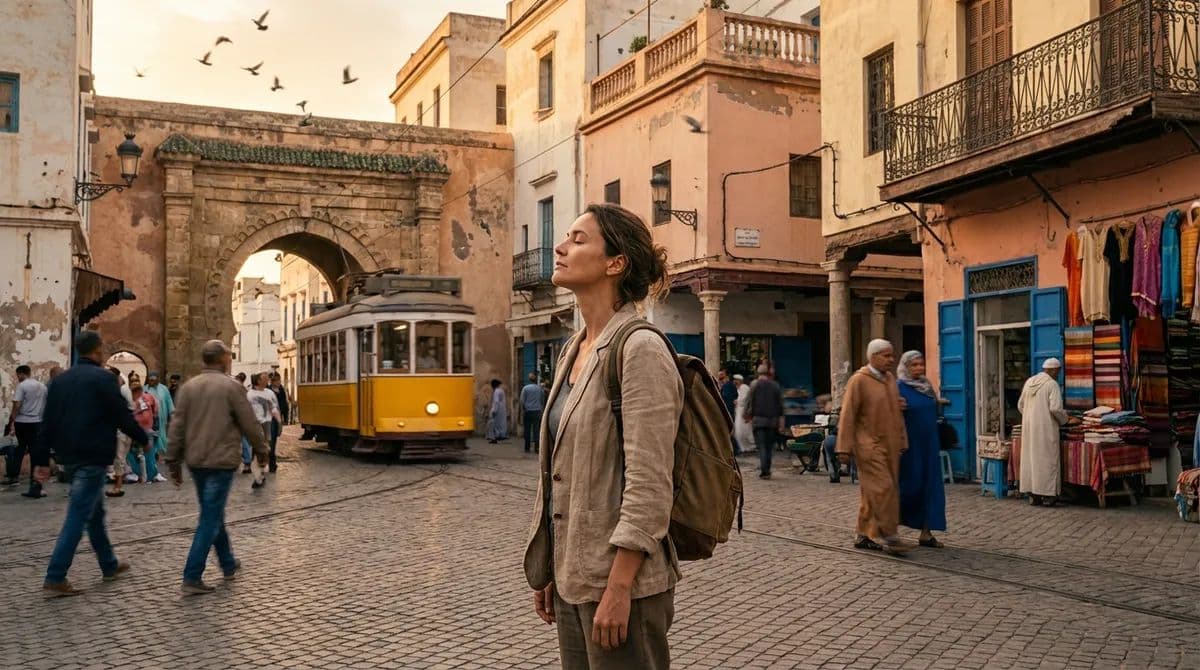
Learning to Hear a City for the First Time

Ingrid Olsen
Writer
The composer Pauline Oliveros used to begin her workshops with a question that unsettled everyone in the room: "What was the last sound you heard before I started speaking?" Silence. Nervous laughter. Then, slowly, the answers: the air conditioning. A car passing outside. Someone's chair creaking. The hum of fluorescent lights. Sounds that had been there all along, filling the room as completely as the air, and that no one had noticed until asked. This is the paradox that sound tourism begins with — we are surrounded by sound at every waking moment, and we hear almost none of it.
Oliveros called this selective deafness "the difference between hearing and listening." Hearing is passive, automatic, the ear's equivalent of peripheral vision. Listening is active, directed, voluntary. We hear the city constantly. We almost never listen to it. And the difference between those two states is the difference between passing through a place and actually arriving.
The practice of soundwalking — walking through an environment with deliberate acoustic attention — was formalized in the late 1960s and early 1970s by the composer R. Murray Schafer and his colleagues at Simon Fraser University in Vancouver. Schafer, alarmed by what he called "the sonic sewage" of industrial modernity, founded the World Soundscape Project to document and analyze the acoustic environments of cities, forests, coastlines, and villages around the world. His students were sent into Vancouver with tape recorders and notebooks, asked to map the city's sounds with the same rigor that a botanist maps its plants. What they discovered — and what any soundwalker discovers — is that a city's acoustic environment is as complex, as layered, and as distinctive as its architecture. And it is almost entirely undocumented.
What Is a Soundwalk?
A soundwalk is, at its simplest, a walk taken with the ears as the primary sense organ. The rules are few: walk slowly. Do not wear headphones. Do not talk, or talk as little as possible. Let your attention rest on what you hear rather than what you see. The urban soundscapes you encounter will reveal themselves in layers — first the dominant sounds (traffic, construction, music), then the secondary sounds (footsteps, birds, wind), then the tertiary sounds (the hum of electrical transformers, the distant ring of a bell, the particular acoustic quality of a narrow street versus a wide boulevard).
There is no correct route for a soundwalk, no prescribed destination, no checklist of sounds to collect. The practice is its opposite: an exercise in receptivity, in allowing the city to compose itself for your ear rather than curating it for your eye. Hildegard Westerkamp, one of Schafer's students and now one of the world's leading sound ecologists, describes it as "the practice of listening as a creative act" — not recording, not analyzing, but simply receiving with full attention.
This sounds simple. It is not. The modern traveler arrives in a new city armed with maps, itineraries, restaurant lists, and a camera. Every one of these tools privileges vision. The soundwalk experience asks you to set them aside — not permanently, but for an hour — and to navigate a city the way you might have before maps existed, before photography existed, before the eye became the dominant organ of travel. What you gain is not information but intimacy. The city enters you differently when it enters through the ear.
Your First Soundwalk: Lisbon
Lisbon is an ideal city for a first soundwalk because its topography creates constant acoustic variety. The city is built on seven hills, and the transitions between hilltop, slope, and valley produce radical shifts in sound environment within a few hundred meters.
Begin in the Alfama, Lisbon's oldest neighborhood, early in the morning — say 7 a.m. on a weekday. The narrow streets of the Alfama are medieval in layout, barely wide enough for two people to pass, and their acoustic character is correspondingly intimate. Sound does not travel far here. It is contained, pocketed, held in place by the stone walls on either side. What you hear is hyper-local: a radio playing fado from an open window, the clang of a pan in a kitchen, the soft pad of a cat on tile, the drip of laundry hung across the street. The Alfama at dawn sounds domestic, private — as though you are walking through the inside of someone's house rather than through public space.
Walk downhill toward the river. As the streets widen and the buildings pull apart, the soundscape opens. The containment of the Alfama gives way to the reflective spaciousness of the Praca do Comercio, where sound bounces off the arcaded facades and the vast paved square acts as an acoustic stage. Here the dominant sound is the Tagus River — a broad, tidal estuary whose waters lap against the stone steps of the Cais das Colunas with a heavy, rhythmic slap that speaks of volume and depth. Seagulls. The clank of the No. 28 tram climbing the hill behind you. A busker tuning a guitar. The square is where Lisbon's private acoustic world meets its public one, and the contrast with the Alfama — merely a ten-minute walk away — is startling.
Continue west along the waterfront toward Belem. Here the soundscape changes again: the river broadens, the wind picks up, and the industrial port sounds — cranes, container ships, the beeping of reversing trucks — create a mechanical layer that is absent in the old city. But listen for the birds. The Tagus estuary is a major flyway, and the mudflats near Belem host thousands of wading birds whose calls — the piping of oystercatchers, the shrill cry of black-tailed godwits — add a wild, non-urban dimension to the soundscape. Lisbon is a city where the natural and the built environments interpenetrate acoustically, and the waterfront walk makes this audible.
Your Second Soundwalk: Marrakech
If Lisbon teaches you to listen for subtlety, Marrakech teaches you to listen for density. The medina of Marrakech is one of the most acoustically saturated environments on earth — a continuous, layered, overwhelming composition of human, animal, mechanical, and musical sound that makes the average Western city sound like a library.
Enter the medina through Bab Doukkala in the early afternoon, when the souks are at their most active. The first thing you notice is the absence of engine noise. The medina is largely car-free, and without the masking effect of traffic, every other sound leaps into clarity. The clang of a coppersmith's hammer — rhythmic, persistent, almost musical — is the medina's dominant acoustic signature, and it can be heard from blocks away, the narrow streets channeling the sound in unpredictable directions. Follow it, and you follow the old artisan geography of the medina, where craftspeople have been clustered by trade for centuries: coppersmiths here, leather workers there, dyers in the quarter where the sound of water is everywhere.
The human voice is Marrakech's second instrument. Vendors call in Arabic, Tamazight, French, and increasingly English, each language occupying a different register and rhythm. The vendor's call is not just commercial speech — it is a performance tradition, a rhythmic chant passed from master to apprentice, and the best calls have a melodic quality that blurs the line between selling and singing. In the spice souk, where the visual spectacle of pyramided saffron and cumin is what every camera captures, close your eyes and listen to the poetry that no photograph preserves: the vendor's recitation of spice names in a rolling, incantatory rhythm, the rustle of dried herbs being scooped into paper cones, the soft thud of a wooden scoop striking the side of a brass scale.
At dusk, move to the Jemaa el-Fnaa, the great square that is the medina's acoustic heart. The square at sunset is a soundscape of extraordinary complexity: the overlapping circles of Gnawa musicians, storytellers, snake charmers, juice sellers, and food stall operators create a sound field with no single center, no dominant voice, no organizing principle except proximity. To walk across the Jemaa el-Fnaa with open ears is to experience something close to what the musicologist called "a ecology of sound" — each performance creating its own acoustic territory that you enter and leave as you move through the space. It is chaotic, glorious, and impossible to record — the experience exists only for the person standing inside it.
Your Third Soundwalk: Tokyo
Tokyo dismantles every assumption the Western ear brings to the idea of "city sound." It is the world's largest metropolitan area, home to 37 million people, and it is, by the standards of any comparably sized city, extraordinarily quiet.
Begin in Shibuya at the crossing — the most famous pedestrian intersection on earth. When the light changes and up to 3,000 people cross simultaneously, what you expect is noise: shuffling, talking, the roar of a crowd. What you hear is something else entirely. The footsteps are barely audible. The conversations are hushed, private, conducted at a volume that in New York or Rome would be considered a whisper. The dominant sounds are electronic: the musical chimes that signal the crossing light, the synthetic voice announcing the walk signal, the jingles emanating from the surrounding buildings. Tokyo has replaced much of its organic urban soundscape with designed sound — composed, intentional, precisely calibrated signals that guide behavior without raising the ambient noise floor.
Walk north to Meiji Jingu, the great Shinto shrine set inside a 170-acre forest in the center of the city. The transition is the most dramatic acoustic event in Tokyo: within a hundred meters of leaving the street, the city vanishes. The forest canopy absorbs traffic noise with an efficiency that seems engineered, and what remains is a soundscape of gravel paths — your footsteps suddenly loud and percussive — birdsong, wind in the camphor trees, and a silence so deep that the occasional crack of a ceremonial clap at the shrine hall makes you flinch. The Japanese concept of ma — the meaningful pause, the space between — is nowhere more evident than in the acoustic design of a Shinto shrine, where silence is not absence but presence.
Continue to the backstreets of Shimokitazawa or Yanaka, the old neighborhoods where Tokyo's acoustic personality is most revealed. Here you will hear the sounds that define Japanese domestic life and that no international visitor expects: the recorded chimes of the garbage truck playing a nursery tune at precisely 8 a.m., the bell of the tofu seller making his rounds on a bicycle, the particular click-clack of geta sandals on stone that is becoming rare but has not yet disappeared. And everywhere, the sound of water — the small fountains and tsukubai water basins outside temples and traditional houses that contribute a constant, quiet trickling to the background.
The Practice Deepens
A soundwalk is not a one-time novelty. The practice deepens with repetition, and the ear — like any instrument of attention — becomes more sensitive the more it is used. Veteran soundwalkers report hearing sounds in familiar cities that they missed for years: the harmonic resonance of a particular bridge in a particular wind, the dawn chorus of birds shifting with the season, the acoustic difference between a street swept clean and one littered with leaves.
The practice also changes how you remember places. Sound memories are stored differently from visual memories — they are more closely linked to emotion, more resistant to decay, more likely to trigger involuntary recall. The traveler who has soundwalked through Marrakech will find the memory returning, unbidden, at the sound of a copper bell or the smell of cumin. The traveler who has listened to Tokyo's silence will hear it again in any quiet forest, any hushed room. Sound anchors memory in the body in a way that images, stored behind the glass of a phone screen, increasingly do not.