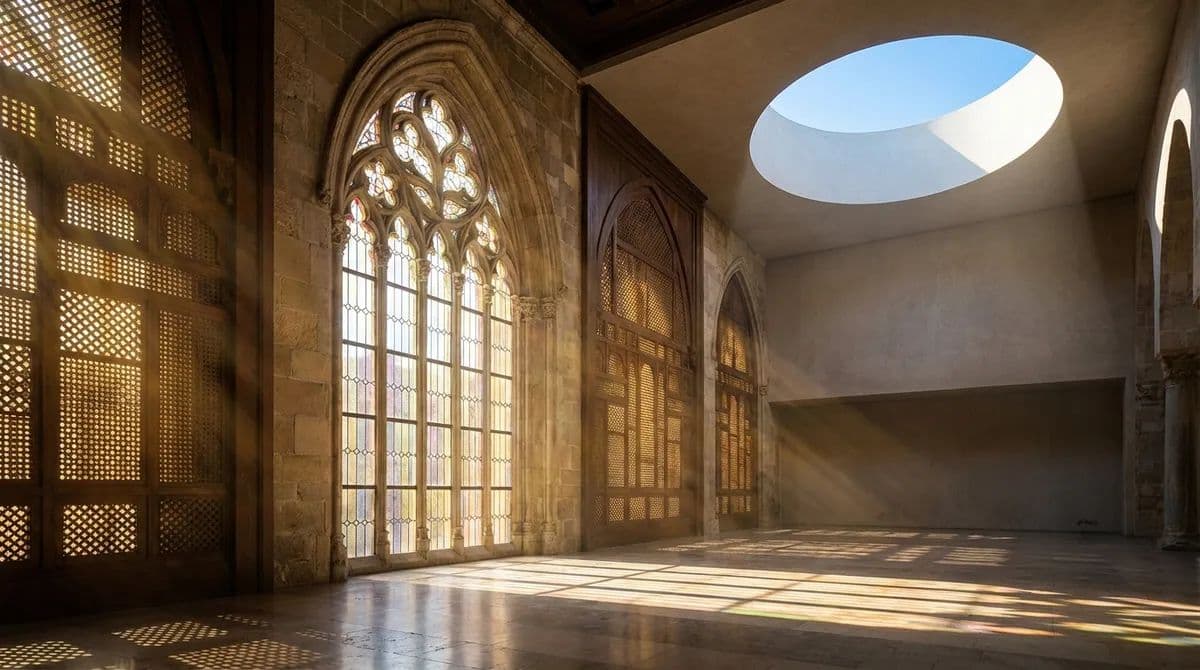
How Light Enters: Windows as the Soul of a Building

Ingrid Olsen
Writer
The question that haunts every great building is deceptively simple: how does the light get in? Not how much light, or what color light, or at what angle -- though all of these matter -- but through what kind of opening, shaped by what intention, filtered by what material. The window is the building's eye, its relationship with the world beyond its walls. Close the windows and you have a tomb. Open them completely and you have a pavilion. Everything that architecture has ever attempted exists somewhere between those two extremes, in the infinite space of partial openings and calibrated revelations.
I began thinking seriously about architectural walking tour ideas organized around light after spending a morning in the Mezquita of Cordoba, standing in the forest of double arches that support the hypostyle hall, watching the light move. The Mezquita was built over two centuries, beginning in 784 CE, and its architects understood something that much of modern architecture has forgotten: that light is not a commodity to be maximized but a material to be composed. The narrow windows in the Mezquita's outer walls admit just enough light to illuminate the lower portion of the arches while leaving the upper reaches in shadow, creating the optical illusion of a space far larger and more complex than it actually is. You feel as if you are standing in a forest at dusk, with the red-and-white voussoirs of the arches playing the role of branches against a darkening sky.
That morning taught me why buildings look the way they do: because they are, at their most fundamental level, instruments for the regulation of light. Every stylistic choice in architectural history -- Gothic pointed arches, Moorish horseshoe arches, Modernist curtain walls, Brutalist concrete slits -- is ultimately a choice about how light enters and what it does once it arrives. Follow the light, and the history of architecture unfolds before you not as a succession of styles but as a continuous, evolving meditation on the relationship between interior and exterior, darkness and illumination, shelter and exposure.
The Gothic Invention: Walls of Light
The Gothic cathedral is, in essence, a technology for the production of colored light. Every innovation that defines the Gothic style -- the pointed arch, the ribbed vault, the flying buttress -- serves a single purpose: to transfer structural loads away from the walls so that the walls can be dissolved into windows. The Gothic builders did not invent stained glass, but they were the first to understand that an entire wall could be made of it, that stone could become a frame for light rather than a barrier against it.
The apotheosis of this idea is the Sainte-Chapelle in Paris, built between 1242 and 1248 to house the Crown of Thorns and other relics acquired by King Louis IX. The upper chapel is essentially a glass box: fifteen windows, each fifteen meters tall, containing 1,113 individual scenes from the Bible rendered in glass of such saturated color that stepping inside on a sunny afternoon is like stepping inside a jewel. The stone mullions between the panels are so slender that they seem inadequate to the task of holding the roof up, which is precisely the point. The architecture wants to disappear, to reduce itself to a minimal framework that maximizes the presence of light.
What the Sainte-Chapelle demonstrates is that sacred architecture tourism is, at its best, a form of light tourism. You do not visit the Sainte-Chapelle to see the building. You visit to see what light does when it passes through twelve hundred square meters of thirteenth-century glass. The building is the instrument; the light is the music.
Chartres Cathedral, thirty minutes by train from Paris, extends this principle on a grander scale. The west facade's three lancet windows, dating from the twelfth century, glow with a blue so distinctive it has its own name: Chartres blue, a color whose exact formula remains a subject of scholarly debate. The blue is not merely beautiful; it is transformative, turning the interior of the cathedral into an underwater world where everything -- stone, wood, human skin -- takes on an aqueous tint. To stand in the nave of Chartres at midday when the sun is hitting the western windows is to understand why the medieval builders called their churches "lanterns of God."
The Mashrabiya: Light as Privacy
While Gothic architects were dissolving walls into transparent narratives, architects in the Islamic world were developing an equally sophisticated but fundamentally different approach to light: the mashrabiya.
A mashrabiya is a projecting oriel window enclosed with elaborately carved wooden latticework, found throughout the historic cities of Cairo, Fez, Jeddah, and the wider Islamic world. The latticework performs multiple functions simultaneously: it admits light while filtering it into complex patterns; it allows air to circulate while slowing and cooling it through evaporative contact with the wood; and it permits the inhabitants to see out without being seen from the street, providing privacy -- particularly for women -- without requiring the oppressive darkness of solid walls.
The mashrabiya is, in architectural terms, a filter of extraordinary subtlety. The size and spacing of the lattice openings can be varied to control exactly how much light and air enter the room, and skilled craftsmen could create patterns of such intricacy that the light inside a mashrabiya room becomes a kind of pointillist painting -- thousands of tiny bright spots dancing across walls and floors as the sun moves through the sky.
Walking through the medieval streets of Islamic Cairo, where mashrabiya windows project from the upper stories of merchant houses and wakala, you understand that the relationship between a building and light is also a relationship between a building and its culture. The Gothic window celebrates transparency, visibility, the public narrative of scripture illuminated for all to see. The mashrabiya celebrates privacy, filtration, the transformation of harsh desert light into something gentle, domestic, and endlessly nuanced. Neither approach is superior. Both are responses to specific conditions -- climatic, social, spiritual -- that demonstrate why buildings look the way they do.
In Jeddah's historic Al-Balad district, the mashrabiya tradition reached its most exuberant expression. The merchant houses along Al-Alawi Street feature mashrabiya windows up to four stories tall, their lattice patterns incorporating geometric, floral, and calligraphic motifs of jaw-dropping complexity. Restoration efforts in recent years have brought many of these houses back from the edge of collapse, and walking through Al-Balad at sunset, when the low light ignites the wooden screens and throws their patterns across the stone streets, is one of the great architectural experiences available anywhere in the world.
Tadao Ando's Cruciform Slits
If Gothic architecture maximized the window and Islamic architecture filtered it, Tadao Ando has spent his career reducing the window to its absolute minimum -- a slit, a slot, a surgical incision in a concrete wall -- and discovering that less light can mean more meaning.
His Church of the Light in Ibaraki, Japan, is the most famous example: a cruciform cut in the wall behind the altar admits a cross of pure daylight that serves as the church's only religious symbol. There is no stained glass, no painted imagery, no sculpture. The cross is made entirely of light, which means it is made entirely of time -- it changes color, intensity, and angle throughout the day, appearing as a bright white blaze at noon and a warm amber glow at sunset. On overcast days, it softens to a luminous grey. In rain, droplets of water enter through the unglazed openings and scatter across the concrete floor.
Ando's approach to light is rooted in the Japanese aesthetic concept of "komorebi" -- the interplay of light and shadow created by sunlight filtering through leaves. In his secular buildings as well as his sacred ones, Ando uses narrow openings to create conditions where light is always partial, always changing, always in dialogue with the concrete surfaces that receive it. His houses and museums are designed to be experienced over time, their interiors transformed by the slow rotation of light through carefully placed slits and gaps.
The Chichu Art Museum on Naoshima Island takes this idea to its most radical conclusion. The museum is built entirely underground, its galleries illuminated solely by skylights and light wells that bring natural light into subterranean spaces. Visitors move through a sequence of rooms in which the light is always indirect, always reflected off concrete walls before reaching the eye. The effect is of a light that has been laundered -- cleaned, softened, stripped of harshness -- until it achieves a quality of almost supernatural calm.
Walter De Maria's installation within Chichu -- a large room containing a sphere and a staircase, both of granite -- demonstrates what this laundered light can do. The room changes character completely between morning and afternoon, between summer and winter, between clear days and cloudy ones, because the artwork is nothing without the light, and the light is different every time you visit. Architecture here is not a container for art but a collaborator with it, and the window -- or rather, the skylight -- is the joint through which the collaboration operates.
James Turrell: The Window as Art
If Ando reduced the window to a slit, James Turrell has expanded it into an entire artistic practice. The American artist, working at the intersection of architecture and perception since the 1960s, creates installations that are, in essence, pure windows -- openings that frame light itself as the subject.
His Skyspaces are the most accessible entry point. A Skyspace is a specifically proportioned room with an aperture in the ceiling open to the sky. That is all. There is no glass, no mechanism, no projection. You sit on a bench, you look up through the opening, and you watch the sky. But the proportions of the room, the angle of the walls, and the quality of the interior light conspire to transform the sky from a background into an object -- a flat, luminous plane of color that seems to hover just above the aperture like a painting hung in midair.
Turrell has built over eighty Skyspaces around the world, in locations ranging from the Yorkshire Sculpture Park in England to the Museum of Old and New Art in Tasmania to Rice University in Houston. Each one offers a slightly different experience, because each one frames a slightly different sky, but the fundamental revelation is always the same: that we have been looking at the sky our entire lives without actually seeing it. The Skyspace, by framing the sky as architecture frames a view, makes seeing possible.
His magnum opus, Roden Crater in the Arizona desert, takes the concept to a geological scale. Turrell has been transforming an extinct volcanic cinder cone into a naked-eye observatory since 1979, carving tunnels and chambers into the earth that frame specific celestial events -- the moonrise, the solstice sun, the precession of the equinoxes -- the way a window frames a garden. The project, still unfinished after more than four decades, is not a building in any conventional sense. It is a window the size of a mountain, an opening in the earth through which the universe enters.
Le Corbusier and the Invention of Modern Light
No account of architectural light would be complete without Le Corbusier, who defined the window's modern identity with a single, polemical statement: "Architecture is the masterly, correct, and magnificent play of masses brought together in light."
His Chapel of Notre-Dame du Haut at Ronchamp, completed in 1955, contains what may be the most inventive windows in the history of architecture. The south wall is a thick concrete plane perforated with dozens of openings of varying sizes and shapes, each set at a different angle and depth within the wall. Some are filled with clear glass, others with colored glass, and the resulting interior light is a constellation of bright points -- warm yellows, deep blues, vivid reds -- scattered across the white-washed walls like a private cosmos.
What makes Ronchamp's windows extraordinary is their apparent randomness, which is in fact a deeply calculated composition. Le Corbusier placed each window to create specific effects at specific times of day: the morning light enters low through the eastern windows, illuminating the altar; the midday light falls from above through the gap between wall and roof; the afternoon light blazes through the south wall's constellation. The building is a sundial, a calendar, a clock -- an instrument for measuring the passage of time through the movement of light.
His later Convent of La Tourette, near Lyon, takes a more systematic approach. The "light cannons" on the church roof -- concrete cylinders that capture light from specific angles and direct it downward in focused beams -- are engineering as much as architecture. They create pools of intense light on the altar and floor that move slowly through the space as the day progresses, turning the church into a kind of solar theater where the sun is both the actor and the spotlight.