Grandmother Recipes: The Women Who Hold a Culture's Memory

Anna Lindqvist
Writer
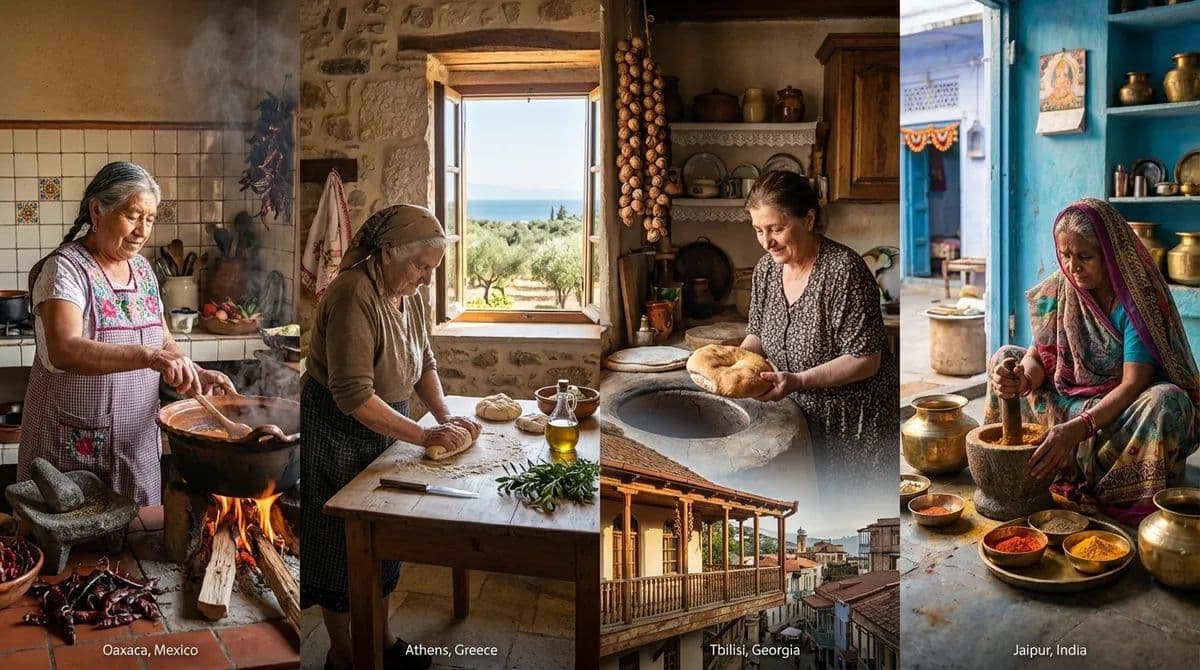
In a courtyard kitchen in Oaxaca's Barrio de Jalatlaco, a woman named Doña Esperanza was making mole negro. She was seventy-eight years old, four feet eleven inches tall, and she had been making this particular mole since she was twelve, when her own grandmother -- her abuela -- stood her on a wooden crate in front of the same comal and taught her to toast the chilhuacle negro chiles until they were black but not bitter, a distinction that exists in no written recipe because it is a distinction of smell, not measurement. Doña Esperanza has never measured anything. She cooks by feel, by taste, by the memory in her hands, and the mole negro she produces -- a sauce of such complexity that food scientists have identified over two hundred distinct flavor compounds in a single batch -- is a local culture exploration in itself, a document of Oaxacan history as rich and as layered as any archive.
This is not an exaggeration. Mole negro contains ingredients from three continents: chiles and chocolate from pre-Columbian Mesoamerica, almonds and sesame from Spain, black pepper and cloves from Asia. Each ingredient marks a historical encounter -- conquest, trade, migration -- and the way they are combined reflects five centuries of culinary evolution that took place not in restaurants or cooking schools but in courtyards like Doña Esperanza's, passed from grandmother to granddaughter in a chain of oral transmission that has no written record and no institutional support.
The cooking class travel experiences that have proliferated in Oaxaca over the past decade -- many of them run by or featuring women like Doña Esperanza -- represent something more profound than culinary tourism. They are acts of archival rescue. The knowledge that these women possess -- not just recipes but entire food systems, encompassing cultivation, preservation, fermentation, and the social rituals that govern when and how particular dishes are prepared -- is stored in human memory and nowhere else. When the grandmother dies, the archive dies with her, unless someone has thought to sit in her kitchen, watch her hands, and listen.
The Nonna Economy
The phrase "cooking with nonnas" has become a shorthand for a global trend: the recognition that the most authentic, most culturally significant cooking in any country is happening not in professional kitchens but in domestic ones, and that the keepers of this cooking are overwhelmingly elderly women.
In Italy, the nonna economy is now a significant sector of the tourism industry. Websites match travelers with Italian grandmothers who offer cooking classes in their homes, and the demand consistently outstrips the supply. The appeal is not merely culinary -- there are easier ways to learn to make pasta -- but existential. Sitting in a nonna's kitchen in Puglia, rolling orecchiette while she tells you about the famine years, or the Americans who liberated her village in 1944, or the way her mother used to stretch a single chicken across three meals for a family of eight, you are accessing a form of knowledge that no cookbook, no cooking show, no Michelin-starred restaurant can provide: the food culture travel stories that exist only in human memory and that are, by their nature, one generation away from extinction.
The food culture travel stories that nonnas tell are not sentimental. They are often brutal. The cuisine of southern Italy -- the cucina povera that food writers now celebrate as a paradigm of sustainability and resourcefulness -- was born of genuine poverty, and the women who perfected it did so not out of philosophical commitment to simplicity but out of necessity. The genius of Italian grandmothers' cooking is the genius of constraint: how to make something extraordinary from almost nothing, using knowledge accumulated over centuries of having almost nothing to work with.
Athens: The Yiayia's Kitchen
In the Psyrri and Exarchia neighborhoods of Athens, a generation of Greek grandmothers -- yiayia, in Greek -- maintains a culinary tradition that is under pressure from multiple directions. Fast food has colonized the younger generation's diet. The economic crisis of 2010-2018 disrupted food supply chains and impoverished the urban working class. And the grandmothers themselves are aging, their knowledge increasingly disconnected from the daily practices that once kept it alive.
The local culture exploration of a yiayia's kitchen in Athens is an encounter with a food tradition of extraordinary depth. Greek cooking is often dismissed as simple -- grilled meat, salad, olive oil -- but this dismissal confuses simplicity of presentation with simplicity of knowledge. The yiayia who roasts a leg of lamb for Easter Sunday is drawing on a knowledge base that includes the specific breeds of lamb that suit different preparations, the wild herbs that grow on specific hillsides at specific times of year, the technique of slow-roasting in a wood-fired oven that requires constant monitoring and adjustment, and the social protocols of the Easter table that determine who carves, who serves, and in what order the dishes appear.
I spent a morning with a yiayia named Eleni in a kitchen the size of a closet in Pangrati, learning to make spanakopita. The recipe, as she described it, contained no measurements: "enough spinach," "some feta," "a good handful of dill," "filo pastry until it looks right." The instruction was delivered not as language but as demonstration -- her hands moving through the preparation with a fluency that decades of repetition had made automatic, folding the filo with a precision that my clumsy attempts could not approach.
What I learned from Eleni was not how to make spanakopita. I can read a recipe for that. What I learned was the speed and confidence with which a lifetime of practice produces knowledge that the hands possess independently of the mind -- knowledge that is, in the strictest sense, unteachable, because it can only be acquired through the same decades of repetition that produced it.
Tbilisi: The Supra and the Matriarch
Georgian cuisine is built around the supra -- the feast -- and the supra is built around the women who prepare it. In a culture where the public ritual of the feast is presided over by a male tamada (toastmaster), the actual work of creating the feast is almost entirely female, and the knowledge base required to execute a proper supra is staggering.
A full Georgian supra might include thirty or more dishes, each with its own preparation timeline, its own seasonal ingredients, and its own place in the sequence of the meal. The pkhali (vegetable pates) must be prepared hours in advance. The khachapuri (cheese bread) must be baked to order. The churchkhela (candle-shaped walnut and grape sweets) must be made weeks ahead. The pickled vegetables, the walnut sauces, the herb salads -- each one requires specific techniques that Georgian grandmothers learn from their mothers and grandmothers in an unbroken chain of domestic transmission.
The cooking class travel experiences available in Tbilisi -- particularly those offered through community tourism organizations that connect visitors with families in the old neighborhoods of Sololaki and Vera -- provide access to this matriarchal knowledge system. The classes are typically held in the grandmother's own kitchen, which in Tbilisi means a room with a wood-fired stove, a collection of cast-iron pots that have been in the family for generations, and an assortment of hand tools -- the special press for churchkhela, the long-handled pan for shotis puri bread -- that have no modern equivalents because no one has needed to modernize them.
What makes the Georgian grandmother's kitchen a food culture travel story of particular power is the connection between food and survival. Georgia's twentieth century was catastrophic: Soviet collectivization, World War II, civil war, economic collapse. Through each crisis, the women who maintained the food traditions were also maintaining cultural identity. The supra was not just a meal. It was a declaration that Georgian culture had survived, that the knowledge had not been lost, that the chain of transmission from grandmother to granddaughter remained unbroken.
Jaipur: The Thali as Library
In the pink sandstone lanes of Jaipur's old city, the Rajasthani thali -- the circular metal plate bearing a sequence of small bowls, each containing a different preparation -- is served in every restaurant, dhaba, and home. But the thali you eat in a restaurant and the thali prepared by a grandmother in her own kitchen are related only in format. The content, the technique, and the knowledge that informs them are separated by a gulf as wide as the one between a photocopy and an illuminated manuscript.
Rajasthani cooking is a cuisine of the desert, and its genius lies in the transformation of constraint into abundance. Water is scarce, so cooks developed techniques for making breads, sweets, and preserves that require no water at all. Fresh vegetables are seasonal and limited, so Rajasthani grandmothers became masters of dried, fermented, and pickled preparations that could sustain a family through the long, harsh summers. The result is a cuisine of extraordinary complexity hidden beneath an appearance of simplicity -- a thali that looks like a collection of small dishes but is actually a nutritional system, balanced across proteins, carbohydrates, fats, vitamins, and the specific micronutrients required for health in a hot, arid environment.
The cooking class experiences available in Jaipur's old city, particularly those organized through women's cooperatives in neighborhoods like Johari Bazaar and Tripolia, connect visitors with grandmothers who are repositories of this desert knowledge. Learning to make ker sangri -- a dried bean and berry preparation that is the cornerstone of Rajasthani cuisine -- from a woman who learned it from her mother, who learned it from hers, is a local culture exploration that connects you not just to a recipe but to a survival strategy refined over centuries.
The Gender of Memory
It is impossible to discuss grandmother recipes without addressing the gendered nature of culinary knowledge transmission. In virtually every culture, the kitchen is coded as female space, and the knowledge it contains -- the recipes, the techniques, the seasonal calendars, the nutritional wisdom -- has been coded as female knowledge, which in practice has meant informal, unwritten, undervalued, and invisible.
This coding has had devastating consequences for the preservation of culinary heritage. Male chefs are celebrated, documented, and supported by institutional structures -- culinary schools, professional associations, Michelin guides. Female home cooks, who maintain the living traditions from which professional cuisine derives its inspiration, are largely undocumented and unsupported. The grandmother who can produce a mole negro of breathtaking complexity from memory has no Michelin star, no cookbook deal, no Instagram following. She has a courtyard, a comal, and a granddaughter who may or may not choose to learn.
The cooking class travel movement, at its best, is an attempt to correct this imbalance -- to recognize that the grandmother's kitchen is a site of knowledge production as significant as any university or research laboratory, and that the knowledge it produces deserves the same level of documentation, respect, and support. At its worst, the movement risks becoming a form of extraction -- foreign tourists paying to access knowledge that the grandmother herself was never compensated for developing, in an exchange that benefits the visitor's Instagram feed more than the grandmother's community.
The ethical cooking class experience is one that returns value to the source: that pays the grandmother fairly, that supports the community organizations that connect visitors with cooks, and that approaches the kitchen not as a performance space but as a classroom in which the visitor is the student and the grandmother is the professor.