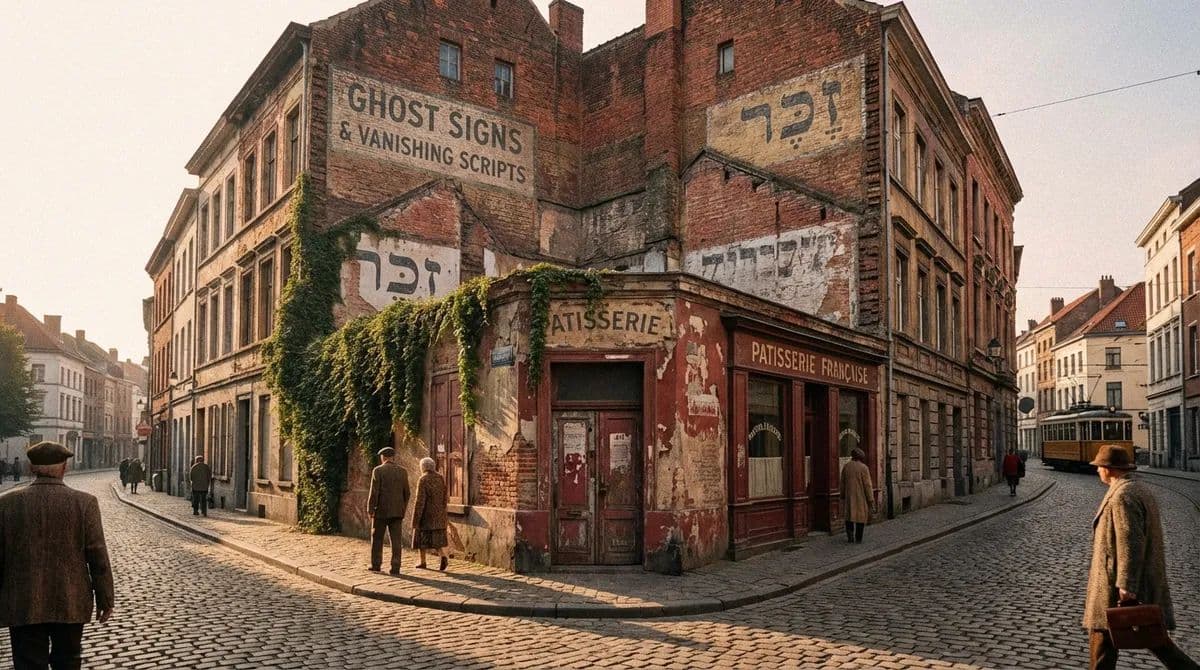
Ghost Signs and Vanishing Scripts: Reading a City's Fading Words

Carmen Ruiz
Writer
On the side of a building in Shoreditch, East London, just above the entrance to a craft cocktail bar that opened in 2019, there is a painted advertisement for a company that ceased to exist in 1923. The letters are faded to the color of old tea, barely legible against the sooty brick, but if you know how to read them — if you tilt your head and let the afternoon light catch the pigment at the right angle — you can make out the words: "BURNHAM & SON, WHOLESALE DRUGGISTS, EST. 1847." The sign has survived two world wars, the Blitz, seventy years of weather, and the complete transformation of the neighborhood from Victorian industrial to twenty-first-century creative hub. It was never meant to be permanent. It was painted by a signwriter whose name is lost, advertising a business whose customers are dead, on a building that has changed hands dozens of times. And yet here it remains — a ghost, whispering about hidden stories of cities that the living city has long since forgotten.
Ghost signs are the typographic residue of vanished economies. They are the painted advertisements, shop names, directional markers, and commercial announcements that were applied directly to building facades before the age of vinyl banners and LED screens, and that persist long after the businesses they promoted have closed, the products they sold have been discontinued, and the neighborhoods they addressed have been transformed beyond recognition. They are, in the most literal sense, forgotten places worth visiting — not because anyone deliberately preserved them, but because paint on brick, under the right conditions, can outlast almost everything else.
Every city has them. But to see them — truly see them, not just glance and move on — requires a particular kind of attention: the willingness to look above street level, to read the building rather than the shop front, and to understand that what appears to be stained and weathered brick may in fact be a message from a previous century, waiting to be deciphered.
The Archaeology of Paint
Ghost signs survive because of chemistry. The paints used by Victorian and Edwardian signwriters were lead-based, mixed with linseed oil, and applied in multiple coats directly onto brick or stone. Lead white, the most common base pigment, is extraordinarily durable — resistant to UV degradation, water penetration, and the chemical attack of urban pollutants. A well-applied lead paint sign on a sheltered wall can remain legible for over a century. Some of London's oldest surviving ghost signs date to the 1860s, their letters still sharp enough to read from across the street.
The signs fade, but they do not disappear uniformly. Different pigments decay at different rates. Red lead, used for emphasis and borders, is the most stable, which is why so many ghost signs appear as faded gray text with strikingly vivid red accents — the last color standing. Prussian blue, common in the late nineteenth century, fades to a pale, ethereal tint that can be mistaken for a shadow. Chrome yellow, popular for eye-catching headlines, oxidizes to a muted ochre. The result is that each ghost sign develops its own distinctive palette of decay, a color scheme that is entirely accidental and often hauntingly beautiful.
The signwriters themselves were a skilled trade, now effectively extinct. In the era before mechanical printing and computer-cut vinyl, every letter on every building was painted by hand, freehand, by artisans who could execute a perfect serif at six inches tall while standing on scaffolding in the rain. The best signwriters were as accomplished as calligraphers, and their work reflects regional and national styles as distinctive as typefaces: the bold, blocky lettering of American commercial signs versus the elegant, attenuated scripts favored in France versus the Gothic black-letter traditions of Germany and Central Europe. A ghost sign is not just a commercial message. It is a specimen of a vanished craft.
London: The Capital of Ghost Signs
London has more documented ghost signs than any other city in the world — over 3,000 at last count, cataloged by a dedicated community of enthusiasts who call themselves "ghost sign hunters." The city's combination of old brick construction, sheltered walls, and relatively dry climate (compared to, say, Manchester) creates ideal preservation conditions, and the continuous commercial activity of London's streets over four centuries has left an unusually dense record.
The richest hunting grounds are in the neighborhoods that experienced rapid commercial development in the Victorian era and have since been only partially redeveloped. Bermondsey, once London's leather-working and tanning district, still bears the painted names of tanners, curriers, and fellmongers on its warehouse walls. Clerkenwell, the old watchmaking quarter, has signs for clockmakers and jewelers whose workshops were demolished a century ago. And the East End — Shoreditch, Spitalfields, Whitechapel — is a palimpsest of painted text that maps the neighborhood's successive waves of immigration.
It is in the East End that ghost signs become most historically poignant. On Brick Lane and the surrounding streets, you can find, if you look carefully, three layers of script on a single building: the faded English text of a Victorian brewery or warehouse, overlaid with Yiddish or Hebrew lettering from the early twentieth century when the neighborhood was London's Jewish quarter, overlaid again with Bengali script from the Bangladeshi community that arrived in the 1970s. The building has not changed. The bricks are the same. But the words painted on them chart a history of displacement, immigration, and cultural succession that no plaque or monument could convey as eloquently. The building is its own history book, written in three languages and three alphabets, each one a chapter in the story of who has called this place home.
Warsaw: The Doorframes That Remember
In Warsaw, the ghost signs are not commercial but domestic, and their emotional charge is of a different order entirely. Before the Second World War, Warsaw was one of the great Jewish cities of Europe, home to approximately 350,000 Jews — nearly a third of the city's population. The Jewish community was not confined to a ghetto (that came later, and horrifically) but was woven throughout the city's fabric, living in the same apartment buildings, shopping in the same markets, walking the same streets.
What remains of this presence, after the Holocaust and after the systematic destruction of the Warsaw Ghetto in 1943, is almost nothing. Almost. But in the doorways and stairwells of pre-war apartment buildings that survived the destruction — and there are more of them than you might expect, scattered through Praga, Muranow, and the Wola districts — you can sometimes find traces of Hebrew and Yiddish script. A mezuzah scar on a doorframe, the outline of the small case that once held a Torah passage still visible as a rectangular indentation in the wood. A painted apartment number in Hebrew numerals, half-hidden beneath layers of post-war paint. A business name, in Yiddish, above a ground-floor entrance that is now a convenience store.
These are not ghost signs in the cheerful, antiquarian sense. They are evidence. They are the physical traces of an absence so total that the city itself seems to have tried to seal over it, as a wound scars. Urban exploration history in Warsaw is necessarily an act of witness — a practice of looking at doorframes and stairwells with the knowledge that the people who made these marks were, almost without exception, murdered, and that the marks themselves survive only because they were too faint or too embedded to be removed by subsequent occupants.
Organizations like the Warsaw Jewish Heritage project have begun documenting these traces with photogrammetry and digital imaging, creating records before renovation and weathering erase the last physical evidence. The work is urgent. Every year, more doorframes are replaced, more paint is applied, more of the script vanishes. The hidden stories of cities like Warsaw have a half-life, and it is shorter than we think.
Hanoi: Colonial Typography and the Politics of Script
In Hanoi, the ghost signs tell a story of colonial power and its aftermath. During the French colonial period (1887-1954), the administrative and commercial life of the city was conducted in French, and the buildings of the French Quarter — the wide-boulevarded district around Hoan Kiem Lake — were marked with French signage in the elegant art-deco and art-nouveau styles of early twentieth-century Paris. Pharmacies, banks, hotels, and government buildings bore inscriptions in French, often carved into stone or cast in iron, announcing their function in the language of the colonial power.
After independence, many of these signs were removed or painted over. But some survived, particularly on buildings that changed function without undergoing major renovation. On the facades of the old Banque de l'Indochine, now a Vietnamese government office, you can still make out the carved French text beneath a layer of pale yellow paint. Above the entrance to what is now a clothing shop on Hang Bong Street, iron letters spelling a French business name cast shadows that are more legible than the letters themselves. And in the Old Quarter, where French and Vietnamese commercial life overlapped, you can find buildings where Vietnamese script was painted directly over French text, the two languages coexisting on the wall like geological strata.
The politics of script in post-colonial cities is never neutral. In Hanoi, as in Algiers, Phnom Penh, and Dakar, the French language on buildings is simultaneously a historical artifact and a residual symbol of domination. The Vietnamese government's ambivalence — neither systematically removing the French text nor preserving it — has produced a layered urban typography that maps the unresolved relationship between colonial past and independent present. The ghost signs here are not quaint. They are contested.
Tbilisi: The Three-Alphabet City
The Georgian capital offers one of the world's most extraordinary typographic landscapes. Georgian script — one of only fourteen unique alphabets in the world — has been in continuous use since the fifth century, and its flowing, curvilinear forms give Tbilisi a visual identity unlike any other city. But beneath and alongside the Georgian letters, the city's buildings carry inscriptions in Russian (from the Tsarist and Soviet periods), Armenian (from the large Armenian community that once dominated the city's commercial life), Farsi (from centuries of Persian influence), and occasionally Arabic.
The old town neighborhood of Abanotubani, built around the sulfur baths that give Tbilisi its name, is particularly rich. On a single block, you can find a bathhouse with a Persian-script inscription above its entrance, an Armenian church with liturgical text carved into its facade, a Soviet-era sign in Russian Cyrillic on a former state shop, and, above all of them, the Georgian script that ties the city to its deepest identity. The layers of alphabet here are not just historical — they are ongoing. New Georgian signs are being added over old Russian ones, just as the Russian ones were added over Persian and Armenian text a century before.
The Race to Document
Ghost signs are disappearing faster than they are being discovered. Renovation, demolition, weathering, and the simple passage of time are erasing the typographic record of cities at an accelerating rate. In response, a global community of documentarians — part historian, part photographer, part urban archaeologist — has emerged, using social media, GPS mapping, and high-resolution imaging to catalog ghost signs before they vanish.
Sam Roberts, a London-based ghost sign hunter who has documented over 1,500 signs across the UK, describes the work as "rescue archaeology for the high street." The analogy is precise. Like an archaeologist racing to document a site before a highway is built through it, the ghost sign hunter is working against a clock set by property developers, weather, and the inexorable chemistry of pigment decay. Every sign they photograph and record is a data point in the history of urban commerce, immigration, and cultural change — a data point that will, within a generation, cease to exist in its original form.
The digital archives being built — Ghost Signs of London, Fading Ads of New York, Enseignes et Pubs Peints of Paris — are themselves a new kind of palimpsest: a digital layer superimposed on the physical one, preserving in pixels what the buildings can no longer hold in paint.