Forest Bathing Beyond Japan: Where Trees Teach Stillness

Carmen Ruiz
Writer
The cedars of Yakushima do not care that you have come a long way to see them. They have been standing here for a thousand years -- some for two thousand, maybe more -- and your arrival, your reverence, your expensive rain jacket and your carefully packed lunch do not register on their timescale. This indifference is, paradoxically, the entire point. Forest bathing travel brings you to places where the trees are so old and so thoroughly committed to their own existence that your human concerns -- the emails, the deadlines, the ambient anxiety that hums beneath modern life like a fluorescent light you have stopped noticing -- begin to seem, not unimportant exactly, but negotiable. Temporary. A passing weather system in a forest that has outlasted a hundred thousand weather systems before.
I came to Yakushima, a subtropical island off the southern tip of Kyushu, because I wanted to understand shinrin-yoku at its source. The term was coined in 1982 by the Japanese Ministry of Agriculture, Forestry and Fisheries -- not as poetry but as public health policy. Japan was urbanizing at a pace that alarmed its health authorities, and the forests were emptying as the cities filled. Shinrin-yoku -- literally "forest bath" -- was an attempt to prescribe what was being lost: the slow, purposeless immersion in woodland that most of human history took for granted and that post-industrial life had rendered exotic.
The science came later. Qing Li, an immunologist at Tokyo's Nippon Medical School, spent years documenting what forest environments do to the human body: lower cortisol levels, reduce blood pressure, boost natural killer cell activity, shift the nervous system from sympathetic (fight-or-flight) to parasympathetic (rest-and-digest). Phytoncides -- the volatile organic compounds that trees release to protect themselves from bacteria and insects -- turned out to have measurable immunological benefits when inhaled by humans. The forest, it seemed, was not merely pleasant. It was therapeutic in ways that could be quantified.
But quantification, however necessary for clinical credibility, misses something essential about the shinrin-yoku experiences that Yakushima provides. Walking the moss-covered trails beneath cedars so large that six people holding hands cannot encircle their trunks, you do not feel your cortisol lowering or your natural killer cells multiplying. You feel something simpler and stranger: a recalibration of scale. The trees are so much larger and older and more patient than you that your own urgency begins to dissolve, not through effort but through comparison. You are a mayfly in a redwood forest. And somehow, this is a relief.
The Protocol of Not-Doing
Forest bathing is not hiking. This distinction, which seems pedantic until you try it, is the foundation of the practice. Hiking has a destination, a pace, a purpose -- even if the purpose is merely exercise. Forest bathing has none of these. The Japanese Association of Therapeutic Nature and Forest Medicine, which certifies shinrin-yoku guides, trains its practitioners in the art of slowing people down to a pace that the Western mind initially finds excruciating: roughly three hundred meters per hour.
At that speed, the forest changes. Details that a hiker would never notice -- the particular quality of light filtered through a canopy of Japanese cypress, the sound of water moving beneath moss, the scent that rises from fallen sugi needles when the afternoon warmth releases their oils -- become not merely visible but overwhelming. The forest, approached at hiking pace, is a backdrop. Approached at shinrin-yoku pace, it is the entire world.
The protocol typically involves a series of invitations rather than instructions. A guide might invite you to find a comfortable place to sit and close your eyes for ten minutes, attending only to sound. Or to walk barefoot along a particular stretch of trail, feeling the temperature and texture of the earth change beneath your feet. Or to choose a single tree and observe it for the length of time it takes to notice something about it that you did not notice at first. None of these invitations require skill, athleticism, or knowledge. They require only willingness -- the willingness to be still in a world that constantly insists on motion.
What surprised me most about practicing shinrin-yoku in Yakushima was how difficult that willingness was to summon, and how quickly, once summoned, it became effortless. The first twenty minutes were agonizing. My mind raced. My phone, silenced and stowed in my backpack, seemed to pulse with phantom notifications. I cataloged everything I should be doing instead of standing motionless beneath a cedar tree. And then, around the thirty-minute mark, something shifted -- a gear catching, a tension releasing -- and the forest came into focus with a clarity that felt almost hallucinatory. I could hear individual drops of water falling from leaf to leaf. I could smell the difference between living wood and dead wood. The light had texture. Time had slowed to the pace of moss growing on stone.
Redwood Cathedrals: The American Forest Bath
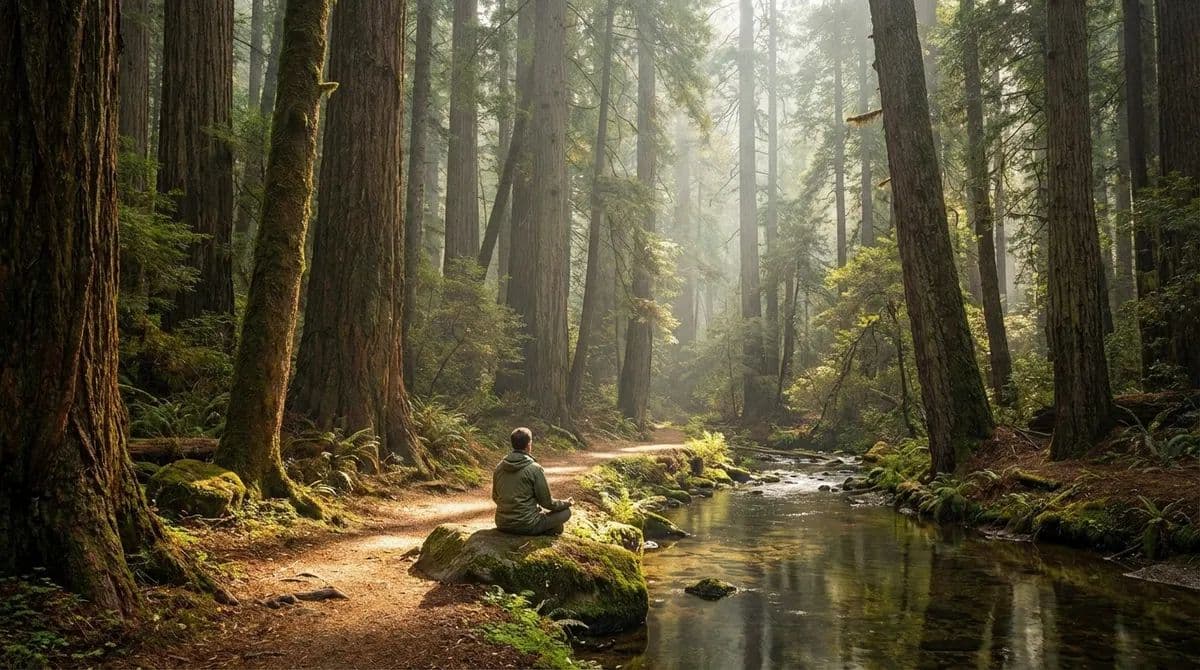
The shinrin-yoku experiences available in North America are different from their Japanese counterparts, and the difference begins with the trees. Where Japanese forests are intimate -- dense understory, filtered light, the sense of being enfolded -- the old-growth redwood forests of Northern California are monumental. Walking among coast redwoods, some over a hundred meters tall and two thousand years old, is less like bathing and more like entering a cathedral. The scale is vertical rather than horizontal, the canopy so high above that it creates its own weather -- fog condenses on the needle tips and falls as a gentle internal rain even on dry days.
The redwoods also produce a distinct acoustic environment. The massive trunks absorb and muffle sound, creating a hush that is subtly different from the silence of an empty room. It is a populated silence -- filled with birdsong, the creak of wood, the distant percussion of a woodpecker -- but the bass frequencies that characterize urban noise are absent, and that absence produces a physiological relaxation that researchers have linked to reduced amygdala activity. Your threat-detection system, the ancient neural circuitry that keeps you vigilant in cities full of cars and strangers, simply switches off. The forest is not threatening, and your body knows it.
Several organizations now offer guided forest therapy walks in the redwoods, following protocols developed by the Association of Nature and Forest Therapy Guides and Programs, which has adapted the Japanese model for North American ecosystems. The walks I have attended in Muir Woods and Prairie Creek Redwoods State Park followed a similar pattern to Yakushima -- slow movement, sensory invitations, prolonged stillness -- but the emotional register was different. Where Yakushima invited intimacy, the redwoods invited awe. Where the Japanese forest whispered, the California forest sang.
Atlas Cedars and the Forests of Morocco
In the Middle Atlas Mountains of Morocco, forests of Cedrus atlantica -- the Atlas cedar -- cover the highlands between Azrou and Ifrane in stands so dense and dark that the forest floor is carpeted in permanent shadow. These are not the delicate, misty woods of Japan or the towering groves of California. They are muscular forests, the trees thick-trunked and deeply rooted in rocky soil, their canopies interlocking into a continuous roof that turns midday into twilight.
Forest bathing in the Atlas cedars is a different therapeutic nature experience, partly because of the trees and partly because of the company. The forests are inhabited by Barbary macaques -- the only wild primates in Africa north of the Sahara -- and their presence changes the quality of attention. You cannot drift into pure introspection when a troop of macaques is moving through the canopy above, their calls and rustlings constantly redirecting your focus from inner landscape to outer. The forest becomes a conversation rather than a meditation.
The scent of the Atlas cedar is also distinctive: warmer and more resinous than Japanese cedar, with a sweetness that intensifies when the sun heats the bark. Local Amazigh communities have used cedar oil for centuries in traditional medicine, and the phytoncide profile of Cedrus atlantica is among the most complex of any conifer species, rich in the sesquiterpenes that Japanese researchers have associated with immune system enhancement.
What the Atlas cedars teach, that Yakushima's sugi and California's redwoods do not, is resilience. These trees grow in poor soil, at altitude, in a climate that alternates between freezing winters and scorching summers. Their survival is not effortless but earned, and spending time among them conveys a different quality of stillness -- not the gentle surrender of the Japanese forest bath but something more like endurance, a quietude that has been tested and not broken.
Tasmania's Eucalyptus and the Smell of Distance
The forests of Tasmania are unlike any other forest on Earth, and the difference begins with the smell. Eucalyptus oil, released from the leaves of the towering Eucalyptus regnans -- the tallest flowering plant in the world, with specimens exceeding ninety meters -- saturates the air with a clean, mentholated sharpness that clears the sinuses and, according to some aromatherapy research, stimulates cognitive function. Where other forests calm the mind, the Tasmanian eucalyptus forest sharpens it.
The Styx Valley in southern Tasmania contains some of the tallest trees in the Southern Hemisphere, their trunks rising like columns in a ruined temple, their bark hanging in long, papery strips that catch the light and sway in the updrafts created by the forest's own microclimate. Walking among them is a therapeutic nature experience of unusual intensity, partly because of the scale and partly because of the light. Tasmanian light has a quality I have not encountered anywhere else -- a crystalline brightness that seems to illuminate objects from within rather than from above, turning the forest into something closer to stained glass than landscape.
The understory is equally remarkable. Man ferns -- ancient tree ferns with trunks like elephant legs, direct descendants of the vegetation that covered Gondwana -- create a secondary canopy three to four meters above the ground, filtering the already filtered light into a green so deep it seems to have weight. Walking beneath the ferns, beneath the eucalyptus, beneath the sky, you occupy a space that has three ceilings and no walls, a natural architecture of extraordinary complexity that human architects have never managed to replicate.
The Urban Forest Bath
Not everyone can travel to Yakushima or the Styx Valley, and one of the most encouraging developments in the forest bathing movement is its adaptation to urban environments. Parks, botanical gardens, and even tree-lined streets can provide meaningful therapeutic nature experiences when approached with the right intention and pace.
Researchers at the University of East Anglia analyzed data from 140 studies involving 290 million participants and concluded that any exposure to green space -- not just old-growth forest but city parks, riverside walks, even streets with consistent tree cover -- was associated with significant reductions in cortisol, heart rate, and the incidence of type 2 diabetes, cardiovascular disease, and premature death. The effect scaled with duration and immersion, but even brief encounters with trees -- twenty minutes in a park, a slow walk along an avenue of limes -- produced measurable benefits.
Tokyo, the city where shinrin-yoku was born, demonstrates this urban potential beautifully. The Meiji Shrine forest, a hundred-hectare artificial woodland planted in 1920, now supports a mature, biodiverse ecosystem in the heart of one of the world's largest cities. Walking the gravel paths beneath the canopy, the sound of Harajuku's crowds fading within minutes of entering the torii gate, you can achieve a state remarkably close to the deep forest immersion of Yakushima -- not identical, but recognizable, the same shift from sympathetic to parasympathetic, the same dissolving of urgency, the same recalibration of scale.
London's Hampstead Heath, Berlin's Tiergarten, New York's Central Park Ramble, and Portland's Forest Park all offer similar possibilities. The key is not the purity of the forest but the quality of attention you bring to it. A twenty-minute session of genuine stillness beneath an oak in Hampstead Heath may do more for your nervous system than an eight-hour hike through a national park undertaken at competitive pace with a podcast in your ears.