Following the Thread

Ingrid Olsen
Writer
The thread begins where you might expect — in a mulberry grove in eastern China, where silkworms feed in a silence so particular it has its own texture. The caterpillars chew with a faint, papery rustle, like rain on dried leaves, and the women who tend them move with the care of people handling something sacred. Which, in a sense, they are. For five thousand years, this fiber — extruded from the salivary glands of Bombyx mori — has shaped trade routes, toppled empires, and woven itself into the very fabric of civilization. To follow it westward is to trace one of the oldest stories in human commerce, told not in words but in thread.
The Silk Road was never a single road. It was a braid of paths, a network as complex as the fiber that gave it its name. Merchants traveling from Xi'an did not plot a single route but chose among dozens, depending on the season, the political situation, and the particular obstinacy of their camels. Some routes crossed the Taklamakan Desert — its name, the old story goes, means "you go in and you don't come out" — while others skirted the Tian Shan mountains to the north or the Kunlun range to the south. But all of them carried silk. Bolts of it, bales of it, thread wound so tightly it could survive months of desert crossing without losing its luster.
I first encountered the Silk Road's textile legacy not in China but in a museum basement in Berlin, where a conservator showed me a fragment of Han dynasty silk recovered from a grave in Xinjiang. The fabric was two thousand years old, yet it still shimmered. The weave was so fine that the conservator used a jeweler's loupe to count the threads — over a hundred per centimeter. "This," she said, holding the fragment up to the light, "was worth more than gold." She wasn't speaking metaphorically. In the Roman Empire, silk sold for its weight in gold, and the Senate periodically attempted to ban its import, worried that Roman wealth was hemorrhaging eastward along the caravan routes. The bans never held. Desire, it turns out, is a poor respecter of legislation.
Silk Road Textile Heritage Travel: From Kashgar to Samarkand
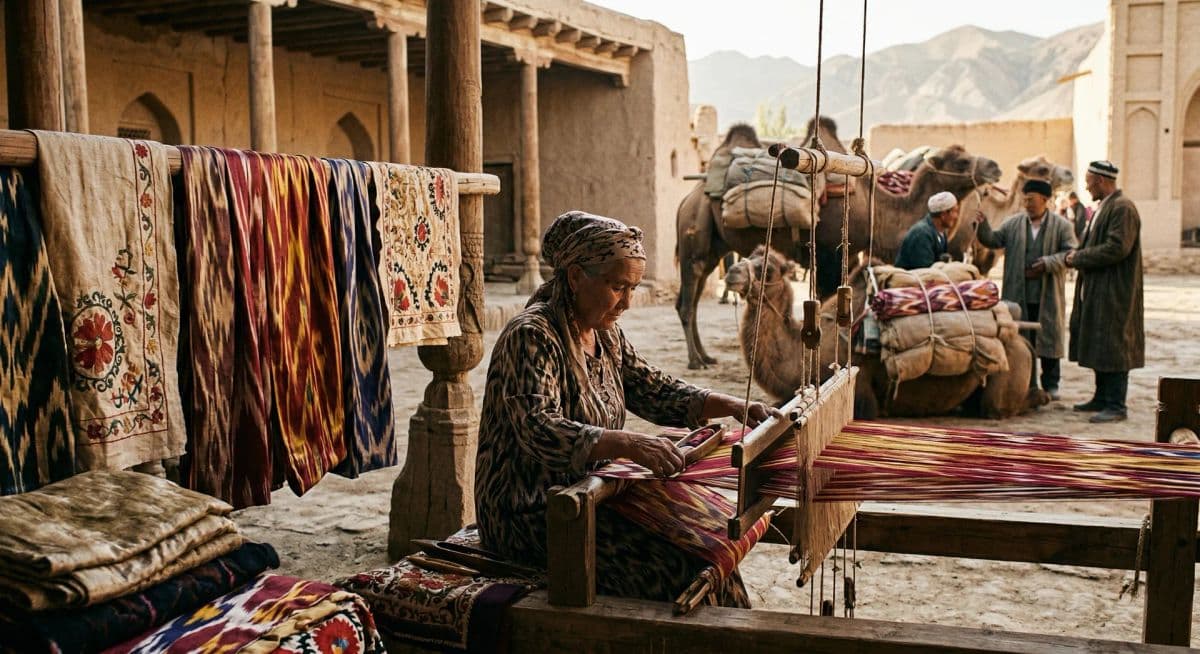
To follow the thread today is to travel through landscapes where the old trade routes have left scars — and gifts. In Kashgar, the Sunday livestock market still operates with the kinetic energy of a medieval bazaar, but walk a few blocks into the old city and you find the textile merchants, their stalls draped with atlas silk in colors that seem to emit their own light: ikat-dyed patterns of crimson and gold that blur at the edges like watercolors left in the rain. The technique — resist-dyeing the warp threads before weaving — produces patterns that are deliberately imprecise, a controlled chaos that no machine can replicate.
Kashgar's position at the western edge of China, where the Taklamakan gives way to the Pamir Plateau, made it a fulcrum of the silk trade for over two millennia. Caravans arriving from the east rested here before attempting the passes into Central Asia, and caravans arriving from the west paused to trade their goods — glass, wool, horses, lapis lazuli — for the fabric that had drawn them thousands of miles from home. The old caravanserais are mostly gone now, replaced by concrete apartment blocks, but in the narrow alleys of the old quarter, artisans still work at wooden looms, their shuttles moving with a rhythm that predates the city's most recent reconstruction.
The Karakoram Highway, which climbs from Kashgar to the Khunjerab Pass at nearly five thousand meters, follows one of the silk trade's most dramatic routes. The road clings to cliffs above the Tashkurgan River, passes through gorges where the rock has been folded by tectonic forces into patterns more complex than any textile, and crosses plateaus where yaks graze at altitudes that would defeat most lowland animals. Somewhere along this route, Chinese silk first entered the world beyond China's borders. The Pamir Plateau — the "Roof of the World" — was not a barrier but a junction, a place where traders from China, India, Persia, and the Mediterranean converged, exchanged goods and languages, and moved on.
Textile Tourism Destinations: The Bazaars of Bukhara
Descending from the Pamirs into the Fergana Valley of Uzbekistan, you enter a landscape that has been shaped by fiber for centuries. The Fergana Valley is Central Asia's breadbasket, but it was historically its silk basket as well. Margilan, a city that appears in few travel guides, has been producing silk since at least the fourth century. The Yodgorlik factory still operates as a workshop rather than a showpiece, and visitors can watch women unreeling cocoons in steaming vats, drawing out single filaments thinner than a human hair and twisting them into thread. The smell — warm, faintly animal, like wet wool mixed with green tea — is the smell of sericulture, unchanged for millennia.
From Margilan, the old routes continued west to Bukhara, where the trade moved through madrasas that doubled as market halls. The Toqi Sarrafon, one of Bukhara's surviving covered bazaars, was originally the money changers' dome — appropriate, given that silk was itself a form of currency. Today it sells tourist souvenirs, but the vaulted ceiling still carries the proportions of serious commerce. The light falls through oculi in the dome, creating pools of illumination that move across the stone floor as the sun tracks westward — a reminder that these spaces were designed for a trade that followed the sun.
Bukhara's textile heritage extends beyond silk. The city was famous for its suzanis — embroidered hangings made by brides as part of their dowry. A traditional suzani takes months to complete, its surface covered in dense floral patterns worked in chain stitch with silk thread. The designs encode fertility, protection, and hope in a botanical language that predates Islam's arrival in Central Asia. In the old houses of the Jewish quarter, where Bukharan Jews maintained a parallel tradition of embroidery for centuries before their emigration to Israel and New York, you can sometimes find antique suzanis whose stitches carry the particular tension of hands that knew they were making something to outlast them.
Samarkand Travel Guide: Where the Threads Converge
Samarkand, the jewel of the Silk Road, is where the thread metaphor becomes almost too literal. The city's great monuments — the Registan, the Shah-i-Zinda necropolis, the Bibi-Khanym Mosque — are decorated with tile work that mimics textile patterns. The geometric interlacing on the facade of the Ulugh Beg Madrasa follows the same mathematical principles as a twill weave, and the floral motifs on the mausoleum of Tamerlane's wife could have been lifted directly from a suzani design. Architecture, in Samarkand, is cloth made permanent.
But Samarkand's textile heritage is not confined to stone. In the workshops of Konigil, just outside the city, artisans have revived the ancient craft of Samarkand paper — made from mulberry bark, the same tree that feeds silkworms. The connection is not coincidental. The mulberry tree sustained two of the Silk Road's most important commodities: the fiber that clothed half the world and the paper that carried its correspondence, its poetry, and its bills of lading. To watch Samarkand paper being made — the bark beaten to pulp in stone mortars, the pulp spread on screens, the sheets dried in the sun — is to witness a technology that was already ancient when Marco Polo passed through in the thirteenth century.
The Registan itself — the word means "sandy place" — was once an open-air market where textiles were among the most prized goods. Three madrasas frame the square, their facades encrusted with tiles in ultramarine and turquoise, and in the late afternoon, when the light turns gold and the shadows deepen in the recessed arches, you can almost hear the bargaining. Almost. The tourists clicking their phones are a different kind of commerce, but the impulse — to carry something beautiful away from this place — has not changed in a thousand years.
The Thread's Western Terminus
The Silk Road did not end in Samarkand. The thread continued west through Persia, where Isfahan's bazaar still stretches for kilometers under vaulted ceilings, and where merchants sell termeh — a brocade woven with patterns so intricate that a single meter can take weeks to produce. It continued to the ports of the Levant, where Venetian and Genoese traders loaded bolts of silk onto galleys bound for Europe. It continued to Damascus, which gave its name to damask — a weave structure, not a place, though the place and the structure are inseparable in the history of cloth.
In Istanbul, the thread reaches its most dramatic architectural expression. The Grand Bazaar — Kapalıçarşı — has been a textile market since the fifteenth century, and its labyrinthine corridors still carry the scent of dyed wool and the sound of merchants calling prices in Turkish, Arabic, and English. The silk merchants cluster in the Sandal Bedesten, the inner sanctum of the bazaar, where the light is dim and the fabrics glow with an inner luminescence that seems to defy the laws of optics. A good piece of Turkish silk catches light the way a prism does — not reflecting it but breaking it into its constituent colors, so that a single fabric can appear crimson from one angle and gold from another.
But the thread's true western terminus is not Istanbul. It is the wardrobes of Rome and Constantinople, where silk was draped on emperors and senators, where the fabric's sheen became synonymous with power itself. The Byzantines eventually broke China's monopoly by smuggling silkworm eggs out of Central Asia — hidden, according to legend, in hollow bamboo canes carried by Nestorian monks. The smuggling of silkworms may be the most consequential act of industrial espionage in history, and it was motivated entirely by the desire to control the thread.
Why Fabric Endures as Cultural Memory
To travel the Silk Road today is to encounter a paradox: the trade that created these cities has been dead for centuries, replaced by container ships and fiber-optic cables (which are, in their own way, threads carrying information across continents). Yet the fabric endures. In every city along the route, artisans continue to weave, dye, and embroider, not because the global economy demands it but because the knowledge in their hands is too valuable to lose.
This is what textile heritage travel reveals that no museum can: the way knowledge lives in the body. Watching a weaver in Kashgar or Margilan or Isfahan, you are watching a form of intelligence that cannot be fully captured in words or diagrams. The tension of the warp, the angle of the shuttle, the moment when the reed beats the weft into place — these are decisions made by fingers that have inherited centuries of practice. The thread carries information, and the information is older than writing.
The Silk Road was never really about silk. It was about the human compulsion to connect, to trade not just goods but ideas, technologies, and stories. Silk was merely the most portable, most beautiful, most desired of the goods that traveled those routes. It was the thread that tied East to West, and its pull was strong enough to create cities, sustain empires, and inspire journeys that took years to complete.