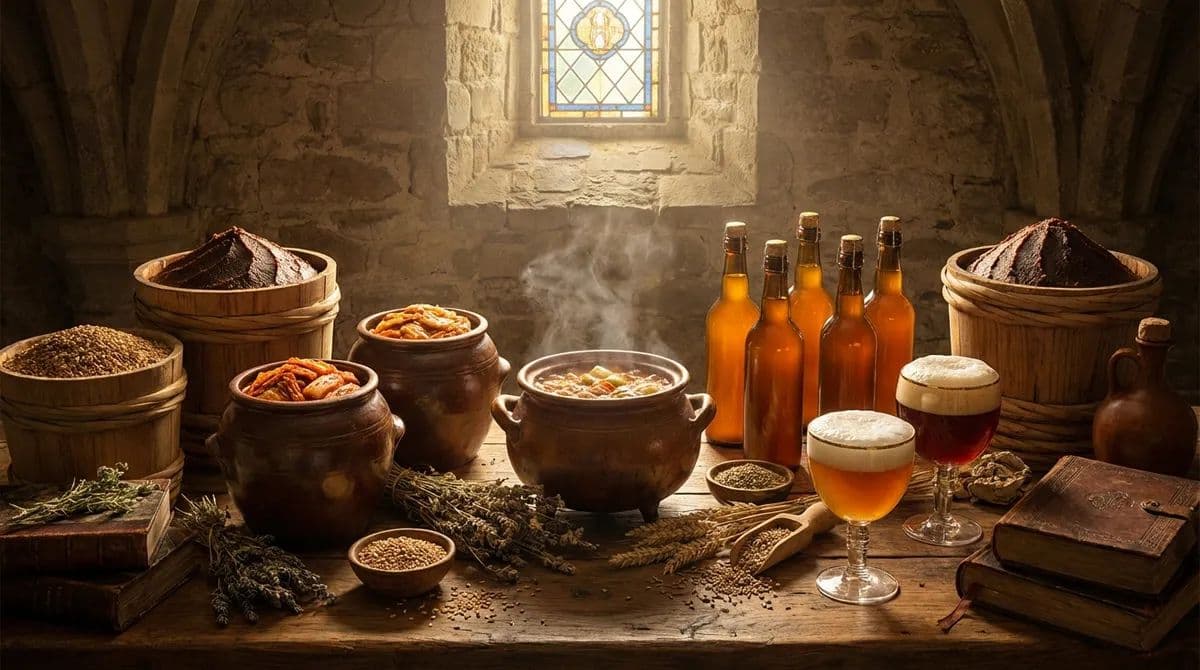
Fermentation and Faith: The Sacred Chemistry of Slow Food

Carmen Ruiz
Writer
Somewhere beneath the surface of a ceramic onggi jar, buried in the earth of a Korean backyard, a hundred trillion microorganisms are conducting a symphony that will take three months to complete. The cabbages and radishes packed into that jar last autumn have ceased to be vegetables in any recognizable sense. They are becoming kimchi — which is to say, they are being digested by bacteria before a human mouth ever touches them, pre-chewed by invisible organisms whose metabolic byproducts happen to produce one of the most complex flavor profiles in the culinary world. The woman who packed this jar is not thinking about microorganisms. She is thinking about her mother, who taught her the ratios, who learned them from her mother, who learned them from hers. Food as cultural identity travel begins here, in the inheritance of a gesture so old that its origins have dissolved into the act itself.
This is what links the most patient foods on earth: not technique, not geography, not religion, but a shared willingness to surrender control to time. Fermentation is the only cooking method that does not involve the direct application of energy. No fire, no blade, no hands shaping the material. Instead, you prepare the ingredients, create the conditions, and then you wait. You trust. You have faith — and it is not a coincidence that across cultures, the foods that require the deepest patience are so often entwined with spiritual practice that it becomes impossible to say where the cooking ends and the worship begins.
The Onggi and the Ancestors
In Korea, the relationship between fermentation and faith is written into the calendar. Gimjang — the annual communal preparation of kimchi for winter — traditionally takes place in late November, and it is considered so culturally significant that UNESCO inscribed it on its Intangible Cultural Heritage list in 2013. The inscription specifies not the recipe but the practice: the gathering of families, the sharing of labor, the exchange of finished kimchi between neighbors, the collective act of preparing for winter together.
The onggi jars themselves are objects of quiet reverence. Made from clay mixed with mineral powder and fired at specific temperatures, they are designed to be semi-porous — they breathe, allowing the controlled exchange of air that is essential to proper fermentation while preventing the uncontrolled intrusion of pathogens. A good onggi is passed down through generations, and its interior surface, colonized over decades by beneficial bacteria, becomes a kind of microbial heirloom. When a Korean family moves house, the onggi go with them, carried as carefully as the ancestral tablets.
The gastronomic storytelling of kimchi is inseparable from the storytelling of Korean identity. During the Japanese occupation of Korea in the early twentieth century, the suppression of Korean cultural practices extended to food, and the preservation of kimchi-making traditions became a quiet act of resistance. During the Korean War, when the peninsula was devastated and food was scarce, kimchi provided essential nutrition — the fermentation process increases the bioavailability of vitamins and produces probiotics that support immune function. The jar buried in the yard was not just a pantry. It was a survival kit, a cultural archive, and a small, stubborn declaration that the family would still be here when spring came.
Three Years of Darkness
Japanese miso occupies a different register of patience. While kimchi measures its fermentation in weeks or months, the most prized varieties of miso — hatcho miso from Aichi Prefecture, in particular — are aged for three years in massive cedar vats topped with river stones weighing several tons. The weight of the stones compresses the paste slowly, forcing out moisture and concentrating the flavors until the miso becomes something almost geological: dark, dense, intensely savory, with an umami depth that seems to have no bottom.
The miso-making process begins with soybeans, which are steamed, mashed, and inoculated with koji — the filamentous fungus *Aspergillus oryzae* that is the keystone organism of Japanese fermentation. Koji is also responsible for sake, soy sauce, mirin, and rice vinegar, making it arguably the single most important microorganism in Japanese culinary history. The Japanese government designated koji a "national fungus" in 2006, a distinction that, while slightly comic in English translation, reflects a genuine cultural appreciation for the role of microorganisms in the national cuisine.
At the Hatcho Miso company in Okazaki, which has been producing miso on the same site since 1337, the vats are arranged in a dim warehouse that smells of cedar and deep fermentation — a smell that is not quite like anything else, part soy sauce, part aged cheese, part forest floor after rain. The workers who tend these vats speak of the miso with a kind of familial concern, checking the stones, monitoring the temperature, occasionally tasting from different vats to track the progress of a fermentation that will not be complete until years after it began. There is no way to rush it. The koji and the bacteria and the enzymes work at their own pace, and the human role is limited to creating the conditions and then exercising a patience that borders on meditation.
This patience is not incidental to the spiritual culture of Japan. The tea ceremony, the rock garden, the practice of ikebana flower arrangement — all of these traditions share a fundamental aesthetic principle: that beauty emerges from attention sustained over time, that the process of waiting is not empty but generative. Miso-making participates in this aesthetic. The three years of darkness inside the vat are not a delay. They are the work.
Honey Wine and the Liturgical Calendar
Ethiopian tej — honey wine fermented with the leaves and bark of the gesho plant, a species of buckthorn — occupies a unique position at the intersection of food, drink, and sacred ritual. Tej has been produced in Ethiopia for at least a thousand years, and its preparation and consumption are woven into the liturgical calendar of the Ethiopian Orthodox Church, one of the oldest Christian traditions in the world.
The fermentation of tej is a relatively quick process compared to miso — five to ten days, depending on the ambient temperature and the honey-to-water ratio — but the making of good tej is considered an art that requires a specific kind of attention. The gesho, which acts as both a bittering agent and a source of wild yeast, must be harvested at the right time and prepared correctly. The honey must be raw and unprocessed. The fermentation vessel — traditionally a smoked clay pot called a berele — contributes its own microbial character to the brew.
In the tejbets, the small bars that serve tej throughout Addis Ababa and the Ethiopian highlands, the wine is poured from a berele into small, handled glass flasks that are unique to this drink. The flavor is a revelation if you have never encountered it: sweet and dry simultaneously, floral from the honey, slightly bitter from the gesho, with a fizzy effervescence that lifts the whole experience toward something almost champagne-like. Different tejbets have different house styles, determined by their particular ratio of honey to gesho and, crucially, by the microbial population that has colonized their fermentation vessels over years of continuous use.
The connection between tej and Ethiopian Orthodox Christianity is not metaphorical. The church's tradition of fasting — Ethiopian Orthodox Christians observe more than two hundred fasting days per year, during which animal products are prohibited — has shaped the country's entire culinary culture, producing one of the world's great vegan cuisines as a byproduct of religious observance. Tej, which is permitted during fasting periods, becomes even more central to social and communal life during these times, and the tejbet becomes a gathering place where the slow food travel experience and the spiritual practice are genuinely, inseparably, the same thing.
God Is in the Beer
The Trappist breweries of Belgium — there are six remaining within the country, though the designation has been extended to a handful of monasteries elsewhere — produce beer under conditions that would be familiar to a miso maker in Okazaki or a kimchi maker in Seoul: the conditions of faith, patience, and an institutional memory that spans centuries. To be designated "Authentic Trappist Product," a beer must be brewed within the walls of a Trappist monastery, under the supervision of the monastic community, with the majority of profits directed toward charitable work. The beer is not a commercial product that happens to be made by monks. It is a monastic product that happens to be beer.
At Westvleteren, often rated the finest brewery in the world, production is deliberately limited. The monks brew only enough to fund the monastery's operations and charitable commitments. There is no marketing, no distribution network, no branding campaign. For years, the only way to purchase Westvleteren 12 — the abbey's dark, complex quadrupel — was to call a dedicated phone line, make a reservation, and drive to the monastery gate. The scarcity is not a marketing strategy. It is the natural consequence of people who have taken vows of simplicity making only as much as they need.
The slow food travel experience of visiting a Trappist brewery is unlike visiting any commercial brewery. There is no tasting room designed for Instagram. There is a monastery with a gate and a small cafe, and beyond the gate, a community of men whose daily schedule is organized around prayer, and for whom brewing is one form of manual labor among several — they also make cheese, bake bread, tend gardens. The beer reflects this context. It is unhurried. The fermentation is long, the conditioning patient, the flavors layered in a way that suggests they were built not by a brewer optimizing for efficiency but by a community that has time, because time is the one resource a monastery will never lack.
The Common Thread
What connects these traditions — Korean kimchi, Japanese miso, Ethiopian tej, Belgian Trappist ale — is not a shared technique or a shared ingredient. It is a shared epistemology: the conviction that some forms of knowledge can only be produced by waiting. That time is not an obstacle to be overcome but a collaborator to be trusted. That the microorganisms doing the actual work — the lactobacillus, the koji, the wild yeast — are not tools to be controlled but partners to be accommodated.
This is a profoundly countercultural idea in a world organized around speed, efficiency, and the elimination of waiting. Fermented foods resist optimization. You cannot rush kimchi. You cannot microwave miso into maturity. You cannot accelerate the complex biochemistry that turns raw honey and gesho bark into tej. You can only create the conditions — the salt concentration, the temperature range, the absence of contaminants — and then step back and let time do what time does, which is everything.
The spiritual dimension of these practices is not decorative. It is structural. Fermentation requires faith in a process you cannot see, producing results you cannot predict with precision, on a timeline you cannot control. This is, by any reasonable definition, a religious posture. And the foods that emerge from it — complex, alive, irreducible to their ingredients — carry that faith in their flavor, which is why they taste, in some essential way, different from anything that was merely cooked.