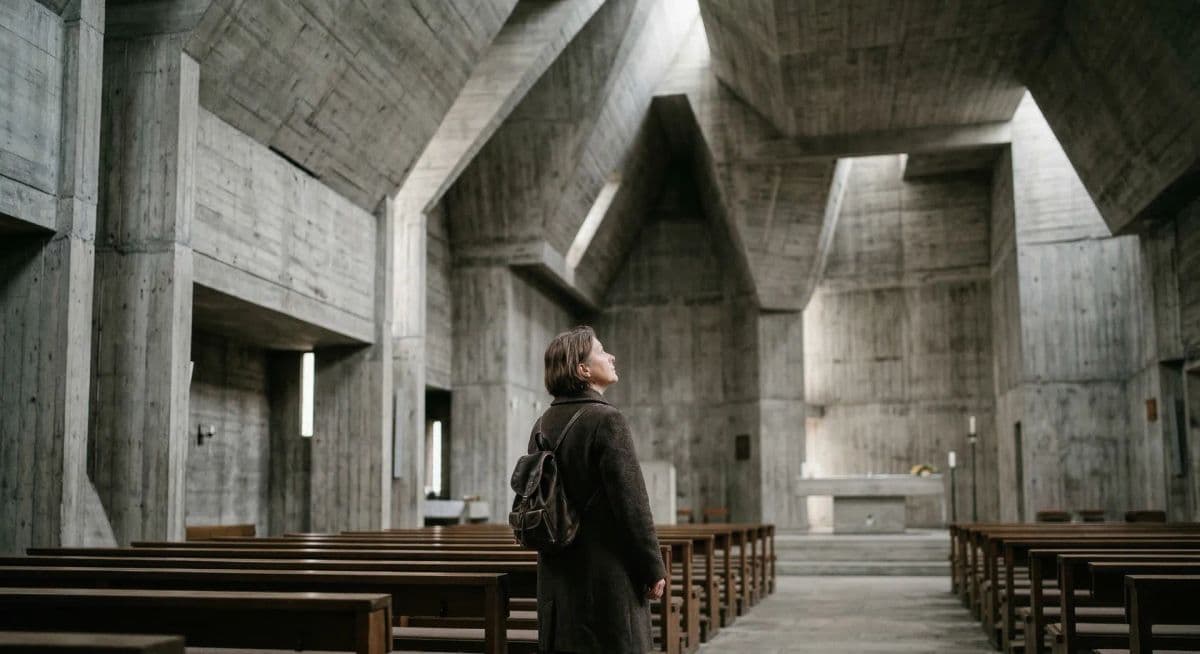
Concrete Prayers: A Pilgrimage to Brutalism's Forgotten Churches

Thomas Hardy
Writer
The first time I saw Notre-Dame du Haut at Ronchamp, I misunderstood it completely. I had studied the photographs, read the criticism, memorized Le Corbusier's own grandiose pronouncements about "ineffable space." I expected to be intellectually stimulated, architecturally educated, suitably impressed. What I did not expect was to cry.
It was the light that undid me. Those seemingly random perforations in the massive south wall -- windows of wildly varying sizes punched through concrete up to three meters thick, some filled with clear glass, others with glass stained in primary colors -- cast a constellation of light points across the interior that shift and breathe as the sun moves. The effect is less like entering a building than like entering the inside of a living creature, something that breathes and watches and has its own slow, geological pulse. Standing there, surrounded by brutalist architecture worth visiting at its most transcendent, I understood for the first time that concrete could pray.
That visit to Ronchamp in 2019 began an obsession that has taken me to dozens of churches, chapels, and monasteries across three continents -- all built in raw, unfinished concrete, all largely unknown outside architectural circles, and all carrying an emotional charge that the sanitized surfaces of contemporary architecture have largely abandoned. This is the story of that pilgrimage, and an invitation to undertake your own.
The Revolution at Ronchamp
To understand why brutalist churches matter, you need to understand what they were rebelling against. By the mid-twentieth century, church architecture in Europe had calcified into a grim repetition of neo-Gothic and neo-Romanesque formulas -- pointed arches, stone vaults, stained glass depicting the same scenes in the same palette. Churches were built to look like churches, which meant they looked like the past. The living God, if He existed, had apparently stopped commissioning new work sometime around 1300.
Le Corbusier, who was not religious in any conventional sense, shattered this consensus with Ronchamp, completed in 1955. Everything about the building was a provocation. The billowing roof, inspired by a crab shell the architect had picked up on a Long Island beach, appeared to float above the walls on a sliver of light. The walls themselves were not straight but curved, thickening and thinning like the hull of a ship. The floor sloped downward toward the altar, pulling the congregation forward with the subtle insistence of gravity. Nothing looked like a church. Everything felt like one.
The Catholic Church, to its credit, understood what Le Corbusier had done. Rather than recoiling from the provocation, the Vatican's post-war liturgical reform movement embraced the idea that sacred space could be reinvented from scratch. The Second Vatican Council's constitution on the liturgy, promulgated in 1963, explicitly called for churches that expressed the spirit of their own age rather than aping the past. The door was open, and the brutalists walked through it.
Giovanni Michelucci and the Church of the Autostrada
If Ronchamp was the manifesto, Giovanni Michelucci's Chiesa dell'Autostrada del Sole outside Florence was the first great response. Completed in 1964, the Church of the Motorway -- built to serve travelers on Italy's new autostrada network -- is one of the most extraordinary buildings of the twentieth century and one of the least known.
Michelucci, who was seventy-two when he designed it, created a structure that looks like a tent pitched by a giant in the Tuscan hills. Enormous copper sails rise from a base of rough stone and exposed concrete, sheltering an interior that is simultaneously monumental and intimate. The plan is deliberately labyrinthine -- there is no single axis, no obvious front or back, no processional route. You are meant to wander, to discover the space gradually, to find your own path to the altar the way a pilgrim finds their own path to God.
The concrete inside is left raw and board-marked, bearing the imprint of the wooden formwork like a fossil record of its own construction. This is a crucial element of brutalist church aesthetics: the refusal to conceal the process of making. Where traditional churches hide their structure behind plaster, paint, and gilt, brutalist churches celebrate the evidence of human labor. Every board mark, every tie-hole, every imperfection in the pour is left visible, a reminder that this space was made by hands, not descended from heaven.
The stories behind buildings like Michelucci's are inseparable from their power. He designed the church as a monument to the workers who died building the autostrada, and that dedication to labor -- to the dignity of physical work and the concrete that results from it -- permeates every surface.
Marcel Breuer's Geometry of Faith
While Italian brutalism favored organic, almost biomorphic forms, the Hungarian-American architect Marcel Breuer brought a different sensibility to sacred concrete: pure geometry deployed with an almost mathematical precision.
His Abbey Church of Saint John at Collegeville, Minnesota, completed in 1961, announces itself from miles away with a freestanding bell banner -- a massive concrete slab perforated with a honeycomb of openings that frame the bells like icons in a brutalist altarpiece. The banner is simultaneously a functional structure, an abstract sculpture, and a landmark visible across the flat Minnesota prairie. It is architecture as declaration, a building that speaks before you enter it.
Inside, the church is a vast, top-lit space supported by folded concrete plates that create a rhythm of light and shadow reminiscent of a forest canopy. Breuer understood that concrete's great gift to sacred architecture was not austerity but plasticity -- the ability to create forms that no other material could achieve. The folded plates are structurally efficient, aesthetically dramatic, and acoustically complex, producing a reverberant quality that makes plainchant sound as if it is being sung inside a mountain.
Breuer's later Annunciation Priory in Bismarck, North Dakota, takes the same principles further. The bell tower is a single, tapering concrete blade that rises from the prairie like an exclamation mark. The chapel interior is a study in how light can be directed, filtered, and modulated through concrete to create an atmosphere that changes with every hour and every season. In winter, when the North Dakota light is low and gold, the concrete seems to glow from within.
Gottfried Bohm: Concrete as Cathedral
No architect has done more to prove that brutalist churches travel well -- that raw concrete can achieve the emotional intensity of the greatest medieval cathedrals -- than the German architect Gottfried Bohm. His Pilgrimage Church in Neviges, completed in 1968, is the undisputed masterpiece of the genre.
Neviges is a small town in the Bergisches Land region of western Germany, an unlikely destination for architectural pilgrimage. But approach the town from the valley below and the church rises above the rooftops like a concrete mountain range, its angular silhouette as commanding as any Gothic spire. Bohm designed the building as a series of intersecting crystalline forms -- imagine a geode split open and scaled up to the size of a cathedral -- that shelter an interior of staggering spatial complexity.
The main worship space seats over a thousand people in a single, column-free volume beneath a ceiling of folded concrete that soars to a height of thirty-four meters. Light enters through narrow slots between the concrete folds, creating ever-shifting patterns that play across the walls like a slow, silent film. The acoustics are extraordinary: a whisper at the altar carries to the back rows with perfect clarity, while the ambient sound of the congregation creates a warm, enveloping hum that makes solitude feel communal.
What makes Neviges genuinely overwhelming, though, is its refusal to compromise. The concrete is raw, the scale is enormous, the forms are uncompromising, and the overall effect is closer to entering a geological formation than a man-made structure. Bohm understood that the sacred is not always comforting. Sometimes it is terrifying -- the numinous, as Rudolf Otto defined it, combining fascination and dread. Neviges captures both.
The Japanese Parallel
While European architects were reinventing the Christian church in concrete, Japanese architects were conducting their own parallel experiment in brutalist sacred space. Kenzo Tange's Saint Mary's Cathedral in Tokyo, completed in 1964, is a hyperbolic paraboloid of gleaming stainless steel over a concrete structure that from the air forms the shape of a cross. Inside, the walls curve upward to meet in a narrow skylight that runs the full length of the building, drawing the eye -- and the spirit -- inexorably upward.
Tange's cathedral is more theatrical than most brutalist churches, but it shares their essential conviction that modern materials and modern forms are not merely adequate for sacred architecture but uniquely suited to it. The sweeping curves that concrete and steel make possible create spatial experiences that stone and timber cannot achieve -- experiences that feel genuinely new, genuinely of their moment, rather than nostalgic citations of a vanished past.
Tadao Ando, whose work I explored in the context of minimalist silence, represents the other pole of Japanese sacred brutalism: not Tange's operatic grandeur but a whispered intensity that makes every surface feel like a meditation. His Church of the Light, discussed elsewhere, is the most celebrated example, but his less-known Chapel on Mount Rokko -- a glass-and-concrete box cantilevered over a forested hillside -- may be even more affecting. The chapel reduces architecture to its absolute minimum: a floor, a ceiling, two walls of concrete, two walls of glass, and the Kobe cityscape spread out below like an offering. It is brutalism not as aggression but as tenderness.
Why These Spaces Still Matter
We live in an age of architectural politeness. Contemporary buildings -- even contemporary churches -- tend to be smooth, friendly, transparent, sustainable, and utterly inoffensive. They are designed to be liked rather than felt. They photograph well for Instagram and render beautifully in architectural magazines, but they rarely provoke the deep, unsettling, transformative emotional response that the greatest brutalist churches deliver.
This is not nostalgia. The brutalist churches were not better because they were rougher or because their architects were more talented (though some certainly were). They were better because they were honest. They used the materials of their time without apology. They addressed the spiritual needs of their congregations without sentimentality. They understood that a sacred space must do more than shelter -- it must confront, challenge, and ultimately transform the people who enter it.
The concrete is cracking now. Many of these churches face uncertain futures, their congregations dwindling, their maintenance budgets nonexistent, their aesthetic out of fashion. Some have been demolished. Others survive only through the devotion of small groups of parishioners and preservationists who understand what will be lost if these buildings disappear.