Café as Observatory: The Art of Sitting Still in Public

Carmen Ruiz
Writer
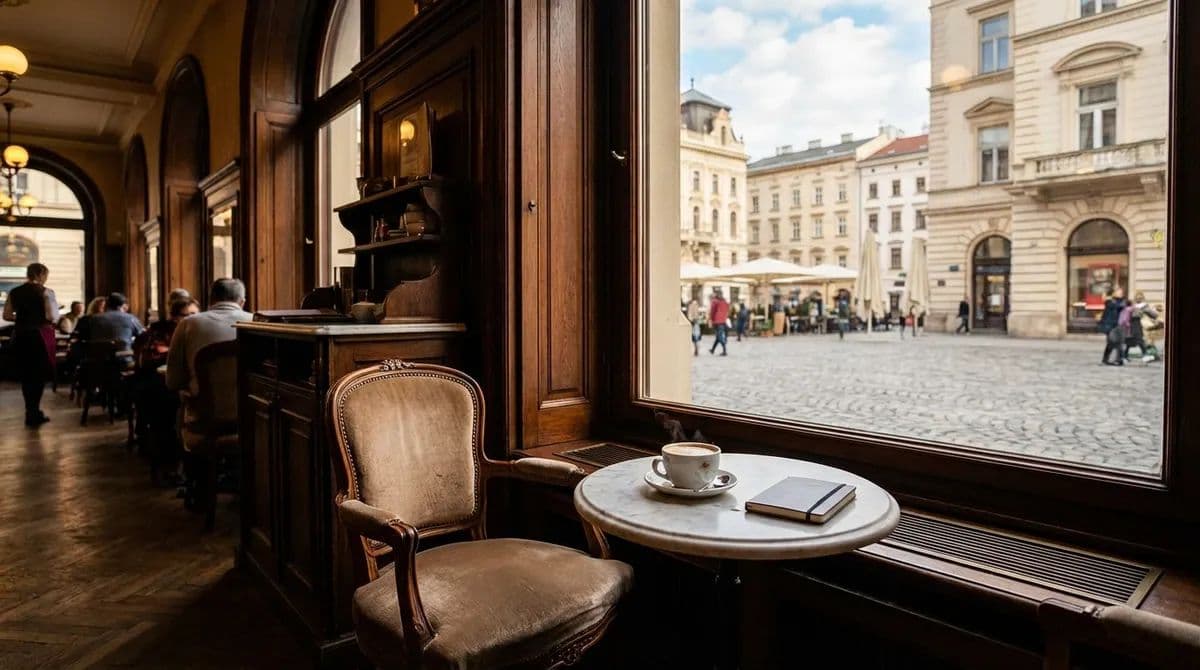
At a corner table in Café Central in Vienna, on a Wednesday afternoon in November, an elderly man is reading a newspaper. He has been reading it for two hours. The newspaper is Die Presse, held open at full broadsheet width, and the man is working through it with the methodical thoroughness of someone who considers the newspaper not a source of information to be scanned but a text to be studied. His coffee — a Melange, the Viennese equivalent of a cappuccino — was ordered ninety minutes ago and has long since gone cold. Nobody has asked him to order another. Nobody has presented a bill. Nobody has so much as glanced in his direction with the impatient look that, in most cities, signals that you have overstayed your welcome. In Vienna's coffeehouse culture, you cannot overstay your welcome. The welcome is the point. The local culture exploration of Vienna begins not in its museums or its palaces but in its coffeehouses, where the art of sitting still in public has been refined over three centuries into something approaching a civic philosophy.
The Viennese coffeehouse is not a café. The distinction matters. A café is a place that sells coffee. A Viennese coffeehouse is a place that sells time — specifically, the time to sit in a beautiful room, in a comfortable chair, with a newspaper, a glass of water (always complimentary, always served on a silver tray), and a cup of coffee, for as long as you wish. There is no minimum order. There is no time limit. The Wi-Fi password is not hidden behind a purchase requirement. The coffeehouse is, in the most literal sense, a public living room — a space where the functions of the home (reading, thinking, talking, doing nothing) are performed in public, and where the act of consuming almost nothing while occupying a seat for hours is not tolerated but celebrated.
UNESCO recognized Viennese coffeehouse culture as an Intangible Cultural Heritage in 2011, and the designation is not ceremonial. The coffeehouses are genuinely endangered. Rising rents, changing habits, and the global spread of takeaway coffee culture — the antithesis of the coffeehouse principle — have closed dozens of historic coffeehouses in the past two decades. The ones that survive — Café Central, Café Sperl, Café Hawelka, Café Pruckel — survive because they are loved, not because they are profitable. They are, in a city famous for its imperial architecture, among the most important buildings in Vienna. Not for what they contain, but for what they permit.
The Coffeehouse as Democratic Institution
The Viennese coffeehouse was, from its inception in the late seventeenth century, a radical institution. In a rigidly stratified society, the coffeehouse was the one space where the aristocrat and the clerk, the professor and the student, the writer and the unemployed could occupy the same room on equal terms. The price of a Melange — then as now, a modest sum — was the admission ticket to a space where status was determined not by birth or wealth but by the quality of your conversation and the depth of your newspaper reading.
The intellectual history of Vienna is inseparable from its coffeehouses. Freud developed psychoanalysis at a corner table. Trotsky planned revolution over chess. The Vienna Circle philosophers debated logical positivism at Café Josephinum. Stefan Zweig wrote there. Arthur Schnitzler wrote there. Gustav Klimt sketched there. The coffeehouse was the laboratory of Viennese modernity — the place where ideas that would reshape the twentieth century were developed in the slow, unhurried atmosphere of a room that asked nothing of its occupants except their presence.
This slow travel experience — the experience of being present in a public space without any obligation to consume, perform, or move on — is increasingly rare. The modern café, shaped by commercial imperatives, treats the customer as a unit of revenue to be maximized: order quickly, consume quickly, leave quickly. The Viennese coffeehouse inverts this logic. The longer you stay, the more you honor the institution. The man with his two-hour newspaper is not loitering. He is participating.
Lisbon's Pastelarias: The Democratic Counter
If the Viennese coffeehouse is the aristocrat of café culture, Lisbon's pastelaria is its working-class cousin — equally vital, equally social, and equally committed to the principle that a cup of coffee and a pastry entitle you to a place in public life. The pastelaria is not a specialty coffee shop. It is a neighborhood institution, found on every block, serving espresso (called bica in Lisbon), pasteis de nata (the custard tarts that are the city's signature food), and an assortment of savory pastries from a glass counter that is replenished throughout the day.
The pastelaria's social function is more democratic and more daily than the coffeehouse's. It is where you go before work, during work, after work, and between meals. It is where the building super discusses the plumbing with the building president. It is where the retired men gather at 10 a.m. for their second bica of the morning. It is where the student studies for her exams, spreading books across a marble counter that has supported elbows since the 1940s. The pastelaria does not require hours of occupation. Its rhythm is faster — a quick bica at the counter, a five-minute conversation, a pastry eaten standing up. But the principle is the same: the café as public space, the coffee as ticket of admission, and the understanding that to sit (or stand) in a pastelaria is to participate in the life of the neighborhood.
The best pastelarias for the traveler who wants to understand Lisbon are not the famous ones. Pasteis de Belem, with its queues of tourists, is a fine establishment, but it is a destination, not a neighborhood. The pastelarias that reveal Lisbon's character are the ones without names on TripAdvisor — the ones in Graca, in Mouraria, in Ajuda, where the clientele is entirely local and the bica costs eighty cents and the pasteis de nata were baked that morning by someone whose grandmother baked them in the same kitchen.
Tokyo's Kissaten: The Temple of Coffee
The Japanese kissaten is the most aesthetically refined of the world's café traditions, and the most endangered. The word translates roughly as "tea-drinking shop," but the kissaten serves coffee, not tea — specifically, hand-dripped, single-origin coffee prepared with a precision and a reverence that elevate the beverage from commodity to craft. The kissaten is small (ten to fifteen seats is typical), quiet (conversation is conducted at a murmur), and dim (the light is amber, filtered through stained glass or heavy curtains). The furniture is dark wood. The cups are ceramic, chosen for their feel in the hand. The music, if any, is vinyl jazz played on equipment that costs more than a car.
The kissaten is a place designed for the practice of what the Japanese call ikigai — the sense of purpose and presence that arises from the careful, attentive performance of a daily ritual. The ritual, in this case, is the drinking of a single cup of coffee. Not a to-go cup gulped on the commute. Not a flat white consumed while scrolling a phone. A single cup, prepared by hand, served in a beautiful vessel, consumed in silence or in quiet conversation, in a room that has been designed to support exactly this activity and no other.
Tokyo's kissaten are closing at a rate of several dozen per year, replaced by chain coffee shops and specialty roasters that offer better beans but none of the atmosphere. The survivors — Kayaba Coffee in Yanaka, Chatei Hatou in Shibuya, Cafe de l'Ambre in Ginza (which has been roasting its own beans since 1948) — are pilgrimage sites for those who understand that coffee culture is not about the coffee. It is about the conditions under which the coffee is consumed: the chair, the light, the sound, the speed, and the implicit permission to be still.
Buenos Aires: The Confitería as Living Room
Buenos Aires has more cafés per capita than any other city in the world, and the porteño relationship with the café — specifically, the confitería, the grand European-style café that is the city's signature social institution — is among the most intense on earth. The confitería is where Buenos Aires thinks, argues, writes, plots, and grieves. It is where Borges wrote. It is where tango was discussed before it was danced. It is where the Madres de Plaza de Mayo organized during the dictatorship. The confitería is not a business. It is a civic organ.
The great confiterías of Buenos Aires — Tortoni, La Biela, El Federal, Las Violetas — are architectural statements as much as commercial ones. Tortoni, on Avenida de Mayo, has been in operation since 1858, and its interior — marble tables, leather banquettes, stained-glass skylights, oil paintings on the walls — is a time capsule of the porteño ideal: European elegance adapted to South American warmth, formal enough to dignify the space and informal enough to welcome anyone who can afford a cortado.
The porteño café ritual is anchored by two beverages: the cortado (espresso with a small amount of steamed milk) and the submarino (a glass of hot milk into which a bar of chocolate is submerged and stirred as it melts). Both are consumed slowly, over conversation, and the conversation is understood to be as essential to the café experience as the beverage. To travel like a local, not a tourist, in Buenos Aires is to choose a confitería, order a cortado, and let the afternoon unfold at the pace of the conversation — which in Buenos Aires is unhurried, passionate, and potentially endless.
The Art of Sitting Still
What connects Vienna's coffeehouses, Lisbon's pastelarias, Tokyo's kissaten, and Buenos Aires' confiterías is not the beverage they serve but the permission they grant: the permission to sit still in public without justification. This permission is, in the twenty-first century, genuinely radical. The modern city is organized around movement and transaction. Public space is designed for flow — pedestrians moving from A to B, consumers entering and exiting retail, commuters transferring between modes of transport. To sit still in this environment, without consuming, without producing, without moving toward a destination, is to resist the city's fundamental logic.
The café is the one public space where this resistance is not just tolerated but institutionalized. The price of a coffee buys not a beverage but a chair, a table, and an unspecified amount of time. What you do with that time — read, think, talk, watch, write, or simply sit — is your affair. The café asks nothing of you except presence. And presence, in a world that demands constant motion, is itself a form of rebellion.