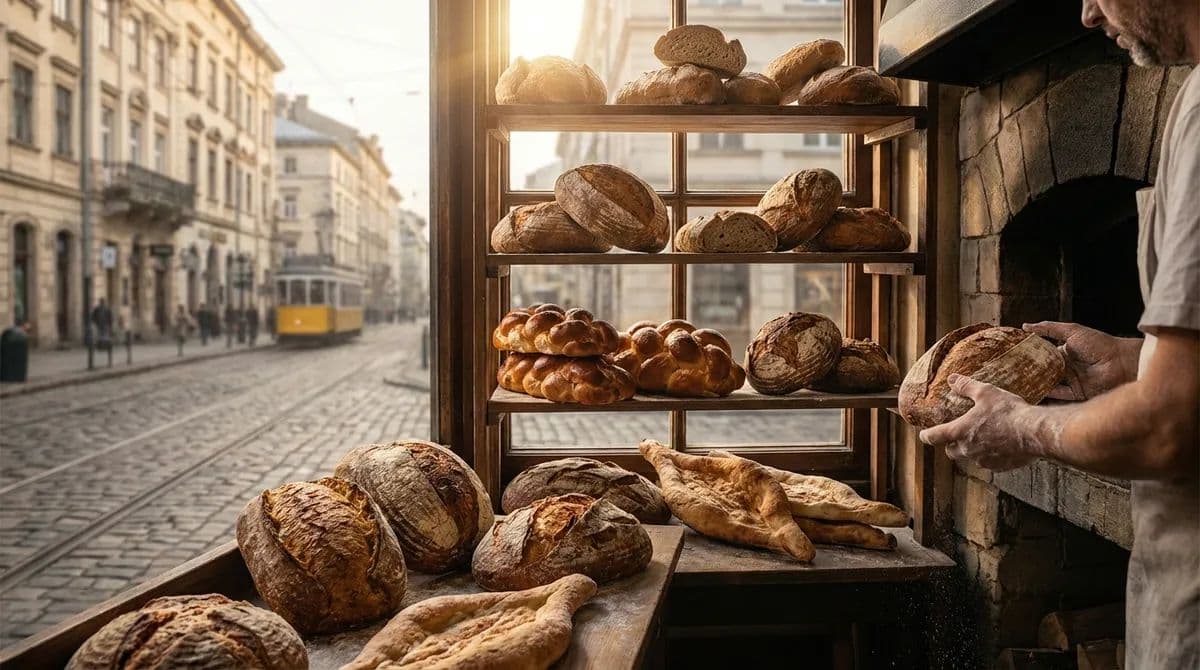
Bread and Time: What a Bakery Tells You About a City

Marcus Webb
Writer
There is a moment in every bakery, regardless of continent, that is essentially the same. The oven door opens. Heat billows outward in a visible wave. And the bread emerges — transformed, irreversible, committed. Whatever the dough was before, it is now something else: crust and crumb, exterior and interior, a thing with an inside and an outside that did not exist ten minutes ago. This is the moment that makes bread different from almost every other food. It is not assembled. It is not mixed. It is undergone. The dough submits to heat the way clay submits to a kiln, and what comes out the other side carries the signature of everything that went into it — the flour, the water, the culture of microorganisms, the altitude, the humidity, and most of all, the time. Food culture travel stories begin in many places, but they always, eventually, lead to bread.
I have stood in front of ovens on four continents now, and what strikes me most is not the differences between breads — though those differences are vast and beautiful — but the similarity of the bakers' attention. The way they watch. The way they listen. A baker in Tbilisi tilts his head toward the tone, the cylindrical clay oven sunk into the floor, and hears something in the sound of the fire that tells him the temperature is right. A baker in Addis Ababa pours injera batter onto a clay mitad and watches the surface for the precise pattern of bubbles — called "eyes" — that indicates the fermentation has reached its peak. A sourdough baker in San Francisco's Mission District presses a fingertip into risen dough and reads the spring-back the way a doctor reads a pulse. They are all doing the same thing. They are all negotiating with time.
The Sourdough Pact
San Francisco's relationship with sourdough is so old and so specific that the dominant strain of lactobacillus in the city's bread was, for decades, classified as its own species: *Lactobacillus sanfranciscensis*. The name has since been revised by taxonomists, but the principle it encoded remains true — something about the combination of the city's cool fog, its particular water, and the microbial population drifting in from the Pacific has produced a sourdough culture with a flavor profile that bakers elsewhere have struggled to replicate.
The history behind local dishes is often a history of accident and stubbornness. San Francisco sourdough became iconic not because someone designed it to be but because the Gold Rush of 1849 brought thousands of people to a foggy peninsula with limited fuel and no commercial yeast. Sourdough starters — living colonies of wild yeast and bacteria maintained by daily feeding — were the only reliable leavening available. Miners carried starter in pouches around their necks to keep it warm. The nickname "sourdough" became slang for a seasoned prospector, someone who had survived long enough to keep their culture alive. The bread and the identity became inseparable.
Today, the great sourdough bakeries of San Francisco — Tartine, Josey Baker Bread, the venerable Boudin — operate on rhythms that would be recognizable to those Gold Rush bakers. The starters are fed on schedule. The bulk fermentation takes twelve to eighteen hours. The bakers arrive at three in the morning and the bread is ready by seven, and in between, very little has happened that a nineteenth-century miner could not understand. The technology has barely changed because the biology has not changed. The microorganisms do not care about your timeline. They work at their own pace, and the baker's job is to accommodate them.
The Baguette and the Law
Paris approaches bread from the opposite direction: not wild fermentation but precise regulation. The *decret pain*, a French law passed in 1993, specifies that a traditional baguette can contain only four ingredients: wheat flour, water, salt, and yeast. No additives. No preservatives. No fats. The result is a bread of extraordinary purity and equally extraordinary fragility — a proper baguette begins to stale within hours of leaving the oven, which is why Parisian bakeries bake multiple times per day and why the sight of someone carrying a baguette home at six in the evening, the bread projecting from a paper sleeve like a periscope, is as reliable a feature of the Parisian streetscape as the zinc rooftops.
What eating like a local means in Paris is, in large part, a matter of bread timing. You learn which bakery bakes at which hour. You learn to squeeze a baguette gently at the midpoint — it should crackle slightly under your fingers, resist without collapsing. You learn the vocabulary: a *baguette tradition* is made with the old-style long fermentation; a *baguette ordinaire* uses faster methods and is considered inferior; a *ficelle* is thinner and crispier; a *batard* is shorter and fatter. Each shape is a different relationship between crust and crumb, between the caramelized exterior and the soft, slightly elastic interior that the French call the *mie*.
The baguette's simplicity is deceptive. Because there are so few ingredients, every variable matters enormously. The protein content of the flour. The mineral content of the water. The temperature of the room during proofing. The steam injected into the oven during the first minutes of baking, which is what produces the shattering crust. Parisian bakers speak of these variables with the precision of chemists and the reverence of priests, because in a bread with nowhere to hide, every lapse in attention is audible in the crust.
Fire in the Ground
Georgian bread is baked in a tone — a large, beehive-shaped clay oven sunk into the earth, heated by a wood fire built at its base. The baker leans into the oven's mouth, reaches down with a padded cushion, and slaps the shaped dough directly onto the interior wall, where it clings by adhesion and bakes in the radiant heat. It is a process that looks, from the outside, physically impossible — the baker's upper body disappears into a hole in the ground that is radiating four hundred degrees of heat — and the fact that it has been practiced in Georgia for at least eight thousand years does nothing to diminish the impression of a minor daily miracle.
Shotis puri, the canoe-shaped bread produced in these ovens, is the default bread of Georgian life. It arrives at the table with everything — with khinkali dumplings, with khachapuri cheese bread, with the long, elaborate feasts called supras that are the social architecture of Georgian culture. But shotis puri is not khachapuri's extroverted cousin. It is quieter, plainer, a bread that exists to be torn and shared, to absorb the juices of stews and salads, to be the constant background against which more assertive flavors perform.
The tone itself is an inheritance. Many Georgian bakeries have been using the same oven, repaired and re-lined but never replaced, for generations. The clay absorbs decades of smoke and flour dust and develops a patina that bakers insist contributes to the flavor — a claim that food scientists regard with polite skepticism but that anyone who has eaten tone-baked bread in a basement bakery in Tbilisi's old town will find difficult to dismiss. There is a depth to the flavor, a faint smokiness married to the clean taste of wheat, that speaks of repetition, of the same gesture performed in the same hole in the ground ten thousand times.
Three Days of Patience
Ethiopian injera requires a commitment that most Western bread cultures would find unreasonable. The batter — made from teff, the tiny grain indigenous to the Ethiopian highlands — must ferment for a minimum of three days, and traditionalists insist on four or five. During this time, the batter develops a complex sourness, a tang that is both the bread's defining flavor and its functional architecture. When poured onto the mitad — a large, flat clay griddle — the batter bubbles and sets into a spongy, porous sheet with a texture unlike any other bread on earth: soft, slightly rubbery, full of tiny holes that are designed, with exquisite evolutionary precision, to absorb the stews and sauces of Ethiopian cuisine.
Injera is not a side dish. It is the plate, the utensil, and the communal surface on which an Ethiopian meal is constructed. Stews — wots — are ladled onto a large sheet of injera, and diners tear off pieces of additional injera to scoop and wrap the food. Eating with injera is an inherently social act; the shared surface creates an intimacy that separate plates cannot achieve. The practice of gursha — feeding a piece of food wrapped in injera directly into another person's mouth — is a gesture of affection and respect so embedded in Ethiopian culture that refusing it would be a serious breach of etiquette.
The teff itself is a marvel of agricultural adaptation. The grain is so small that a single handful contains thousands of seeds, and it thrives in the waterlogged highland soils where other cereals fail. It is naturally gluten-free, rich in iron and calcium, and its fermentation produces a bread that is nutritionally superior to most wheat breads. For centuries, teff was virtually unknown outside Ethiopia. Now, as global interest in ancient grains grows, teff farms are appearing in the American Midwest and the Australian outback — but the injera produced from exported teff never quite tastes right, because the fermentation cultures are different, the water is different, and the mitad is not the same mitad that has been seasoned by decades of daily use in an Addis Ababa kitchen.
What the Oven Remembers
Every bakery is a recording device. The oven remembers the heat of every fire. The starter remembers every feeding. The flour remembers the field where the grain grew, the rain that fell or did not fall, the particular mineral composition of the soil. When you eat bread in a city you are visiting, you are tasting a compressed autobiography of the place — its climate, its agriculture, its relationship to time, its understanding of patience and necessity.
This is why the best bread is almost always the bread you did not plan to eat. Not the bread in the famous bakery with the line around the block, but the bread in the neighborhood place where a man in a flour-dusted apron hands you a warm loaf wrapped in paper and waves off your attempt to ask questions because he has six more loaves in the oven and the timer in his head is already counting down. That bread — unremarkable, unnamed, perfectly suited to the city in which it was baked — is the bread that tells you where you are.
The differences between these breads are not superficial. They are geological. San Francisco's sourdough is what happens when wild microorganisms meet Pacific fog and Gold Rush desperation. The Parisian baguette is what happens when a culture decides that four ingredients are enough if you pay absolute attention. Georgian shotis puri is what happens when you bake bread in a hole in the ground for eight thousand years and never see a reason to stop. Ethiopian injera is what happens when you trust time so completely that you give it three days to do its work before you even begin.