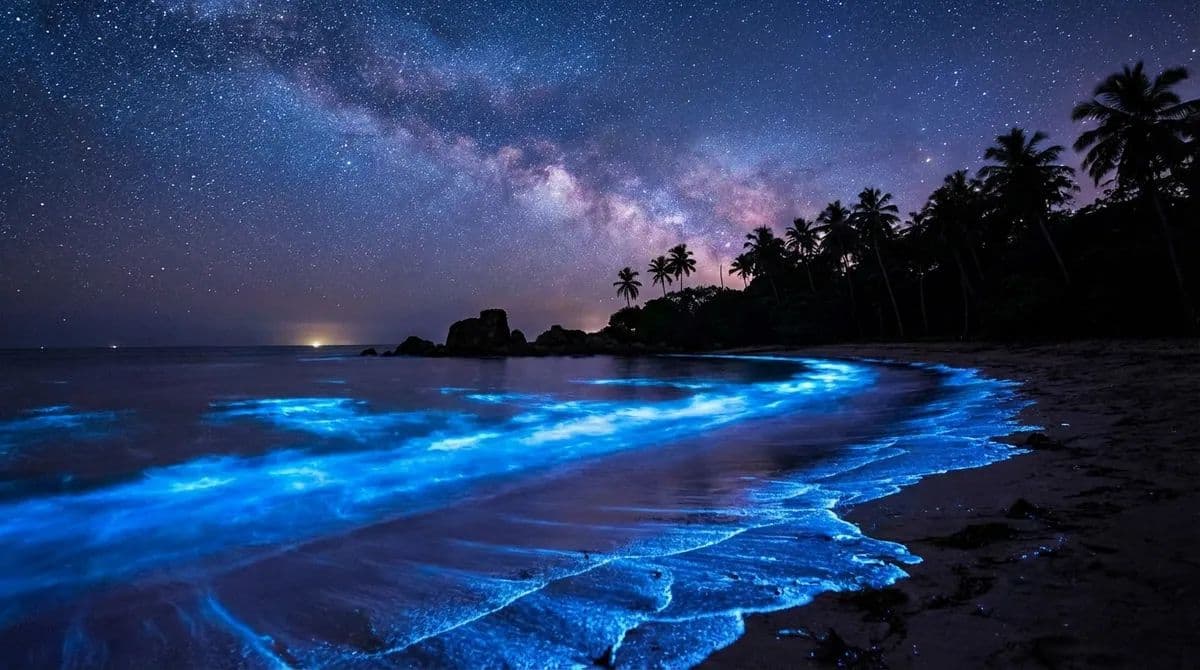
Bioluminescence and the Blue Glow: Where the Sea Lights Up

Anna Lindqvist
Writer
You are standing ankle-deep in the shallows of a Maldivian beach, and the water around your feet is glowing. Not reflecting — there is no moon tonight, no external light source to account for what you are seeing. The water itself is producing light, a pale electric blue that pulses with each wavelet, intensifies where your foot disturbs the surface, and fades slowly in your wake as you take a step, then another, each footfall detonating a small silent explosion of blue radiance. The effect is so alien, so thoroughly unlike anything your visual system was designed to process, that your brain briefly abandons its usual interpretive frameworks and simply presents the raw data: you are walking on light. The water is alive, and it is speaking to you in the only language it has, which is luminescence. This is a bioluminescence travel experience, and the first thing it teaches you is that the boundary between the living and the non-living is thinner than you thought.
The organisms responsible for this display are dinoflagellates — single-celled marine plankton, each one smaller than the period at the end of this sentence, each one equipped with a chemical mechanism that produces light when the cell is mechanically disturbed. A wave. A footstep. The hull of a boat. A swimming fish. Any physical contact triggers the reaction, and because there are millions of these organisms per liter of seawater in the right conditions, the cumulative effect is a bay, a beach, an entire stretch of ocean that lights up in response to touch. The sea has become a vast, distributed, photosensitive instrument, and you are the finger pressing the keys.
Mosquito Bay: The Brightest Water on Earth
Puerto Rico's Mosquito Bay, on the southern shore of the island of Vieques, holds a distinction that sounds like the invention of a particularly imaginative tourism board but is in fact a scientific measurement: it is the brightest bioluminescent bay in the world, as certified by the Guinness Book of World Records. The concentration of *Pyrodinium bahamense* — the specific dinoflagellate species responsible for the glow — reaches densities of up to seven hundred thousand organisms per gallon, producing a luminescence so intense that the wake of a kayak paddle leaves a trail of blue fire that lingers for several seconds before fading.
The conditions that produce this extraordinary concentration are specific and fragile. Mosquito Bay is shallow, warm, and almost entirely enclosed, connected to the Caribbean Sea by a narrow channel that limits water exchange. The surrounding mangrove forests drop organic matter into the bay — leaves, bark, detritus — that feeds the vitamin B12-producing bacteria that in turn feed the dinoflagellates. The ecosystem is a closed loop of mutual dependency: remove the mangroves, and the bacteria decline; remove the bacteria, and the dinoflagellates starve; remove the dinoflagellates, and the light goes out. The glow is not a phenomenon. It is a relationship.
Kayaking through Mosquito Bay on a moonless night — moonlight suppresses the visible intensity of the bioluminescence, so dark nights are essential — is one of those unusual nature experiences that reshapes your understanding of what nature is capable of. Every paddle stroke ignites a burst of blue-white light. Fish darting beneath the kayak leave luminous contrails. If you trail your hand in the water, your fingers become outlined in fire, each one distinct, the light following the contours of your skin with the precision of a medical scan. The water does not merely glow. It traces you. It makes you visible to yourself in a medium that should be dark, using light that is not your own.
Tasmania: The River That Remembers
On the other side of the world, the Derwent River in southern Tasmania produces a bioluminescent display that is quieter, less theatrical, and in some ways more profound than the Caribbean bays. The organism here is *Noctiluca scintillans* — a larger dinoflagellate, visible as tiny orange spheres during the day, transforming into blue light-emitters at night. The Derwent's bioluminescence is seasonal and unpredictable, appearing in the austral autumn and winter when water temperatures and nutrient concentrations align, and its arrival is treated by locals with a mixture of excitement and reverence, the way residents of northern latitudes treat the aurora.
What distinguishes the Tasmanian experience is its setting. The Derwent flows through Hobart, the state capital, and the bioluminescence appears not in a remote wilderness but within view of the city — under the Tasman Bridge, along the waterfront promenade, in the harbor where fishing boats rock at their moorings. The juxtaposition of the urban and the biological is disorienting in the best sense. You are standing on a city dock, looking at the same water that carried ferries and freight all day, and it is glowing. The utilitarian surface has become a canvas of living light, and the city that ignored the water during business hours is now forced to acknowledge that the water has an inner life, a capacity for beauty that owes nothing to human design.
The scientists who study Tasmanian bioluminescence emphasize that the displays are indicators of ecosystem health — or, more precisely, of ecosystem change. *Noctiluca* blooms are increasing in frequency and intensity in Tasmanian waters, likely driven by warming ocean temperatures and changes in nutrient runoff. The blue glow that delights onlookers is, from an ecological perspective, a symptom — a signal that the marine environment is shifting in ways that are not entirely understood. The beauty and the warning are inseparable, contained in the same flash of blue light.
Toyama Bay: The Firefly Squid
Japan's Toyama Bay, on the Sea of Japan coast, offers a bioluminescent experience that differs from the dinoflagellate displays in a crucial respect: the light is produced not by microscopic plankton but by cephalopods. The firefly squid — *Watasenia scintillans* — is a small deep-water species, about seven centimeters long, that possesses photophores along its tentacles and body capable of producing an intense blue light. Each spring, from March through June, the squid rise from their deep-water habitat to spawn in the shallow waters of Toyama Bay, and the surface of the bay becomes a field of pulsing blue lights — each one a squid, each one signaling, each one participating in a reproductive drama that has played out in these waters for millennia.
The firefly squid season is a significant cultural event in Toyama Prefecture. Fishing boats go out before dawn to harvest the squid, and the catch is served fresh in the local restaurants — sashimi, tempura, pickled, dried — the bioluminescent organs still visible as faintly luminous specks in the translucent flesh. There is something unsettling and beautiful about eating a creature that was, hours earlier, producing its own light. The meal becomes a meditation on the relationship between beauty and consumption, between the sublime and the appetitive, between the living light and the human hunger.
Viewing boats take tourists out to the fishing grounds in the predawn hours, and the experience of watching the fishermen's nets come up filled with pulsing blue light — thousands of squid, each one flashing its photophores in distress or confusion or some response that has no human analogue — is one of the most visually extraordinary night tourism destinations in Asia. The squid continue to glow for several minutes after being removed from the water, and the deck of the fishing boat becomes a temporary installation of living light, the blue glow fading gradually as the organisms expire, the display beautiful and melancholy in equal measure.
The Chemistry of Living Light
Bioluminescence is among the most widespread biological phenomena on earth, and among the least understood by non-scientists. The basic chemistry is consistent across most bioluminescent organisms: a molecule called luciferin is oxidized by an enzyme called luciferase, producing light as a byproduct. The specific luciferin and luciferase vary between species — the chemistry of dinoflagellate bioluminescence is different from that of firefly squid, which is different from that of deep-sea anglerfish — but the principle is the same: a chemical reaction that converts chemical energy into photons with extraordinary efficiency. Bioluminescent reactions produce almost no heat, making them among the most efficient light sources known. An incandescent bulb wastes ninety percent of its energy as heat. A dinoflagellate wastes almost none.
The evolutionary purposes of bioluminescence are various and often debated. In dinoflagellates, the flash is thought to be a defense mechanism — the light attracts predators of the organism that is eating the dinoflagellate, creating a kind of biological burglar alarm. In firefly squid, the photophores serve both as camouflage (the belly lights match the ambient light from above, hiding the squid's silhouette from predators below) and as communication during mating. In deep-sea organisms, bioluminescence serves as lure, as searchlight, as species-recognition signal, and as a way of disappearing into the ambient light of the deep ocean.
What is most striking about bioluminescence, from a human perspective, is its age. The chemistry of luciferin-luciferase reactions has evolved independently at least forty times across the tree of life, in organisms as different as bacteria, jellyfish, beetles, and fish. This convergent evolution suggests that producing light from chemistry is, in some fundamental sense, easy — that life, given sufficient time and sufficient pressure, will almost inevitably discover how to glow. The blue light in Mosquito Bay and the blue light on Toyama Bay were invented separately, by organisms that share no common bioluminescent ancestor, and yet they produce the same color, the same eerily beautiful blue, because the physics of light emission constrains the chemistry in ways that transcend taxonomy.
The Darkness Required
Every bioluminescent experience shares a common prerequisite: darkness. The light produced by dinoflagellates and squid is faint by human standards — bright enough to see, but only if the competing light sources are eliminated. Moonlight, streetlight, the glow of a phone screen — any of these can overwhelm the biological signal and render the display invisible. The best bioluminescent experiences occur on moonless nights, in locations far from artificial light, when the darkness is deep enough that the eyes have fully adapted and the faintest glow becomes visible.
This requirement connects bioluminescence to the broader noctourism movement and to the growing awareness that darkness itself is an endangered resource. The same light pollution that obscures the stars obscures the glowing sea, and the same urbanization that is shrinking the world's dark skies is threatening the conditions that produce bioluminescent displays. In Mosquito Bay, the construction of a waterfront resort in the 2000s introduced light that measurably reduced the bay's bioluminescent intensity, and only after community protest and regulatory intervention was the lighting modified to protect the display. The glow is fragile. It requires the absence of our light to reveal its own.