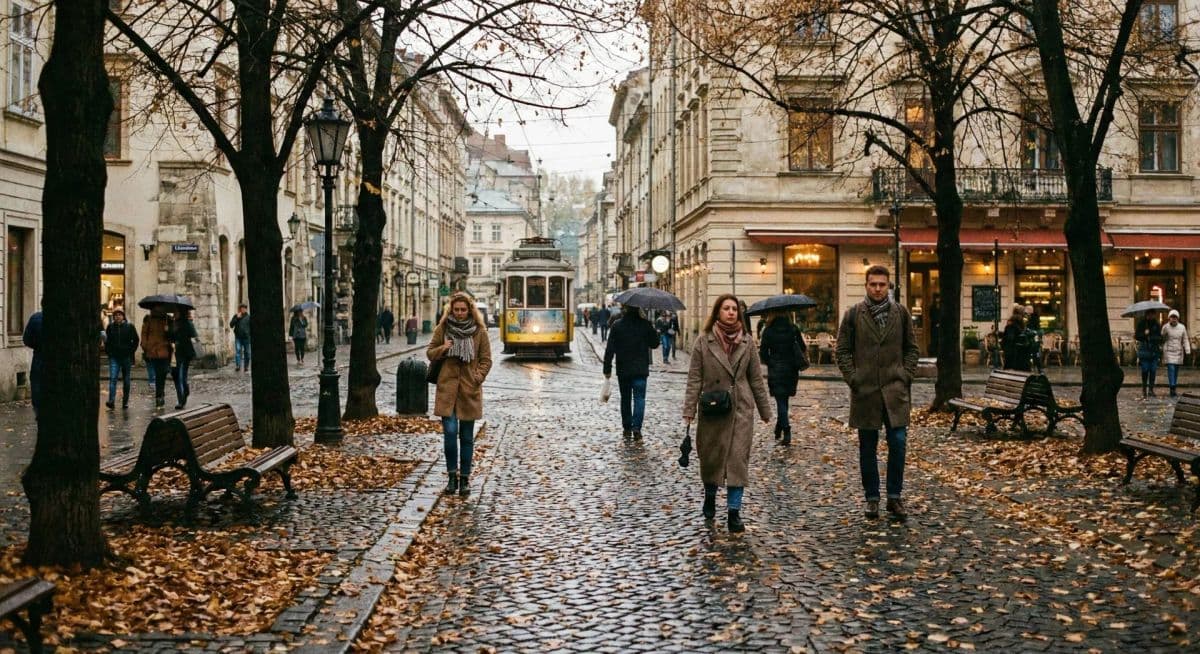
Autumn in Five Cities: The Season of Letting Go

Elena Mori
Writer
Autumn is the season that knows it is ending. This is what distinguishes it from every other quarter of the year — not its colors, though those are spectacular, not its temperatures, though those are ideal, but its awareness. Spring is oblivious, summer is confident, winter is resigned. Autumn is self-conscious. It knows that the gold in the leaves is a byproduct of dying, that the harvest festivals are celebrations of an ending, that the shorter days are not a pause but a countdown. And this knowledge — this beautiful, melancholic, entirely honest acknowledgment that the best things do not last — is what makes autumn travel destinations the most emotionally resonant experiences available to the seasonal traveler. You are not visiting a place at its peak. You are visiting a place in the act of letting go, and the letting go is the beauty.
The science of autumn color is a science of withdrawal. During spring and summer, leaves produce chlorophyll continuously, the green pigment masking the other pigments — carotenoids (yellow, orange) and anthocyanins (red, purple) — that are always present in the leaf tissue. As the days shorten and temperatures drop, the tree forms an abscission layer at the base of each leaf stem, cutting off the supply of water and nutrients. Chlorophyll production ceases. The green fades. And the underlying pigments, no longer hidden, emerge in a final display of color that is, biochemically speaking, a tree's preparation for death — or at least for dormancy, which, from the leaf's perspective, is the same thing.
New England: The Pilgrimage
The autumn foliage of New England — the six northeastern states of the United States, stretching from Connecticut to Maine — has been a travel destination for over a century, and the phenomenon has generated its own vocabulary, its own industry, and its own mythology. "Leaf-peeping" is the slightly embarrassing term for the activity of driving slowly through the countryside to observe the color change. "Peak foliage" is the two-week window, varying by latitude and elevation, during which the color is at its most intense. And the "foliage report" is a weekly bulletin issued by state tourism offices that tracks the progression of color from north to south, from high elevation to low, with the detail and urgency of a military dispatch.
The colors of New England are dominated by sugar maples, which produce the most vivid reds and oranges in the deciduous forest. A sugar maple in full autumn color is an almost violent sight — the red is so saturated, so unnatural-looking, that it seems like the tree is on fire, or bleeding, or performing some extravagant act of self-expression that is entirely out of character for an organism that spent the previous six months being green and unremarkable. The maples are joined by birches (yellow), oaks (bronze and russet), aspens (gold), and the occasional sumac (scarlet), and the effect, seen from a hilltop in Vermont or New Hampshire, is of a landscape that has been repainted overnight in a palette that would be rejected as excessive if it appeared in a painting.
The seasonal travel experience of New England autumn is enriched by the culture that surrounds it. Apple orchards offer cider pressing. Farm stands sell pumpkins, winter squash, and the last tomatoes of the season. Country inns light their fireplaces. The air smells of wood smoke and decomposing leaves, a scent that is both sweet and slightly sad, the olfactory equivalent of the colors — beautiful and terminal. There is a reason that New England has become synonymous with autumn: the combination of the biology (the right mix of tree species), the climate (cold nights and warm days produce the most intense anthocyanin production), and the culture (a long tradition of celebrating the harvest) creates a seasonal experience that no other region on earth has quite replicated.
Rural Japan: The Persimmon Hour
Japan's autumn, called *aki*, arrives with a subtlety that New England's does not attempt. The Japanese maples — smaller, more delicate than their American counterparts — produce a color range that is less explosive and more nuanced: not fire-engine red but a spectrum of amber, coral, burgundy, and a particular shade of salmon pink that exists only in the Japanese maple's repertoire. The practice of *momijigari* — "maple hunting," the autumnal counterpart to spring's *hanami* cherry blossom viewing — is a centuries-old tradition that sends families and couples into the temple gardens of Kyoto and Nara to sit beneath the colored canopy and contemplate the season's teachings about impermanence, beauty, and the passage of time.
But the autumn moment that has lodged most permanently in my memory is not a temple garden. It is a persimmon tree in a village in the Kiso Valley, in the mountains of central Honshu. The tree stood in the yard of a farmhouse, and its leaves had already fallen, leaving the fruit — bright orange, perfectly spherical, each one the size of a tennis ball — hanging from bare black branches against a gray November sky. The effect was of a tree decorated for a holiday that no one had announced, a celebration conducted entirely in the language of fruit and branch, without human intervention.
Persimmons — *kaki* in Japanese — are the taste of Japanese autumn. The Hachiya variety, astringent until fully ripe, is dried on strings under the farmhouse eaves, producing *hoshigaki*, a concentrated sweetness that is eaten through the winter months. The Fuyu variety is eaten fresh, sliced onto plates with the casual beauty that characterizes Japanese domestic food presentation. In rural Japan, autumn is not primarily a visual season. It is a gustatory one — the season of new rice, of matsutake mushrooms foraged from the pine forests, of sweet potatoes roasted on street corners, of the persimmon tree in the yard offering its final, sweetest product before the cold arrives.
Mendoza: The Crush
In the Southern Hemisphere, autumn arrives in March, and in Argentina's wine country of Mendoza, it arrives as a deadline. The grape harvest — *la vendimia* — must be completed before the cold sets in, and the entire province mobilizes for the effort. The vineyards that stretch from the foothills of the Andes across the broad, flat valley floor change color in a progression that tracks the ripening: the Malbec vines go first, their leaves turning from green to gold to deep burgundy, the same color as the wine they will produce. The Cabernet Sauvignon follows, then the Torrontes, and by the end of April the vineyards are a patchwork of gold, bronze, and red that mirrors the hillside forests of the Northern Hemisphere's October.
The Festival de la Vendimia, held annually in the first week of March, is Mendoza's largest cultural event — a multi-day celebration of the harvest that includes parades, concerts, the election of a harvest queen, and, beneath the festivity, the serious business of getting the grapes off the vines and into the wineries before the sugar levels tip from optimal to overripe. The slow travel fall experience in Mendoza is the experience of a community organized around a plant, a season, and a deadline. The urgency is real. The grapes do not wait.
But between the rows of vines, in the early mornings before the harvest crews arrive, the Mendozan autumn achieves a stillness that the festival obscures. The Andes, visible from every vineyard, are already white with early snow. The air is cool and dry, carrying the faint sweetness of fermenting grapes from the wineries that are already processing the early harvest. The vineyard leaves, backlit by the morning sun, glow with a translucence that makes each one look like a stained-glass window — a comparison that is not merely visual but structural, since both stained glass and autumn leaves achieve their color through the selective transmission of light, allowing some wavelengths through while blocking others.
Istanbul: Smoke and Chestnuts
Istanbul's autumn is announced by smell before it is announced by sight. Sometime in October, the chestnut roasters appear on the street corners — men and women standing behind small, barrel-shaped metal stoves, turning chestnuts on a perforated tray over charcoal, the smoke rising in thin gray columns that mix with the ambient haze of the city and produce a scent so evocative that anyone who has spent an October in Istanbul will recognize it instantly, decades later, in any city where chestnuts are roasted. It is the smell of autumn in a city that does autumn better than any city in Europe, though it rarely appears on the lists.
The reason Istanbul is an overlooked autumn destination is that its autumn pleasures are domestic rather than spectacular. There is no equivalent of New England's foliage or Japan's momijigari. The trees of Istanbul — plane trees, mostly, lining the boulevards of Beyoglu and Besiktas — produce a modest yellow-brown that would not merit a detour. But the seasonal shift in Istanbul is felt in the rhythm of life rather than the color of the landscape. The summer crowds thin. The ferries across the Bosphorus, packed to capacity in August, become comfortable again. The tea gardens that in summer are social obligations become, in autumn, retreats — places to sit with a glass of dark Turkish tea and watch the cargo ships pass through the strait, the water gray-blue under the October clouds, the Asian shore just visible through the haze.
The Grand Bazaar, which in summer is a furnace of compressed humanity, becomes navigable in October. The carpet sellers, who in August must compete with thousands of browsers for every potential customer, relax into longer conversations, and the transaction — always as much a social event as a commercial one in Istanbul — regains its proper tempo: tea, conversation, the unrolling of carpet after carpet, the gradual narrowing of choices that is really a gradual widening of understanding. Autumn gives Istanbul back its tempo, and Istanbul's tempo, it turns out, is slow.
Prague: Leaves on the Vltava
Prague in autumn achieves a quality that can only be described as cinematic. The city, already one of the most visually dramatic in Europe — the castle above, the river below, the bridges between, the red rooftops spreading in every direction like a spilled terracotta — takes on a golden filter in October that softens its Gothic angularity and gives it the warmth of a Renaissance painting. The trees along the Vltava turn gold and copper, and the leaves, falling from the branches, drift on the surface of the river, forming slow-moving constellations of color that pass under the Charles Bridge and out toward the weirs downstream.
The melancholy of Prague in autumn is not sadness. It is something more precise — a particular Central European emotion for which Czech has several words and English has none. The closest approximation might be "beautiful sorrow" or "sweet nostalgia," the feeling produced by the awareness that beauty is temporary and that the awareness itself is part of the beauty. The Czechs have been practicing this emotion for centuries — it runs through their literature, their music, their national character — and autumn in Prague is its physical expression. The falling leaves, the shortening days, the first fires lit in the old tile stoves, the return of the warm drinks — svarak (mulled wine) and grog — to the bar menus: all of these are the seasonal rituals of a culture that has learned to find pleasure in letting go.
Walking through Petrin Hill in October, the park that climbs the slope above the Mala Strana district, is to walk through a canopy of gold that is simultaneously present and departing. The leaves are on the branches and on the ground and in the air between, and the light filtering through them is golden, not from the sun alone but from the leaves themselves, which act as filters, transmitting their own color into the light that passes through them. You are walking inside a golden light that is being produced by the same process that is destroying it — the dying leaves making the light that celebrates their dying — and the circularity of this, the beauty feeding on its own mortality, is autumn's central lesson, delivered here in Prague with a specificity and a beauty that makes the lesson feel, for once, not melancholic but generous.